
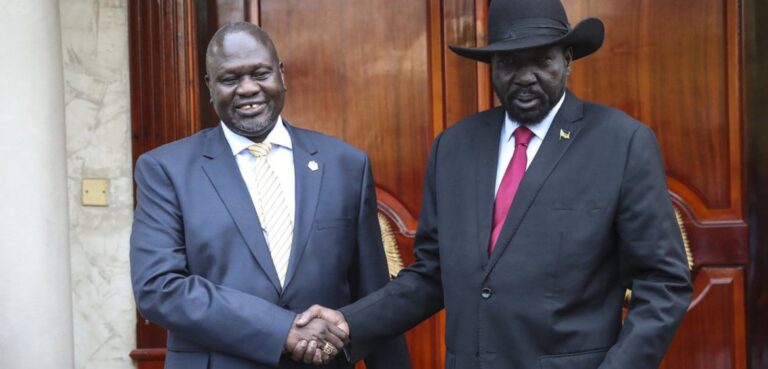
Machar Testifies Kiir Ignored Request to Delay Troop Deployment
Former First Vice President Dr. Riek Machar testified in a special court in Juba on Wednesday, February 20, 2025, stating that President Salva Kiir ignored his request to delay the deployment of South Sudan Peoples Defence Forces (SSPDF) troops to Nasir.
Machar, during the 129th session of a trial, recounted that he had written to President Kiir on February 20, 2025, seeking a two-week postponement of troop deployment to Nasir. This delay was intended to allow local leaders to engage residents and prepare them for the arrival of the forces, as there were significant tensions and fears among the local population. Residents were reportedly agitated, believing the incoming troops were exclusively SSPDF rather than the agreed-upon Necessary Unified Forces, and harbored concerns about potential disarmament. Machar stated that President Kiir did not respond to his letter, which consequently prevented him from sending Members of Parliament from Nasir and Ulang counties to help de-escalate the situation. The specific charges or the overall outcome of this trial are not reported in the excerpt.
This testimony carries significant legal weight as it highlights potential non-compliance with the Revitalized Agreement on the Resolution of the Conflict in the Republic of South Sudan (R-ARCSS), particularly concerning the formation and deployment of unified forces. For legal professionals, it underscores the persistent challenges in implementing peace agreements and maintaining security arrangements, signaling the potential for legal disputes arising from perceived breaches of these protocols. The fact that this testimony is occurring in a "special court" suggests a judicial process addressing matters of national security or political stability, which could have far-reaching implications for the country's peace process.
The core legal context for this matter is the R-ARCSS, which mandates the integration of various signatory parties' forces into a Necessary Unified Force (NUF). The deployment of exclusively SSPDF troops, if true, would represent a direct contravention of these security arrangements. The "special court" implies a judicial body established to address specific, often sensitive, matters, potentially related to the peace agreement or national security, though its specific legal framework is not detailed. The mention of the Joint Defence Board (JDB) further indicates the institutional framework for security sector reform and integration that is central to the R-ARCSS.
Attorneys advising clients in South Sudan, particularly those involved in security sector reform, peacebuilding, or humanitarian efforts, should closely monitor developments related to the implementation of the R-ARCSS and the formation of unified forces. The testimony underscores the critical importance of adherence to agreed-upon security protocols and the potential for significant legal and political ramifications when these are perceived to be violated. Businesses operating in areas prone to such security tensions should assess their risk exposure and consider the implications of unstable security arrangements on their operations and personnel. The outcome of this matter is not yet reported, but the testimony itself is a significant indicator of ongoing political and security challenges that could lead to further legal or political instability.
How does this affect you?
Get an AI analysis of this article grounded in your jurisdictions, practice areas, and any policy documents you've uploaded to Wansom.
Finish Reading the Full Story and the Expert Analysis.
Get the latest legal & regulatory intelligence in South Sudan
Wansom is AI and can make mistakes.