
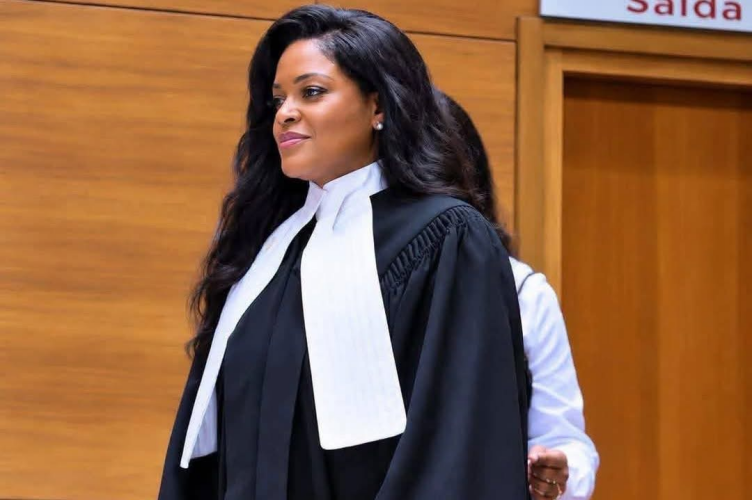
Liberian Charlyne Brumskine Elected ECOWAS Court of Justice President
ABUJA, Nigeria — Liberian lawyer and law professor Charlyne M. Brumskine was elected president of the Community Court of Justice of the Economic Community of West African States (ECOWAS) on Tuesday, a week after she was sworn in as one of five new judges on the regional bench. Her fellow judges chose her on 13 October 2026 to lead the Abuja-based court, the judicial arm of the West African bloc, for a two-year term. The election makes Justice Brumskine, the first Liberian woman to sit on the court, the head of an institution that rules on disputes between member states, ECOWAS institutions and individuals, including human rights complaints brought by ordinary citizens of the region. “With profound humility and a deep sense of duty, I address you as the newly elected President of this distinguished judicial institution,” she said in her acceptance address. “I am sincerely grateful to my esteemed colleagues for the confidence they have each reposed in me. I accept this responsibility fully conscious of the obligations it entails and the expectations that accompany leading a regional judicial institution entrusted with interpreting and applying community law and protecting human rights.” She said she saw the presidency as a duty rather than an honour. “I regard this office not as a personal distinction, but as an opportunity to serve the courts, the ECOWAS community, and ultimately the people of West Africa,” she said. What the president does As president, Justice Brumskine presides over the court’s hearings and deliberations and directs its judicial business, including assigning cases and scheduling proceedings. She also chairs the Bureau of the Court, which sets its strategic direction, work programme and budget priorities, and she oversees the Registry and the court’s administration. Beyond the courtroom, she is the court’s public face. She represents it externally, presents its activity report and budget to the statutory bodies of ECOWAS, and works with national judiciaries, other regional and continental courts, bar associations and civil society groups to widen access to justice. A central part of that role is persuading member states to comply with and enforce the court’s judgments, a long-standing challenge for the institution, which has no enforcement arm of its own and depends on national governments to carry out its rulings. A court open to citizens Established under ECOWAS treaty provisions and operational since 2001, the court interprets and applies the bloc’s laws and settles disputes over them. Its reach widened significantly in 2005, when a supplementary protocol allowed individuals to bring human rights cases directly before it without first exhausting remedies in their national courts. That feature has made the court one of the most accessible regional human rights forums in Africa. Citizens, journalists and civil society groups have used it to challenge arbitrary detention, restrictions on free expression and other alleged abuses by their own governments. Justice Brumskine takes office at a delicate moment for the bloc. Mali, Burkina Faso and Niger, all under military rule, formally withdrew from ECOWAS in January 2025, placing their citizens outside the court’s jurisdiction and testing the community’s cohesion. Five new judges sworn in Justice Brumskine was among five judges inducted on Tuesday, 6 October, at the ECOWAS Commission headquarters in Abuja for the 2026–2030 term. Senegalese President Bassirou Diomaye Faye, chairman of the ECOWAS Authority of Heads of State and Government, administered the oath of office. The other new judges are Désiré Henri Aihou of Benin, Awa Bah of The Gambia, Henrietta Uzoamaka Didigu of Nigeria and Yaouza Ouro-Sama of Togo. They replace five judges whose four-year mandates have ended: Ricardo Cláudio Monteiro Gonçalves of Cape Verde, Sengu Mohamed Koroma of Sierra Leone, Dupe Atoki of Nigeria, Gberi-Bè Ouattara of Côte d’Ivoire and Edward Amoako Asante of Ghana. The judges el
How does this affect you?
Get an AI analysis of this article grounded in your jurisdictions, practice areas, and any policy documents you've uploaded to Wansom.
Finish Reading the Full Story and the Expert Analysis.
Get the latest legal & regulatory intelligence in Liberia
Wansom is AI and can make mistakes.