
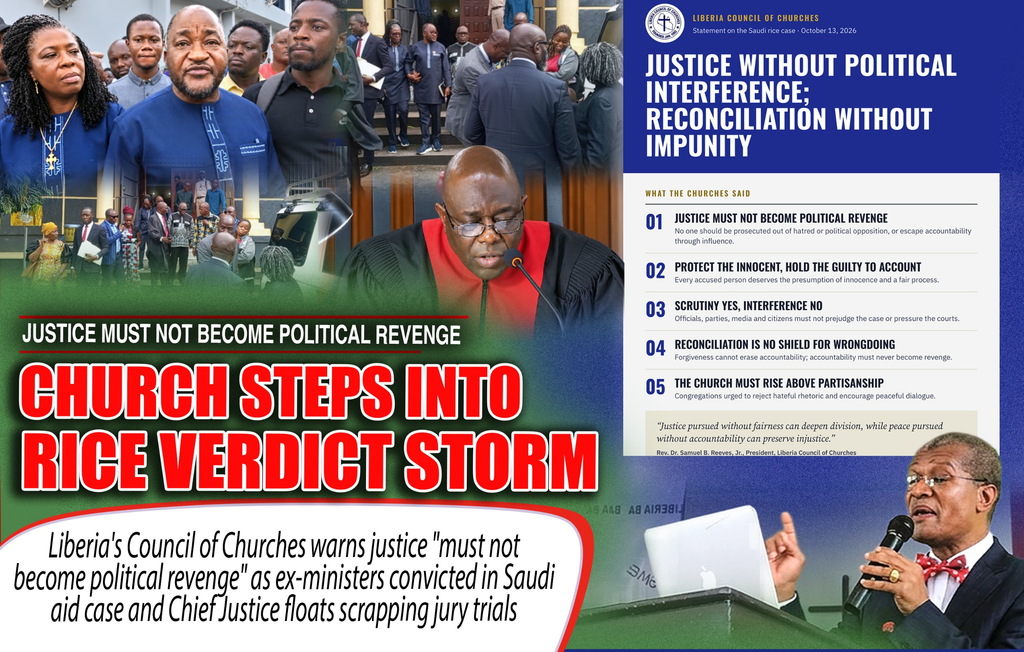
Liberia: Council of Churches Warns Against Political Revenge in Justice System
In Liberia, the Liberia Council of Churches (LCC) issued a statement on Tuesday, following a mixed verdict delivered on Friday, October 9, at Criminal Court C in Monrovia, where a jury convicted former foreign minister Dee-Maxwell Saah Kemayah and other ex-officials of stealing Saudi aid rice. The LCC's statement, titled "Justice Without Political Interference; Reconciliation Without Impunity," urged the government, courts, and political class to ensure justice is governed by evidence and law, free from political interference, intimidation, and public pressure, while also cautioning against impunity. The jury found eight of the thirteen defendants guilty, including former Foreign Affairs Minister Dee-Maxwell Saah Kemayah and former Internal Affairs Minister Varney A. Sirleaf, with three acquitted and verdicts on two others inconclusive. Notably, the jury was reportedly split on several counts for Kemayah, who was found guilty on all five charges: theft of property, economic sabotage, misapplication of entrusted property, abuse of office, and criminal conspiracy.
This case carries significant legal weight as it highlights Liberia's ongoing struggle with public sector corruption and the imperative for judicial independence. The LCC's intervention underscores the societal demand for a justice system free from political manipulation, particularly in high-profile cases involving former government officials. The mixed verdict and the reported split among jurors also bring into sharp focus public and civil society perceptions of the fairness and integrity of the judicial process, which can profoundly impact the rule of law and investor confidence. The excerpt also alludes to the Chief Justice's consideration of scrapping jury trials, a potential systemic reform that, if implemented, would fundamentally alter criminal procedure in Liberia.
The legal context for this matter involves Liberia's Penal Law, under which charges such as theft of property, economic sabotage, misapplication of entrusted property, abuse of office, and criminal conspiracy are codified. The proceedings took place in Criminal Court C, which is part of Liberia's common law-based judicial hierarchy, where juries traditionally play a role in determining facts in criminal cases. The Asset Recovery and Property Retrieval Taskforce (AREPT) acted as the prosecution, indicating a governmental commitment to combating corruption and recovering illicitly obtained assets. The Chief Justice's reported contemplation of changes to the jury system suggests a potential shift towards a more judge-centric fact-finding process, which would represent a substantial procedural departure from current practice.
Key parties involved include the Liberia Council of Churches (LCC), former Foreign Affairs Minister Dee-Maxwell Saah Kemayah, former Internal Affairs Minister Varney A. Sirleaf, other unnamed ex-officials, the Asset Recovery and Property Retrieval Taskforce (AREPT), and Criminal Court C in Monrovia. The Liberian Chief Justice, though unnamed, is also a significant figure due to the reported consideration of judicial reforms. The outcome of the sentencing or any appeals for the convicted individuals is not reported in the excerpt.
Practitioners in Liberia should closely monitor any developments regarding judicial independence and potential reforms to the jury system, as these could significantly impact criminal defense strategies and the overall administration of justice. Attorneys advising clients in public service or those involved in the distribution of humanitarian aid must emphasize stringent compliance with anti-corruption laws and ethical conduct to mitigate the risks of prosecution for offenses like economic sabotage or misapplication of funds. The LCC's public statement serves as a crucial reminder of the intense public and civil society scrutiny that high-profile corruption cases attract, necessitating robust, transparent, and legally sound processes.
How does this affect you?
Get an AI analysis of this article grounded in your jurisdictions, practice areas, and any policy documents you've uploaded to Wansom.
Finish Reading the Full Story and the Expert Analysis.
Get the latest legal & regulatory intelligence in Liberia
Wansom is AI and can make mistakes.