
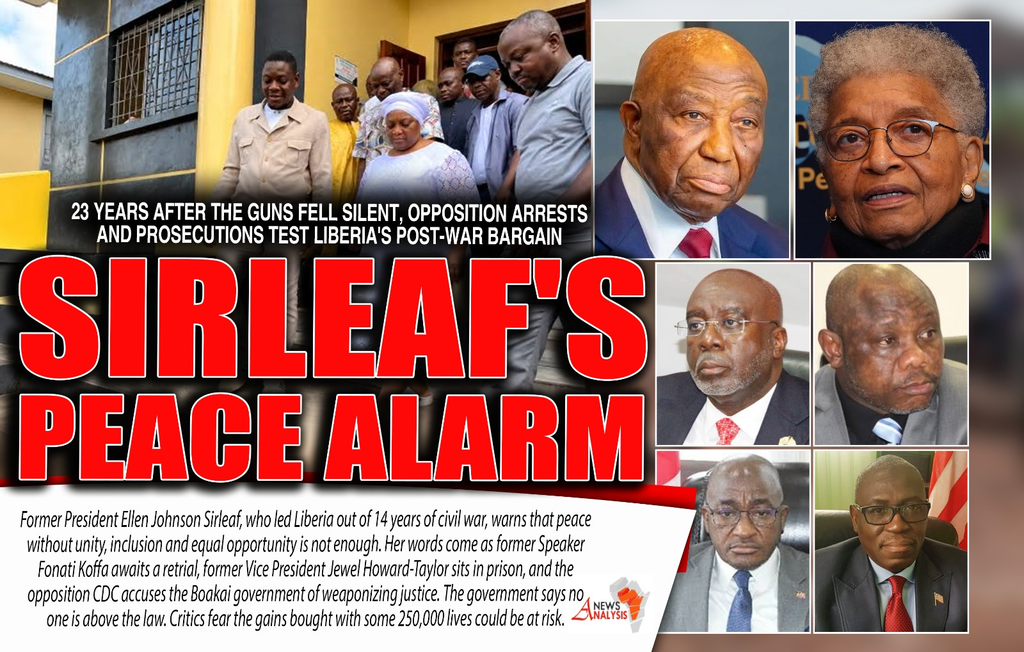
Liberia Opposition Arrests Justice System Under Scrutiny Amid Sirleaf Warning
Summary
- Former President Ellen Johnson Sirleaf warned that Liberia's 23 years of peace could be undone if leaders fail to build unity and inclusion.
- The warning comes amidst high-profile legal actions against opposition figures, including a former House Speaker facing a retrial for arson and attempted murder, and a former vice president awaiting a drug trial.
- The main opposition party alleges that the justice system is being weaponized against it, raising concerns about Liberia political prosecutions.
- Critics fear the government's actions, regardless of legal merit, could erode the fragile post-war consensus that has held Liberia together since 2003.
- Sirleaf's past administration prioritized keeping rivals within the political system, a strategy she implies is crucial for maintaining peace.
Current Political Climate and Warnings
The primary opposition party has openly accused the government of weaponizing the justice system against its members.
Liberia is currently experiencing a period of heightened political tension, marked by significant legal actions against prominent opposition figures. This situation has prompted a stark warning from former President Ellen Johnson Sirleaf, who recently spoke at a gathering in Monrovia. Sirleaf, now 88, cautioned that the nation's 23 years of uninterrupted peace could be jeopardized if its leaders fail to foster unity, inclusion, and equal opportunity among its populace. While she refrained from explicitly naming President Joseph Boakai or any specific legal cases, her remarks resonate deeply within the current political landscape.
Her warning arrives as the Liberia opposition arrests justice system is increasingly under scrutiny. A former House Speaker, J. Fonati Koffa, is currently facing a retrial concerning the burning of the Capitol Building, while a former vice president remains incarcerated in Monrovia Central Prison, awaiting a drug trial. The primary opposition party has openly accused the government of weaponizing the justice system against its members. Critics express concern that the government's current approach, irrespective of its legal merits, risks undermining the delicate consensus that has maintained stability in Liberia since 2003.
Legal Challenges and Political Prosecutions
The legal challenges facing opposition figures highlight growing concerns about Liberia political prosecutions. The case of J. Fonati Koffa, for instance, stems from an incident on December 18, 2024, when a fire ravaged the joint chambers of the Capitol Building during a contentious period regarding his potential removal as Speaker. In 2025, a special grand jury issued a comprehensive 63-count indictment against Koffa and thirteen other individuals, including sitting lawmakers. The charges range from arson to attempted murder, underscoring the severity of the allegations.
These high-profile cases, occurring under the Joseph Boakai administration, have fueled the opposition's claims of political interference and a potential erosion of Liberia rule of law. The detention of a former vice president on drug charges, alongside the ongoing retrial of a former Speaker, contributes to the perception that the legal system is being used to target political adversaries. This environment raises questions about due process and fair trial standards, prompting calls for careful adherence to legal principles to safeguard the nation's democratic institutions.
Historical Context and Fragile Peace
The current political climate tests Liberia’s post-war bargain, a peace forged after a devastating civil conflict that claimed an estimated 250,000 lives between 1989 and 2003. Leymah Gbowee, a Nobel laureate, recounted how a crucial US$10,000 grant from the African Women's Development Fund was instrumental in sustaining peace talks in Accra in 2003, a period when Liberian women, many of whom had lost family members, were on the verge of abandoning negotiations. Gbowee emphasized that the war had left no household untouched across the country.
Former President Sirleaf, who led Liberia out of the ashes of war, is uniquely positioned to issue such a warning. Taking office in January 2006, she inherited a nation devoid of an electricity grid, with decimated ministries, disarmed ex-combatants, and 15,000 UN peacekeepers. Over her 12-year tenure, she oversaw two elections, secured debt relief, managed the drawdown of the UN mission, and facilitated Liberia's first peaceful transfer of power from one elected president to another in decades in 2018. Her leadership, which earned her a share of the 2011 Nobel Peace Prize with Gbowee, was characterized by an inclusive approach that sought to keep rivals within the political fold, ensuring no group felt marginalized from the system. This historical precedent underscores the importance of unity and inclusion for Liberia's continued stability.
Practical Implications
This development signals potential political interference and weaponization of Liberia's justice system, raising concerns about due process and fair trial standards. Lawyers should be acutely aware of increased political risk and the potential for politically motivated charges when advising clients operating in Liberia or those involved in legal disputes with political undertones.
Source
How does this affect you?
Get an AI analysis of this article grounded in your jurisdictions, practice areas, and any policy documents you've uploaded to Wansom.
Finish Reading the Full Story and the Expert Analysis.
Get the latest legal & regulatory intelligence in Liberia
Wansom is AI and can make mistakes.