
Liberia National Police: Musa Bility Srimex Cheque Dispute Reopens
Summary
- Liberian opposition leader Musa Hassan Bility is under renewed police investigation concerning an alleged unpaid cheque from his company, Srimex Oil & Gas, dating back to a 2017 complaint.
- Bility maintains the cheque was never presented to Guaranty Trust Bank or dishonored, asserting the underlying financial obligation was satisfied.
- The Liberia National Police received confirmation from Global Bank Liberia Limited (now Bloom Bank Africa) stating the cheque was presented to GTBank and returned unpaid.
- Bility has formally requested certified copies of all relevant banking and police documentation to verify the claims.
- International police organization Interpol has contacted the LNP regarding the case, which is also being reported to Liberia's Justice Minister.
Police Reopen Decade-Old Commercial Dispute
The re-emergence of this nearly decade-old commercial dispute, which Bility believed had been resolved, highlights the enduring nature of financial disagreements, especially when law enforcement becomes involved.
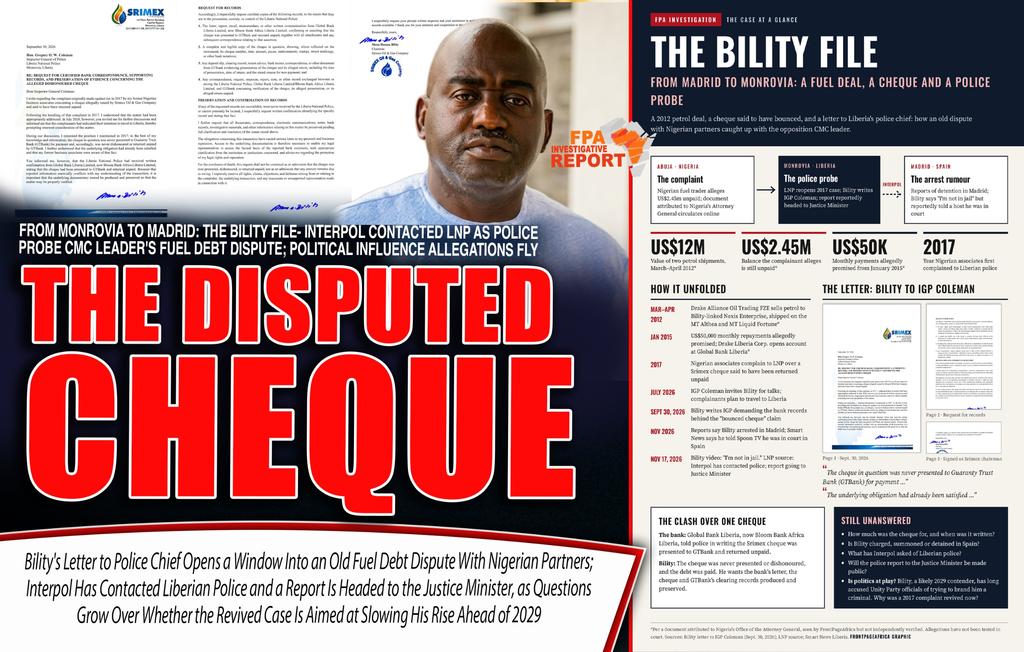
Opposition leader Musa Hassan Bility recently found himself summoned by Liberia's Inspector General of Police, Gregory O. W. Coleman, concerning a commercial complaint he believed had been settled almost ten years prior. This development unfolded weeks before rumors of Bility's potential arrest in Spain circulated on Liberian social media. The renewed police interest centers on a dispute with his former Nigerian business associates, involving an alleged unpaid cheque issued by Bility's company, Srimex Oil & Gas Company.
In response to the police inquiry, Bility penned a three-page letter to Inspector General Coleman on September 30, 2026, challenging a crucial piece of evidence presented against him. This evidence is a bank's written confirmation asserting that the Srimex cheque was presented for payment but subsequently returned unpaid. The letter serves as the clearest public indication that this long-standing financial disagreement remains an active matter before Liberian law enforcement, extending beyond mere social media speculation. The re-emergence of this nearly decade-old commercial dispute, which Bility believed had been resolved, highlights the enduring nature of financial disagreements, especially when law enforcement becomes involved.
Adding an international dimension to the case, Interpol, the global police organization, has contacted the Liberia National Police (LNP) to indicate its interest in the investigation. A source familiar with the inquiry informed FrontPageAfrica that a report on the matter is being prepared for Justice Minister Bettie Lamin-Blamo, though it has not yet been made public. While Interpol facilitates information sharing and tracking across its 196 member countries, it does not possess arrest powers itself, leaving the specifics of its request to Liberian police unclear.
The Core of the Cheque Controversy
The complaint against Bility originated in 2017 from his former Nigerian business partners, revolving around a cheque purportedly issued by Srimex Oil & Gas Company that was allegedly returned unpaid. Bility states that after the initial police handling of the complaint in 2017, he understood the issue to have been appropriately resolved. However, this changed in July 2026 when Inspector General Coleman invited Bility for further discussions, informing him that the complainants intended to travel to Liberia, prompting the police to re-examine the case.
During this meeting, Bility reiterated his consistent position from 2017: to his knowledge, the cheque was never presented to Guaranty Trust Bank (GTBank) for payment and, therefore, was never dishonored or returned unpaid. He further asserts that the underlying financial obligation had already been satisfied, a fact he believes his former business associates were aware of. Bility's stance does not deny an initial debt but rather contends that the payment was made, challenging the assertion of an unpaid cheque.
Demands for Documentation and Transparency
At the heart of the current dispute is a document Bility claims he has never seen. According to Bility's letter, Inspector General Coleman informed him that the Liberia National Police had obtained written confirmation from Global Bank Liberia Limited, now known as Bloom Bank Africa Liberia Limited. This confirmation reportedly stated that the cheque in question had been presented to GTBank and subsequently returned unpaid. Bility asserts that this information fundamentally conflicts with his understanding of the transaction.
To clarify the situation, Bility has formally requested that the police provide certified copies of several critical records. These include the bank's letter or any other communication confirming the cheque was returned unpaid, along with all attachments; a complete copy of the cheque itself, detailing its number, date, amount, payee, stamps, and any return markings; any GTBank clearing record, return advice, or other document indicating when the cheque was presented, when it was returned, and the reason for non-payment; and all correspondence between the police, Global Bank/Bloom Bank, and GTBank concerning the cheque. Bility also demanded the preservation of all documents, bank records, and investigative materials related to the case, requesting written confirmation if any record was never received or cannot be located. The specific amount of the cheque was not disclosed in the letter, but Bility emphasized that the ongoing situation is causing serious harm to his reputation.
Practical Implications
Lawyers should advise clients, particularly high-profile individuals or companies, that commercial disputes, even those believed settled, can be re-activated by law enforcement, especially when political influence is alleged or international bodies like Interpol become involved. This case underscores the critical need for meticulous documentation of all financial transactions, particularly cheque clearances and proof of payment, to effectively counter allegations of unpaid debts.
Source
How does this affect you?
Get an AI analysis of this article grounded in your jurisdictions, practice areas, and any policy documents you've uploaded to Wansom.
Finish Reading the Full Story and the Expert Analysis.
Get the latest legal & regulatory intelligence in Liberia
Wansom is AI and can make mistakes.