
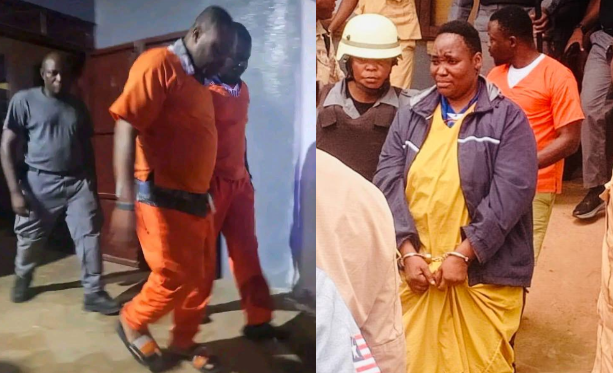
Liberia LDEA Commanders: 20-Year Sentencing in Quita Dolo Kosso Case
Summary
- Former LDEA commander Joe I. Logan, his deputy Lovette L. Flowers, and Nigerian national Tony Obi were each sentenced to 20 years in prison.
- The sentencing by Judge Roosevelt Willie in Margibi County followed a unanimous guilty verdict by a trial jury.
- The defendants were convicted on multiple charges, including illicit trafficking and criminal conspiracy, related to a cocaine seizure at Roberts International Airport.
- The case involved allegations that four of fourteen seized cocaine plates were removed and sold by officers, with proceeds shared.
- The court's decision was based on Section 14.83 of Liberia's New Drug Law, with the Probation Office characterizing the defendants as recidivists.
LDEA Commanders Sentenced in Cocaine Trafficking Case
The court's decision underscores the serious consequences for public officials found to be engaged in illicit drug activities, particularly those entrusted with enforcing anti-narcotics laws.
A Liberian court has handed down significant sentences to a former high-ranking anti-narcotics official, his deputy, and a Nigerian national, following their conviction in a major drug trafficking case. Joe I. Logan, the former commander of the Liberia Drug Enforcement Agency (LDEA) at Roberts International Airport, along with his deputy, Lovette L. Flowers, and Nigerian citizen Tony Obi, each received 20-year prison terms. The sentencing was delivered by Judge Roosevelt Willie of the 13th Judicial Circuit Court of Margibi County during its August Term of Court.
The court's decision came after a trial jury returned a unanimous guilty verdict against the three defendants. Judge Willie, in his ruling, emphasized that the court meticulously considered the specific facts and circumstances of the case, the relevant legal statutes, and a report from the Probation Office. This report notably characterized the defendants as recidivists, indicating a history of repeated offenses against the state. The judge affirmed the jury's findings, stating that the evidence and legal framework supported the conviction.
The ruling, which took immediate effect, mandates that the Clerk of Court communicate with the Superintendent of the Kakata Central Prison to ensure the prompt implementation of the final judgment. This sentencing marks a critical development in the high-profile Quita Dolo Kosso drug case, which has drawn considerable attention to corruption within Liberia's law enforcement agencies and the broader issue of drug trafficking through key entry points like Roberts International Airport.
Allegations of Cocaine Diversion and Official Misconduct
The convictions stem from a complex series of events surrounding the seizure of cocaine at Roberts International Airport. The case originated with the arrest of Quita Dolo Kosso on July 12, 2025, who arrived in Liberia from Thailand aboard Kenya Airways carrying a substantial quantity of cocaine. Prosecutors alleged that 14 plates of cocaine were initially seized from Kosso, but a critical part of their case centered on the claim that four of these plates were subsequently removed, sold, and the proceeds illicitly distributed among some of the accused officers.
The defendants faced a litany of charges, including unlicensed possession and importation of controlled substances, criminal facilitation, forgery, misapplication of entrusted property, theft of property, criminal conspiracy, illicit trafficking, and the unlicensed sale and distribution of controlled drugs or substances. A key prosecution witness, former LDEA officer Mankarpoe Duo, testified that Logan instructed him and others to alter official records to show only 10 plates seized instead of 14, thereby concealing the removal of the four missing plates. Prosecutors also presented evidence suggesting the defendants were involved in a scheme to secure Kosso’s release, which allegedly included a US$10,000 payment.
Defense Challenges and Legal Basis
Throughout the trial, the defense vigorously contested the prosecution's narrative. They argued that initial investigations and contemporaneous records consistently indicated that only 10 plates of cocaine were seized, directly contradicting the claim of 14 plates and subsequent diversion. The credibility of prosecution witness Mankarpoe Duo was also challenged, with the defense highlighting that Duo had previously made statements asserting only 10 plates were seized and had admitted during trial that some of his earlier statements were false.
Each defendant offered a distinct defense. Joe I. Logan denied ordering any alteration of records or the removal of cocaine, asserting that the alleged US$10,000 payment was part of a sting operation designed to identify individuals attempting to bribe LDEA officers. Lovette L. Flowers similarly denied any involvement in a scheme to remove cocaine. Tony Obi maintained that he was merely transporting money to the airport at the request of a friend and was unaware of its alleged illicit purpose. Despite these arguments, the jury found them guilty.
The 20-year sentences imposed on Logan, Flowers, and Obi were issued pursuant to Section 14.83 of the New Drug Law of the Republic of Liberia. This specific statute provides the legal framework for prosecuting and penalizing individuals involved in drug-related offenses, underscoring the nation's commitment to combating illicit narcotics trade.
Significance of the Verdict
The conviction and sentencing of these individuals, particularly high-ranking LDEA officers, send a powerful message regarding accountability within Liberia's law enforcement apparatus. The court's decision underscores the serious consequences for public officials found to be engaged in illicit drug activities, particularly those entrusted with enforcing anti-narcotics laws. This outcome highlights the judiciary's resolve to address corruption and illicit trafficking, even when it involves state actors.
This case, often referred to as the Quita Dolo Kosso drug trafficking incident, has brought to light the vulnerabilities within the system designed to prevent drug smuggling. The involvement of LDEA officers in the alleged removal and sale of seized narcotics, as confirmed by the jury's verdict, points to systemic challenges that Liberia faces in its fight against organized crime. The sentencing of Joe I. Logan, Lovette Flowers, and Tony Obi serves as a significant precedent, reinforcing the principle that no one is above the law, regardless of their position or influence.
Source
How does this affect you?
Get an AI analysis of this article grounded in your jurisdictions, practice areas, and any policy documents you've uploaded to Wansom.
Finish Reading the Full Story and the Expert Analysis.
Get the latest legal & regulatory intelligence in Liberia
Wansom is AI and can make mistakes.