
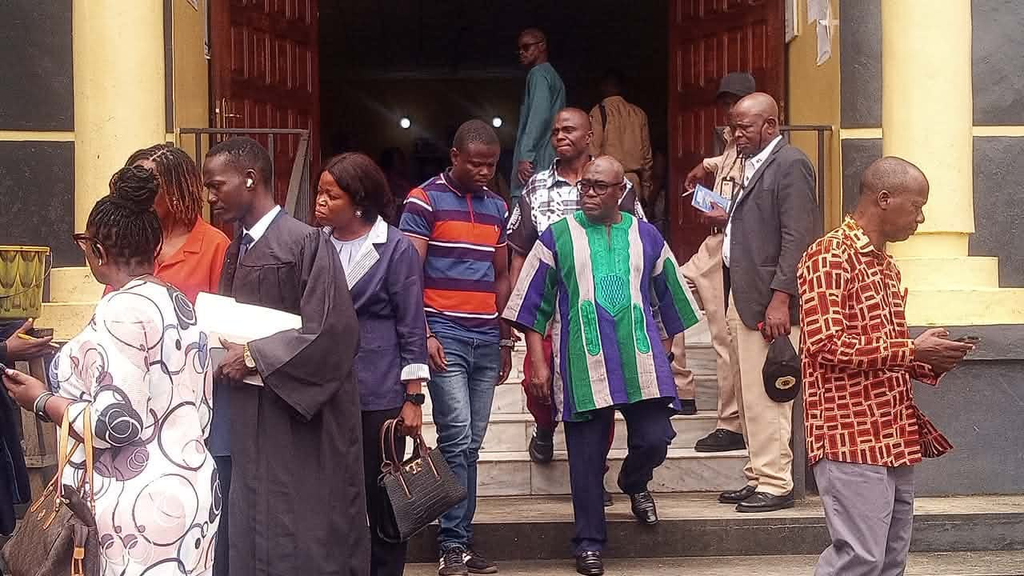
Liberia: Kemayah Appeals Saudi Rice Case Conviction to Supreme Court
Summary
- Former Foreign Affairs Minister Dee-Maxwell Saah Kemayah and co-defendants have appealed their convictions in the US$500,000 Saudi Rice case to Liberia's Supreme Court.
- The appeal follows Criminal Court ‘C’s denial of a new trial motion and the imposition of 10-year and 5-year prison sentences on November 13, 2026.
- The case involves the alleged diversion of 25,054 bags of humanitarian rice, valued at approximately US$425,918, donated by the King Salman Humanitarian Aid and Relief Center in April 2023.
- Defendants, including former Internal Affairs Minister Varney A. Sirleaf, were convicted on charges such as theft of property and economic sabotage after an October 9 jury verdict.
- The Supreme Court will review the trial proceedings, jury findings, new-trial denial, and sentences, marking a critical phase in this high-profile corruption prosecution.
High-Profile Corruption Conviction Heads to Supreme Court
The Supreme Court now stands as the final judicial avenue for Minister Kemayah and his co-defendants to challenge the outcome of this prosecution.
Former Foreign Affairs Minister Dee-Maxwell Saah Kemayah, along with several co-defendants, has formally appealed their convictions in the US$500,000 Saudi Rice case to the Supreme Court of Liberia. This move follows a decision by Criminal Court ‘C’ to deny their request for a new trial and subsequently impose prison sentences. The appeal was announced on Friday, November 13, 2026, marking a significant escalation in one of Liberia's most closely observed corruption prosecutions.
The defendants' legal teams are now challenging the integrity of the trial proceedings, the jury's conclusions, the rejection of their new trial motion, and the resulting penalties before the nation's highest judicial body. Presided over by Judge Ousman Feika, Criminal Court ‘C’ in Monrovia's Temple of Justice had previously sentenced Minister Kemayah and some of his co-defendants to ten years in prison. Other individuals implicated in the case received five-year prison terms, reflecting varying degrees of culpability as determined by the court.
The Core Allegations and Initial Verdicts
The convictions stem from allegations surrounding the improper handling and distribution of a substantial humanitarian aid package. In April 2023, the King Salman Humanitarian Aid and Relief Center donated 29,412 bags of 25-kilogram rice to Liberia, intended specifically for disaster victims and vulnerable communities. Prosecutors contended that a significant portion of this donation—25,054 bags, valued at approximately US$425,918—was diverted from its designated humanitarian purpose.
The legal proceedings involved thirteen defendants, who faced a range of serious charges including theft of property, economic sabotage, misuse of public office, criminal conspiracy, and misapplication of entrusted property. The prosecution maintained that the humanitarian donation was mishandled, while the defense consistently disputed both the allegations and the evidence presented. The jury delivered its verdicts on October 9, finding eight defendants guilty, acquitting three, and failing to reach unanimous decisions on two others. Among those convicted were Minister Kemayah and former Internal Affairs Minister Varney A. Sirleaf, alongside other former government officials.
Appellate Review and Legal Precedent
The defense's decision to pursue an appeal follows their unsuccessful attempt to convince Criminal Court ‘C’ to overturn the October 9 jury verdicts and mandate a fresh trial. The motion for a new trial, which was deliberated on November 6, argued that the jury's findings were inconsistent with the evidence presented during the extensive trial, which spanned over 40 days. However, Criminal Court ‘C’ declined to grant this relief, thereby paving the way for the sentencing phase.
The Supreme Court now stands as the final judicial avenue for Minister Kemayah and his co-defendants to challenge the outcome of this prosecution. This appellate review is poised to scrutinize not only the trial proceedings and the jury's findings but also the denial of the new-trial motion and the legality of the imposed sentences. The case represents a critical juncture for Liberia's anti-corruption efforts, as the Supreme Court's ruling could establish important precedents for future high-profile corruption convictions and the standards for granting new trials.
Practical Implications
Lawyers and compliance officers in Liberia should monitor the Supreme Court's review of the Kemayah Saudi Rice case. The outcome could establish significant precedents regarding the appellate process for high-profile corruption convictions, the standard for granting new trials, and judicial scrutiny of public officials involved in humanitarian aid diversion, potentially influencing future legal strategies and compliance risk assessments.
Source
How does this affect you?
Get an AI analysis of this article grounded in your jurisdictions, practice areas, and any policy documents you've uploaded to Wansom.
Finish Reading the Full Story and the Expert Analysis.
Get the latest legal & regulatory intelligence in Liberia
Wansom is AI and can make mistakes.