
Liberia Ex-Ministers: Saudi Aid Conviction for Rice Theft
Summary
- A Liberian jury convicted eight former officials, including ex-Foreign Minister Dee-Maxwell Saah Kemayah, in a Saudi aid rice theft case.
- The case involved the alleged diversion of 25,054 bags of rice, valued at approximately US$500,000, donated by Saudi Arabia for vulnerable Liberians.
- Mr. Kemayah was found guilty on five counts, though the jury's verdict was split on several charges.
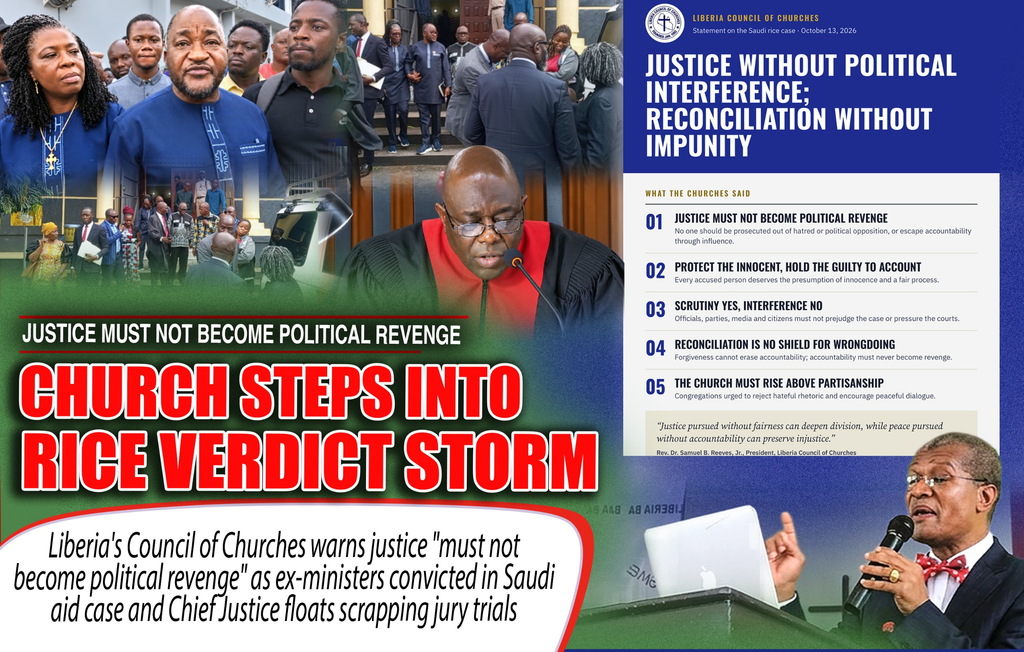
- The Liberia Council of Churches issued a warning against political interference in the justice system, emphasizing evidence-based decisions.
- One convicted official claimed political persecution, while the government's Asset Recovery and Property Retrieval Taskforce welcomed the verdict.
Convictions in Saudi Aid Theft Case
The LCC explicitly stated that no individual should face prosecution due to personal animosity or political opposition, nor should anyone evade lawful accountability through political leverage.
A Liberian jury recently delivered a mixed verdict in a high-profile case involving the alleged theft of humanitarian rice aid from Saudi Arabia. On Friday, October 9, at Criminal Court C in Monrovia, eight of thirteen defendants were found guilty of various charges related to the misappropriation of the donated staple food. Among those convicted were former Foreign Affairs Minister Dee-Maxwell Saah Kemayah and former Internal Affairs Minister Varney A. Sirleaf, both of whom served in the previous administration.
Mr. Kemayah, a prominent figure, was found guilty on all five counts he faced: theft of property, economic sabotage, misapplication of entrusted property, abuse of office, and criminal conspiracy. However, the jury's decision was not unanimous across all charges; four of the twelve jurors reportedly voted to acquit him of theft, and four also voted against conviction for both economic sabotage and conspiracy. The charge of abuse of office was the only one on which the jury reached a unanimous decision. Three other defendants were acquitted entirely, while verdicts for two individuals remained inconclusive. Notably, former National Disaster Management Agency (NDMA) chief Henry O. Williams was found not guilty on all charges, despite his agency's role in the rice's storage and distribution. Mary Broh, formerly of the General Services Agency and a one-time acting mayor of Monrovia, was arrested and charged in connection with the alleged theft of Saudi aid by the Asset Recovery and Property Retrieval Taskforce (AREPT). The intense public interest surrounding the case, which involved recognizable figures from Liberia's past government, was underscored by reports of jurors wearing masks to conceal their identities during the proceedings.
The Allegations of Misappropriation
The core of the case revolved around a significant humanitarian donation made by Saudi Arabia in 2023: 29,412 bags of rice, valued at approximately US$500,000. This aid was specifically intended for disaster victims and vulnerable populations within Liberia. The indictment brought forth by the Asset Recovery and Property Retrieval Taskforce (AREPT) alleged that a substantial portion, specifically 25,054 bags, had been unlawfully diverted or misapplied from its intended purpose.
Rice, being the staple food in Liberia, a nation recognized as one of West Africa's poorest, meant the alleged diversion of this crucial aid ignited widespread public anger over corruption. Mr. Kemayah, who had been instrumental in securing the donation during his tenure as foreign minister, consistently maintained his innocence, denying any involvement in stealing, receiving, or misappropriating the rice. His defense team contended that the financial aspects of the donation were managed directly by Saudi humanitarian authorities and the supplier, rather than by him. This prosecution emerged as part of President Joseph Boakai's broader anti-corruption agenda, initiated after his victory over incumbent George Weah in the 2023 election, with both Kemayah and Sirleaf having served in Weah's cabinet.
Warnings of Political Interference
In the wake of the convictions, Liberia's most influential Christian organization, the Liberia Council of Churches (LCC), issued a strong statement titled "Justice Without Political Interference; Reconciliation Without Impunity." The LCC, led by Rev. Dr. Samuel Broomfield Reeves, Jr., who also serves as vice president of the Inter-Religious Council of Liberia, urged the government, courts, and political class to ensure that judicial processes remain free from political influence. While refraining from determining guilt or dictating outcomes, the Council emphasized that justice must be guided by evidence and law, unburdened by political interference, intimidation, or public pressure. The LCC explicitly stated that no individual should face prosecution due to personal animosity or political opposition, nor should anyone evade lawful accountability through political leverage.
This call for judicial independence comes amidst claims from supporters of the defendants that the trials are politically motivated. Further intensifying these concerns, Rev. Rosetta L. Gbassay Bowah, a former NDMA official and ordained Baptist minister who was also convicted, publicly rejected her verdict on Facebook. On Monday, she alleged that prosecutors had persistently pressured her to become a state witness, a claim for which her post offered no supporting evidence and which has not been independently verified. Ms. Bowah warned that Liberia risks entering a cycle of vengeance, political persecution, and score-settling disguised as justice. Conversely, the government, through the Asset Recovery and Property Retrieval Taskforce (AREPT), has welcomed the verdict, indicating a different perspective on the proceedings.
Practical Implications
Lawyers and compliance officers in Liberia should note the heightened anti-corruption enforcement targeting former officials, signaling increased risk for public sector engagement. Monitor judicial independence concerns and potential reforms to jury trials for implications on due process and litigation strategy.
Source
How does this affect you?
Get an AI analysis of this article grounded in your jurisdictions, practice areas, and any policy documents you've uploaded to Wansom.
Finish Reading the Full Story and the Expert Analysis.
Get the latest legal & regulatory intelligence in Liberia
Wansom is AI and can make mistakes.