
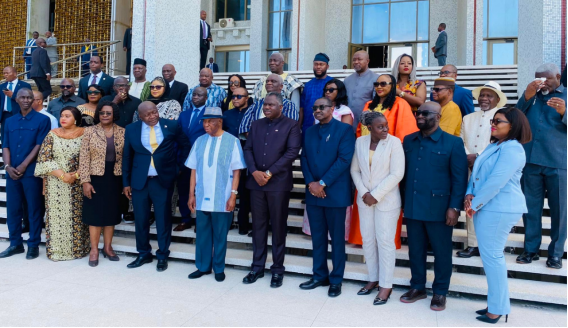
Liberia: Boakai Reshuffle Reduces Female Cabinet Representation
Summary
- President Boakai's September cabinet reshuffle initially brought near gender parity with the appointment of Betty M. Lamin-Blamo as justice minister.
- Within 24 hours, two female ministers, Geraldine J. George and Magdalene E. Dagoseh, were removed, reducing female representation to 37 percent.
- Boakai's administration had previously achieved higher female representation (42 percent) than prior governments, including those of Ellen Johnson Sirleaf and George Weah.
- The justice system faces significant challenges, including bribery in human trafficking cases and a low conviction rate for sexual violence, highlighting the need for empowered female leadership.
- Despite domestic changes, President Boakai publicly committed to women's participation in decision-making at the UN General Assembly and outlined a 2026-2031 plan for expanded female leadership.
Cabinet Changes and Representation Shifts
The true measure of commitment to gender equality lies not merely in appointments but in ensuring that female leaders are empowered to improve public services, particularly in areas like security and justice for survivors of sexual and gender-based violence.
A cabinet reshuffle initiated by President Joseph Boakai in September prompted immediate scrutiny from women's rights advocates concerning the stability of female representation within the government. Initially, the appointment of Betty M. Lamin-Blamo as the acting minister of justice and attorney general was widely praised. This marked the fourth instance of a woman holding this significant position, and her elevation briefly brought Boakai’s cabinet to a state of near gender parity, an unprecedented achievement in Liberia's history.
However, this equilibrium was short-lived. Just 24 hours following Lamin-Blamo's appointment, President Boakai removed two prominent female ministers from their roles: Geraldine J. George, who had served as Liberia's first female defense minister, and Magdalene E. Dagoseh, the Minister of Commerce and Industry. Their positions were subsequently filled by two men, causing the proportion of women in the cabinet to decline to seven out of 19 positions, representing 37 percent of the total.
Historical Context and Initial Gains
Despite the recent setback, President Boakai's administration had initially shown a stronger commitment to female representation compared to previous governments. Upon taking office in 2024, six women were included in his cabinet. By January 2025, this number had increased to seven out of 19 ministers. The subsequent appointment of Cornelia Wonkerleh Kruah as the youth and sports minister further boosted female representation to eight positions, or 42 percent.
These figures represent a notable improvement over prior administrations. For instance, when Ellen Johnson Sirleaf commenced her first term in 2006, women held five of 23 cabinet posts (22 percent), rising slightly to six of 23 (26 percent) at the start of her second term in 2012. George Weah's administration, beginning in 2018, saw women occupy four of 19 ministerial roles (21 percent). Furthermore, Boakai's initial appointment of Geraldine Janet George as the first female defense minister was groundbreaking, accompanied by a mandate to increase female presence in the Armed Forces of Liberia, where women constituted only 7.4 percent. In February, the Ministry of National Defense and UN Women launched a US$663,000 project, supported by the Elsie Initiative Fund, with the goal of raising female representation in the armed forces to 15 percent within two years, a campaign that included extensive outreach efforts across various counties from mid-2026.
Justice System Challenges and Advocacy
The appointment of Betty M. Lamin-Blamo as justice minister was particularly significant given the documented failures within Liberia's justice system. Reports from FrontPage Africa/New Narratives highlighted severe deficiencies, including instances where bribery obstructed human trafficking cases from reaching court. A prosecutor even conceded that only two individuals accused of sexual violence had been convicted over a six-year period, despite more than 300 such cases pending and many accused remaining in pretrial detention for years.
Boakai's Stated Commitments and Future Goals
The recent cabinet adjustments have reignited discussions about whether the increasing presence of women in government genuinely translates into enduring decision-making authority and influence. Women's rights advocates assert that President Boakai must demonstrate a tangible commitment to empowering women with the necessary authority and resources to enhance public services.
Despite the domestic reshuffle, President Boakai has consistently championed women's representation on the international stage, recognizing its priority for European donors. Ten days after the cabinet changes, he underscored women's participation in decision-making during his address at the United Nations General Assembly in New York. He declared, "Liberia does not intend to advocate for women’s participation in peacebuilding around the world while failing to create space for women at home," adding, "Now, we must ensure they have the opportunity, authority and institutional support to lead." A comprehensive plan for 2026 to 2031 further aims to expand women's involvement in leadership and peacebuilding initiatives.
Source
How does this affect you?
Get an AI analysis of this article grounded in your jurisdictions, practice areas, and any policy documents you've uploaded to Wansom.
Finish Reading the Full Story and the Expert Analysis.
Get the latest legal & regulatory intelligence in Liberia
Wansom is AI and can make mistakes.