
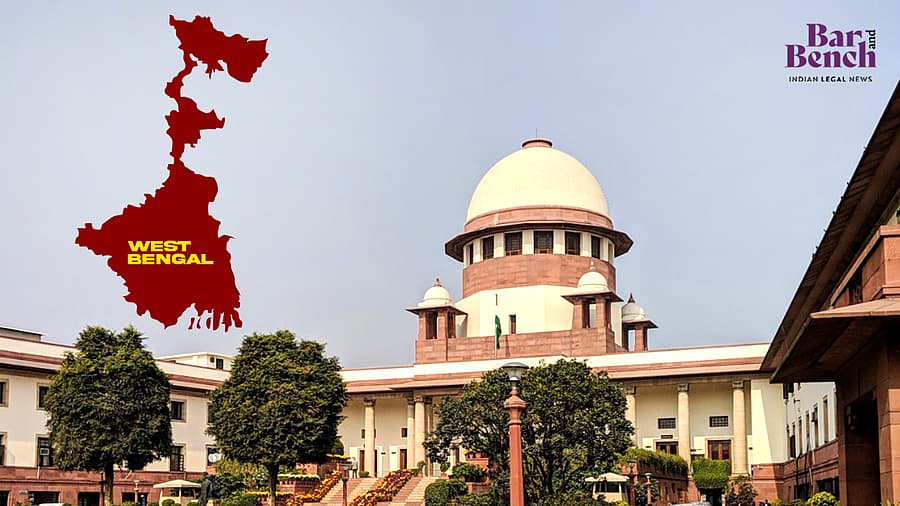
Supreme Court: Moots Transfer in Kolkata Ward Delimitation Case
Summary
- The Supreme Court proposed staying a Calcutta High Court order that had halted Kolkata Municipal Corporation elections.
- The High Court's order was issued in response to a challenge against the delimitation of municipal wards.
- The apex court suggested transferring the delimitation challenge from a single-judge to a division bench of the Calcutta High Court.
- KMC elections will remain postponed until the High Court's division bench renders a decision on the matter.
- This approach aims to provide a fair procedural framework without the Supreme Court ruling on the merits of the dispute.
Supreme Court's Intervention
The Supreme Court's proposal stipulates that while its stay on the High Court's interim order would take effect, the KMC elections would nonetheless remain postponed until the newly assigned division bench delivers its decision on the matter.
India's Supreme Court recently proposed a significant procedural adjustment concerning the ongoing dispute over the delimitation of municipal wards in Kolkata. This intervention, made by a bench comprising Chief Justice of India Surya Kant, Justice Joymalya Bagchi, and Justice V Mohana, aims to resolve a deadlock that has stalled elections for the Kolkata Municipal Corporation (KMC).
The apex court suggested staying an interim order previously issued by the Calcutta High Court. This High Court directive had effectively halted the notification of KMC elections, following a challenge mounted against the process of redrawing municipal ward boundaries. The case, formally known as The State Of West Bengal & Anr. v Dipu Das & Ors., underscores the complexities involved in electoral preparations when faced with legal challenges to foundational administrative decisions like delimitation.
Proposed Judicial Rationale
Beyond merely staying the High Court's interim order, the Supreme Court also put forth a recommendation to transfer the entire challenge regarding the delimitation exercise. This challenge, currently being heard by a single-judge bench of the Calcutta High Court, would be moved to a division bench for a fresh and comprehensive review. The Supreme Court's proposal stipulates that while its stay on the High Court's interim order would take effect, the KMC elections would nonetheless remain postponed until the newly assigned division bench delivers its decision on the matter.
Chief Justice Kant articulated the rationale behind this approach, stating that the stay on the impugned order was intended to allow a division bench to thoroughly examine the factual and legal issues presented and subsequently issue an appropriate fresh order. He emphasized that the writ petition, originally before the single judge, would be directly transferred to the division bench. This strategic move, according to CJI Kant, is designed to place both contesting parties on an "even keel," ensuring that the Supreme Court refrains from expressing any opinion on the substantive merits of the underlying dispute.
Implications for Kolkata Elections
The immediate consequence of the Supreme Court's proposed action is that the Kolkata Municipal Corporation elections will continue to be held off. This delay will persist until the Calcutta High Court's division bench concludes its consideration of the delimitation challenge and issues a definitive ruling. The Supreme Court's intervention, therefore, acts as a procedural mechanism to ensure a more robust judicial review of the delimitation process without directly adjudicating the core dispute itself.
Senior Advocate Bikas Ranjan Bhattacharya, who represented the respondent—the party that initially challenged the delimitation before the High Court—reportedly offered his initial agreement to the Supreme Court's suggestions. This indicates a potential path forward in resolving the electoral impasse, contingent on the High Court's subsequent actions and decisions regarding the ward boundaries.
Source
How does this affect you?
Get an AI analysis of this article grounded in your jurisdictions, practice areas, and any policy documents you've uploaded to Wansom.
Finish Reading the Full Story and the Expert Analysis.
Get the latest legal & regulatory intelligence in India
Wansom is AI and can make mistakes.