
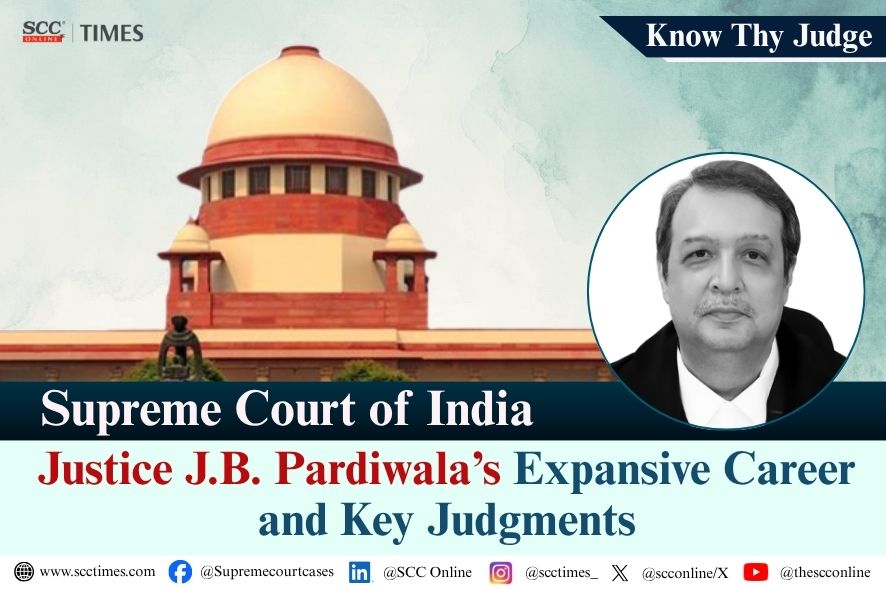
Supreme Court of India: Know Thy Judge J.B. Pardiwala's Path to CJI
Summary
- Justice Jamshed Burjor Pardiwala is a fourth-generation lawyer.
- He was appointed as a Judge of the Supreme Court of India on May 9, 2022.
- Justice Pardiwala is in line to become the Chief Justice of India.
- His term as Chief Justice is projected to last two years and three months, from May 2028 to August 2030.
Who is Justice Pardiwala?
His prospective term as the Chief Justice of India is slated to commence in May 2028 and extend through August 2030.
Justice Jamshed Burjor Pardiwala represents a profound legacy within the Indian legal system, being a distinguished fourth-generation lawyer. This deep-rooted connection to the legal profession underscores a lifetime immersed in jurisprudence and advocacy, a background that is relatively unique and speaks to a significant family tradition of public service through law. Such a lineage often brings with it an inherent understanding of legal history, precedent, and the evolving societal role of the judiciary, shaping a jurist's approach to complex cases. His ascent through the ranks of the judiciary culminated in his appointment to the highest court in the nation.
On May 9, 2022, Justice Pardiwala officially assumed his duties as a Judge of the Supreme Court of India. This appointment marked a pivotal moment in his extensive career, placing him at the apex of the judicial hierarchy where he now contributes to shaping national legal precedents and constitutional interpretations. His tenure on the Supreme Court is not only a recognition of his past contributions and legal acumen but also a precursor to an even more prominent and influential role within the Indian judiciary, signaling a significant future for his leadership.
Path to the Supreme Court and Beyond
The trajectory of Justice Pardiwala's career indicates a clear path toward the very pinnacle of India's judicial system. Following his elevation to the Supreme Court, he is now positioned to become the Chief Justice of India, a role that carries immense responsibility and influence over the country's legal landscape. This anticipated progression highlights the rigorous selection process and the high regard in which his judicial acumen is held by his peers and the appointing authorities, underscoring the trust placed in his leadership capabilities.
His prospective term as the Chief Justice of India is slated to commence in May 2028 and extend through August 2030. This period is projected to span two years and three months, a substantial duration for a Chief Justice in India, where terms can often be shorter due to age-related retirement mandates. A longer term allows for greater continuity in judicial administration, policy implementation, and the potential to steer the court's direction on critical legal and constitutional matters with sustained vision, enabling a more impactful and consistent leadership.
Significance of the Appointment
The appointment of Justice J.B. Pardiwala to the Supreme Court, coupled with his position in line for the Chief Justice of India role, carries significant implications for the future of Indian jurisprudence. His background as a fourth-generation lawyer brings a unique perspective, potentially enriching the court's deliberations with insights drawn from a long family history of legal practice and understanding of the law's evolution. Such a heritage often instills a deep respect for legal traditions while also fostering an appreciation for necessary reforms and an understanding of the practical impact of judicial decisions on society.
Furthermore, the prospect of a Chief Justice serving for over two years, specifically from May 2028 to August 2030, offers a rare opportunity for stability and long-term strategic planning within the Supreme Court. This extended tenure could enable the implementation of more comprehensive judicial reforms, the consistent application of legal principles, and a more coherent approach to addressing the complex socio-legal challenges facing the nation. The leadership of a Chief Justice with such a term can leave an indelible mark on the judiciary, influencing its direction and efficiency for years to come, potentially shaping the court's legacy for a generation.
Source
How does this affect you?
Get an AI analysis of this article grounded in your jurisdictions, practice areas, and any policy documents you've uploaded to Wansom.
Wansom is AI and can make mistakes.