
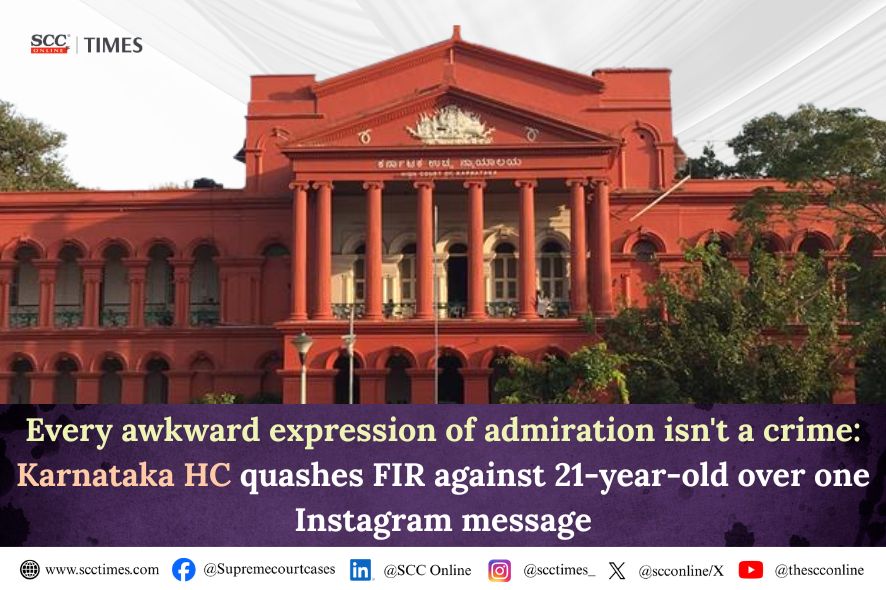
Karnataka HC: No FIR for Single Instagram Compliment
Summary
- A 21-year-old individual's FIR was quashed by the Karnataka High Court for sending a single Instagram compliment.
- The court ruled that a solitary expression of admiration cannot be considered a crime without further evidence.
- Indian voyeurism and stalking laws (now under the Bharatiya Nyaya Sanhita) require specific circumstances to be considered offenses, not just a single message.
- A nuanced approach is necessary in applying Indian laws to online interactions.
What Happened
The post Every awkward expression of admiration isn’t a crime: Karnataka HC quashes FIR against 21-year-old over one Instagram message appeared first on SCC Times.
A 21-year-old individual was charged with an FIR under the Indian Penal Code (IPC) for sending a single compliment to a woman via Instagram direct message. The Karnataka High Court reviewed the case and ultimately quashed the FIR, ruling that a solitary expression of admiration cannot be considered a crime without further evidence. The court's decision highlights the importance of distinguishing between genuine expressions of appreciation and potential harassment or stalking behavior.
Legal Context
The provisions on voyeurism (formerly Section 354C of the IPC, now Section 77 of the Bharatiya Nyaya Sanhita (BNS)), stalking (formerly Section 354D of the IPC, now Section 78 of the BNS), and insult to a woman's modesty (formerly Section 509 of the IPC, now also Section 78 of the BNS) require specific circumstances, such as repeated unwanted contact or explicit content, to be considered offenses. The court emphasized that a single Instagram message, no matter how awkward or inelegant, cannot be automatically classified as an offense without proof of these essential ingredients. This decision underscores the need for a nuanced approach in applying Indian laws to online interactions.
Why It Matters
The Karnataka High Court's ruling has significant implications for lawyers and individuals navigating online communication laws in India. The court's emphasis on distinguishing between genuine expressions of admiration and potential harassment or stalking behavior serves as a reminder that a single, awkward message is unlikely to be considered an offense unless accompanied by other suspicious behavior. This decision will likely influence future cases involving online interactions and the application of Indian voyeurism and stalking laws, now under the Bharatiya Nyaya Sanhita.
Practical Implications
Lawyers should note that a single, awkward Instagram message is unlikely to be considered an offence under Indian voyeurism or stalking laws, unless accompanied by other suspicious behaviour.
Source
Source: Original reporting via SCC Times
How does this affect you?
Get an AI analysis of this article grounded in your jurisdictions, practice areas, and any policy documents you've uploaded to Wansom.
Wansom is AI and can make mistakes.