
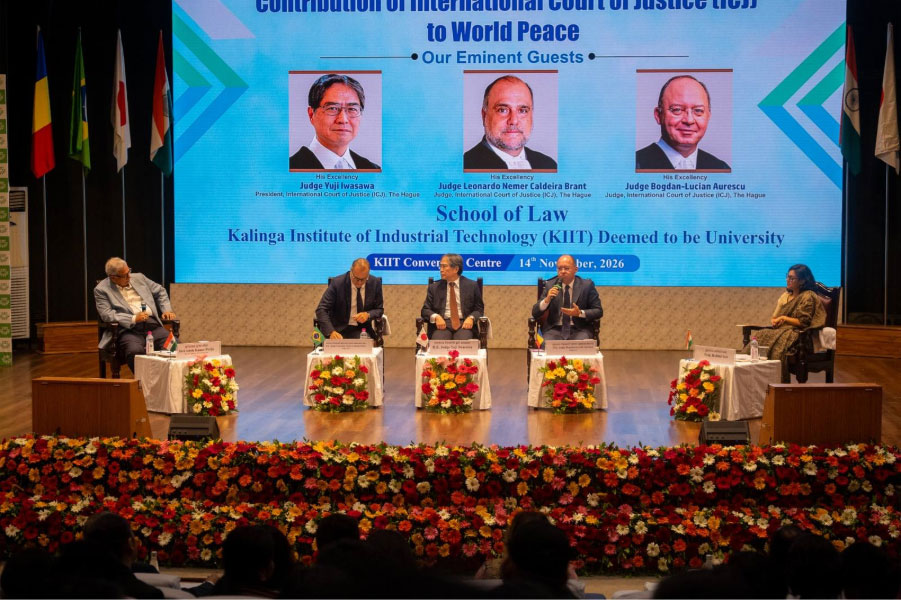
KIIT School of Law: ICJ Conference Explores Court's Role in World Peace
Summary
- The KIIT School of Law organized an international law conference focused on the International Court of Justice.
- The conference examined the ICJ's contributions to maintaining international peace and promoting justice.
- Discussions centered on the evolving role of the ICJ in strengthening the international legal order.
- The event provided a crucial platform for deliberations among experts on these critical global issues.
Conference Overview
The conference extensively explored the three core pillars of the International Court of Justice's engagement with the international community, as they relate to its overarching goal of achieving world peace.
The KIIT School of Law recently convened a significant international law conference, dedicating its focus to the pivotal contributions of the International Court of Justice (ICJ) in fostering global peace. This academic event served as an essential forum for comprehensive deliberations, bringing together experts and scholars to discuss the multifaceted aspects of the ICJ's work.
The conference, organized by the KIIT School of Law, specifically aimed to explore the dynamic and evolving role of the ICJ within the contemporary international legal landscape. Participants engaged in in-depth discussions regarding how this principal judicial organ of the United Nations navigates complex global challenges and adapts its functions to meet the demands of an ever-changing world order. The gathering underscored the academic community's commitment to understanding and analyzing the mechanisms that uphold international stability.
The ICJ's Evolving Mandate
A central theme of the KIIT School of Law ICJ conference was the continuous evolution of the court's responsibilities and influence. Discussions centered on how the ICJ's role in international law is not static but rather a responsive and adaptive process, shaped by geopolitical shifts, emerging legal doctrines, and the increasing interconnectedness of nations. This evolving mandate requires constant re-evaluation and understanding, which the conference sought to facilitate.
The deliberations provided an important platform for examining the practical implications of the ICJ's changing operational environment. Experts considered how the court's interpretations and rulings contribute to the development of international jurisprudence, thereby influencing future state conduct and the broader framework of global governance. The conference highlighted the ongoing academic and practical interest in the ICJ's capacity to remain relevant and effective in its crucial mission.
Pillars of International Order
The conference extensively explored the three core pillars of the International Court of Justice's engagement with the international community, as they relate to its overarching goal of achieving world peace. A primary area of focus was the ICJ's critical function in maintaining international peace, often through the peaceful resolution of disputes between sovereign states. This involves adjudicating cases where nations bring their disagreements before the court, seeking legally binding decisions.
Furthermore, the discussions at the KIIT international law conference delved into the ICJ's indispensable role in promoting justice on a global scale. This aspect encompasses ensuring accountability under international law and upholding fundamental legal principles that govern relations between states. Finally, the conference emphasized how the court actively contributes to strengthening the international legal order, providing a stable and predictable framework for international relations and reinforcing the rule of law across borders.
Significance of Academic Discourse
The convocation of such a specialized conference by the KIIT School of Law underscores the vital importance of academic platforms for dissecting and understanding complex international legal issues. By providing a dedicated space for deliberations, the event fostered a deeper appreciation for the intricate mechanisms through which international bodies like the ICJ operate to achieve their mandates.
Such gatherings are crucial for advancing scholarly thought and contributing to the broader discourse on global governance and the future of international law. The insights generated from these discussions help to inform policy, educate future legal professionals, and ensure that the critical functions of institutions like the International Court of Justice are continually scrutinized and supported in their pursuit of a more peaceful and just world.
Practical Implications
This article reports on a past academic conference and does not present any direct actionable legal implications for lawyers or compliance officers. It serves as an informational piece about discussions on international law.
Source
Source: Original reporting via SCC Times
How does this affect you?
Get an AI analysis of this article grounded in your jurisdictions, practice areas, and any policy documents you've uploaded to Wansom.
Finish Reading the Full Story and the Expert Analysis.
Get the latest legal & regulatory intelligence in India
Wansom is AI and can make mistakes.