
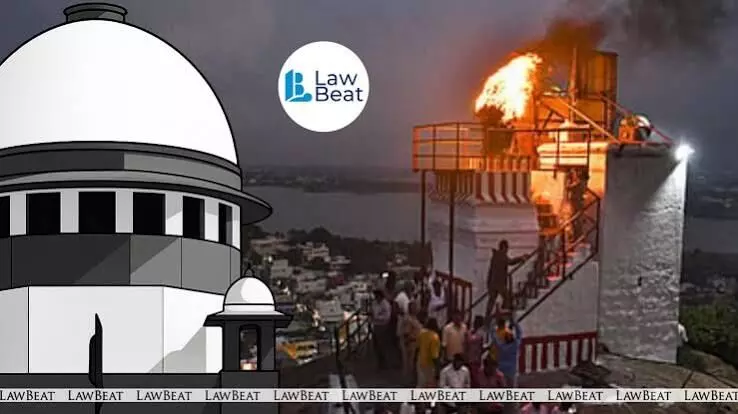
“That Is Not Proof Of Custom”: Tamil Nadu Tells Supreme Court No Tradition Backs Thirupparankundram Deepathoon
What Happened
Home / Top Stories “That Is Not Proof Of Custom”: Tamil Nadu Tells Supreme Court No Tradition Backs Thirupparankundram Deepathoon Lamp X Tamil Nadu tells Supreme Court no custom backs lighting the Thirupparankundram lamp on the Deepathoon Tamil Nadu urged the Supreme Court to stay the Madras High Court's direction permitting the lamp to be lit on the Deepathoon near the Dargah, contending that no such custom was ever proved The Tamil Nadu government on Tuesday asked the Supreme Court to stay a Madras High Court direction that allows the Karthigai Deepam to be lit on a stone pillar, known as the Deepathoon, close to the Dargah on the Thirupparankundram hill in Madurai district. The State argued that the petitioners before the High Court had never proved a custom of lighting the lamp at that spot, and that no mandamus could therefore have issued. It pressed for urgent interim relief because the Deepam falls on November 24, and the lamp would have to be lit at the disputed site that day unless the direction is stayed. The Bench of Justice Aravind Kumar and Justice Vipul M. Pancholi heard the State and the supporting respondents for over an hour and a half on November 17. The hearing will continue on Wednesday, November 18, at 2 PM . Senior Advocate Jaideep Gupta , appearing for the State, told the Bench that there was no prevailing custom of lighting the lamp at the Deepathoon. He relied on the temple priests, who have affirmed that under the Agamas the lamp is to be lit where it has traditionally been lit, near the Uchi Pillaiyar Temple, and not at the pillar near the Dargah. "If the temple says this is the practice, normally the Courts will not interfere," Gupta submitted. Gupta argued that the burden of proving the custom lay on those asserting it, and that they had not discharged it. Taking issue with the reasoning in the impugned judgment, he said, "One of the things stated in the judgment is, generally in Tamil Nadu, temple lamp is lit on the hilltop. That is not proof of custom. The proof of custom is what the sthanikars have said, regarding the lighting of deepam at Uchi Pillaiyar Temple." From the absence of a proved custom, Gupta drew the conclusion that the petitioners had no enforceable right to the lamp being lit at the Deepathoon. Without such a right, he contended, the High Court could not have issued a mandamus directing it. Gupta also took the Bench through earlier High Court judgments that had rejected pleas to light the lamp at the disputed location. Tamil Nadu Additional Advocate General Prashanto Chandra Sen built on this. He submitted that since the High Court had already turned down the prayer to light the lamp at the Deepathoon in earlier proceedings, the latest petition was barred by res judicata. Senior Advocate Shekhar Naphade , appearing for the Commissioner of the Hindu Religious and Charitable Endowments (HR&CE) Department, questioned the need to disturb a long-settled arrangement. "If some practice has been going on for 100 years, why change it?" he asked. Naphade also took issue with the High Court's view that the lamp must be lit at the hilltop. The top of the hill, he pointed out, is where the Dargah stands, and the High Court had erred on that count. The reasonable course, he submitted, was to maintain the status quo that had held for years until the Supreme Court decides the appeal. Senior Advocate Gopal Sankaranarayanan made submissions on behalf of the District Collector in support of the State. Senior Advocate Huzefa Ahmadi , for the Sikandar Badhusha Dargah, briefly submitted that the High Court's direction had created a new practice. The Special Leave Petition (SLP), filed on June 11 through Advocate-on-Record B. Karunakaran, assails a January 6 judgment of a Division Bench of the Madras High Court (Madurai Bench), which upheld an earlier order of a single judge allowing devotees to light a lamp at the ' Deepa Thoon ' (stone lamp pillar). The dispute pertains to a stone pillar located arou
Practical Implications
This case underscores the high evidentiary bar for proving customary practices in Indian courts, particularly when seeking judicial directives like mandamus. Lawyers should note the emphasis on *res judicata* in preventing re-litigation of claims previously rejected by higher courts, even in matters concerning religious traditions.
Source
Source: Original reporting via LawBeat
How does this affect you?
Get an AI analysis of this article grounded in your jurisdictions, practice areas, and any policy documents you've uploaded to Wansom.
Finish Reading the Full Story and the Expert Analysis.
Get the latest legal & regulatory intelligence in India
Wansom is AI and can make mistakes.