
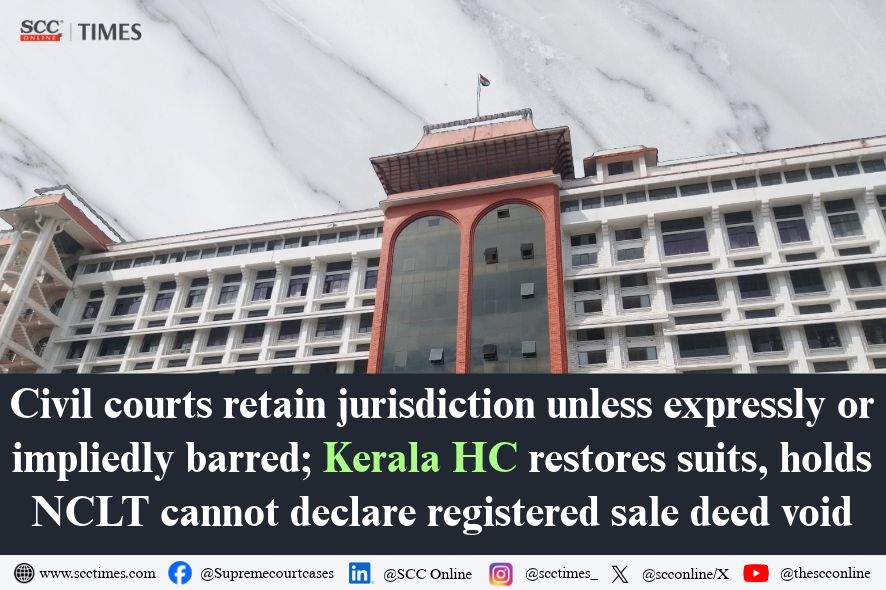
Kerala High Court: NCLT Lacks Jurisdiction to Void Sale Deeds
Summary
- The Kerala High Court has clarified that the NCLT lacks the power to declare a registered sale deed void.
- The NCLT's jurisdiction under Sections 241 and 242 of the Companies Act, 2013, is limited to matters of oppression and mismanagement.
- These NCLT powers do not extend to invalidating property transactions or deeming them non-binding on a company.
- Civil courts retain their inherent jurisdiction over disputes concerning the validity of registered sale deeds.
- Challenges to registered sale deeds, even if related to corporate disputes, must be pursued in civil courts.
What Happened
The Kerala High Court recently issued a significant ruling, clarifying the jurisdictional boundaries between the National Company Law Tribunal (NCLT) and civil courts, particularly concerning the validity of property transactions.
The Kerala High Court recently issued a significant ruling, clarifying the jurisdictional boundaries between the National Company Law Tribunal (NCLT) and civil courts, particularly concerning the validity of property transactions. The High Court decided to restore certain suits, asserting that the NCLT does not possess the authority to declare a registered sale deed void. This decision underscores a critical distinction in the powers allocated to different judicial bodies.
The court's pronouncement explicitly states that the NCLT's mandate, derived from Sections 241 and 242 of the Companies Act, 2013, is specifically tailored to address issues of oppression and mismanagement within companies. It found that these statutory provisions do not extend to adjudicating the validity of a disputed registered sale deed or deeming it non-binding on a company. This ruling provides essential guidance on the scope of the Kerala HC NCLT void sale deed jurisdiction.
Legal Context
The National Company Law Tribunal operates under specific statutory powers, primarily focused on corporate governance and the resolution of disputes related to company affairs, such as those arising from oppression and mismanagement. Sections 241 and 242 of the Companies Act, 2013, empower the NCLT to intervene in situations where a company's affairs are being conducted in a manner prejudicial to public interest, its members, or the company itself. However, the recent High Court decision reiterates that these NCLT powers Sections 241 242 Companies Act are not all-encompassing.
The fundamental principle governing judicial jurisdiction in India dictates that civil courts retain their inherent power to hear all civil matters unless their jurisdiction is explicitly or implicitly barred by statute. The Kerala High Court's ruling reinforces this principle, emphasizing that disputes concerning the validity of a registered sale deed void NCLT claim fall squarely within the purview of civil courts. This distinction is crucial for understanding the appropriate forum for different types of legal challenges, particularly when corporate disputes intersect with property law. The judgment effectively delineates the civil court jurisdiction NCLT boundaries.
Why It Matters
This judgment from the Kerala High Court carries substantial implications for companies, their stakeholders, and legal practitioners. It provides much-needed clarity regarding the Kerala High Court NCLT limits when it comes to adjudicating property rights. Parties involved in corporate disputes, especially those alleging oppression mismanagement NCLT jurisdiction, must now be acutely aware that while the NCLT can address corporate governance issues, it cannot invalidate a registered sale deed.
Therefore, any challenge to the legitimacy or binding nature of a registered sale deed, even if it arises in the context of alleged corporate misconduct, must be initiated and pursued in a civil court. This prevents potential procedural missteps and ensures that such complex property matters are handled by the judicial forum specifically equipped to deal with them. The ruling serves as a vital reminder that the NCLT's specialized role does not supersede the general jurisdiction of civil courts over property disputes, even when intertwined with company law matters.
Practical Implications
Lawyers advising companies or individuals involved in disputes over registered sale deeds, particularly in the context of oppression and mismanagement, should note that the NCLT lacks jurisdiction to declare such deeds void. Challenges to the validity of registered sale deeds must be pursued in civil courts, not the NCLT, even if related to company law matters under Sections 241 and 242 of the Companies Act.
Source
Source: Original reporting via SCC Times
How does this affect you?
Get an AI analysis of this article grounded in your jurisdictions, practice areas, and any policy documents you've uploaded to Wansom.
Wansom is AI and can make mistakes.