
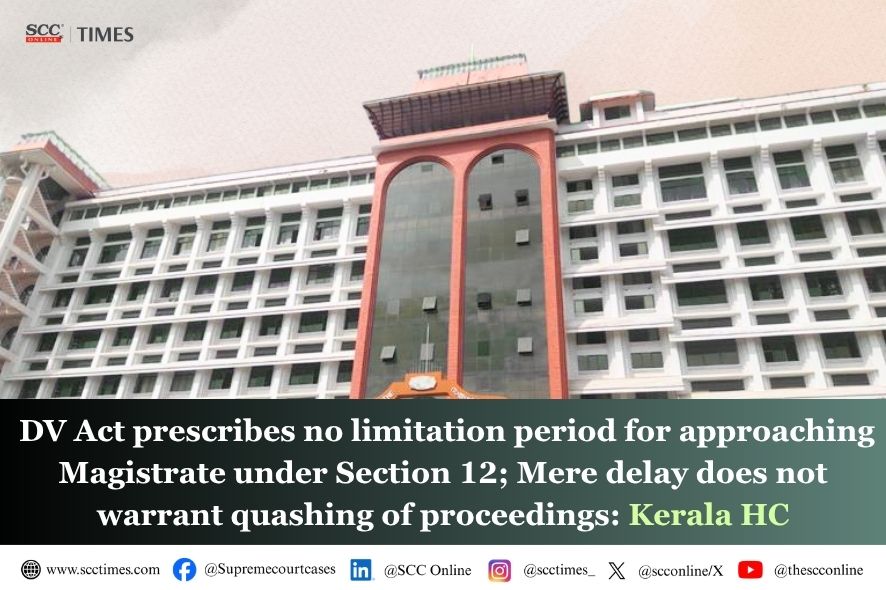
Kerala High Court: Kerala HC DV Act Limitation Period Not Applicable for Section 12
Summary
- The Kerala High Court has clarified that no specific limitation period exists for filing applications under Section 12 of the Domestic Violence Act.
- Proceedings initiated under the DV Act cannot be quashed solely on the grounds of delay in approaching the Magistrate.
- Disputed factual allegations in such cases must be resolved by the jurisdictional Magistrate through an evidence-based process.
- High Courts should not conduct a "mini trial" to determine facts when exercising inherent jurisdiction under Section 528 of the BNSS.
What Happened
The Kerala High Court has definitively stated that applications filed under Section 12 of the Domestic Violence Act are not subject to a specific limitation period, meaning mere delay cannot be the sole basis for dismissing such proceedings.
The Kerala High Court has recently issued a significant clarification regarding the procedural aspects of the Protection of Women from Domestic Violence Act (PWDVA), specifically concerning applications filed under Section 12. The court unequivocally stated that there is no prescribed limitation period for individuals to approach a Magistrate seeking relief under this section. This pivotal ruling means that the mere passage of time or any perceived delay in filing an application cannot, by itself, serve as a sufficient ground to quash the ensuing legal proceedings.
The Kerala HC DV Act limitation period was a point of contention, but the court underscored that any factual disputes arising from such applications must be thoroughly examined and adjudicated by the competent jurisdictional Magistrate, with decisions predicated solely on the evidence presented. This directive ensures that the substantive merits of a case take precedence over procedural timelines when considering applications under the Domestic Violence Act Section 12 delay.
Legal Context
Central to the Kerala High Court's determination is the nature of proceedings under Section 12 of the PWDVA, which allows an aggrieved person to seek various forms of relief from domestic violence. The court emphasized that when exercising its inherent jurisdiction, specifically under Section 528 of the Bharatiya Nagarik Suraksha Sanhita (BNSS), it is impermissible to conduct a "mini trial" to ascertain the veracity of disputed factual allegations. Instead, such matters are reserved for the jurisdictional Magistrate, who is tasked with evaluating all submitted evidence to arrive at a just conclusion.
This approach reinforces the legislative intent behind the Protection of Women from Domestic Violence Act limitation, ensuring that procedural technicalities, such as an alleged delay in filing, do not prematurely obstruct the substantive examination of domestic violence claims. The ruling effectively prevents the quashing of DV proceedings Kerala based on procedural delays, redirecting the focus to the merits of the case and the evidence presented before the Magistrate.
Why It Matters
This pronouncement by the Kerala High Court holds substantial implications for both victims of domestic violence and legal practitioners across the state. For those seeking protection and redress under the Domestic Violence Act, the ruling removes a significant potential barrier, assuring them that their applications under Section 12 will not be dismissed simply because of a delay in reporting or filing. This strengthens the position of applicants by ensuring their claims receive a full evidentiary hearing, regardless of the Magistrate DV Act application delay.
For lawyers, the decision mandates a shift in strategy; instead of relying on arguments centered around the Kerala High Court Section 12 PWDVA limitation period or application delay to quash proceedings, the emphasis must now firmly be on addressing the substantive merits and factual evidence of the case. This judicial clarity reinforces the principle that justice in domestic violence matters should not be derailed by procedural technicalities but must be grounded in a thorough assessment of the facts.
Practical Implications
This ruling clarifies that applications under Section 12 of the DV Act in Kerala cannot be dismissed solely due to delay, strengthening the position of applicants and requiring lawyers to focus on the substantive merits rather than procedural delays when defending or prosecuting such cases.
Source
Source: Original reporting via SCC Times
How does this affect you?
Get an AI analysis of this article grounded in your jurisdictions, practice areas, and any policy documents you've uploaded to Wansom.
Finish Reading the Full Story and the Expert Analysis.
Get the latest legal & regulatory intelligence in India
Wansom is AI and can make mistakes.