
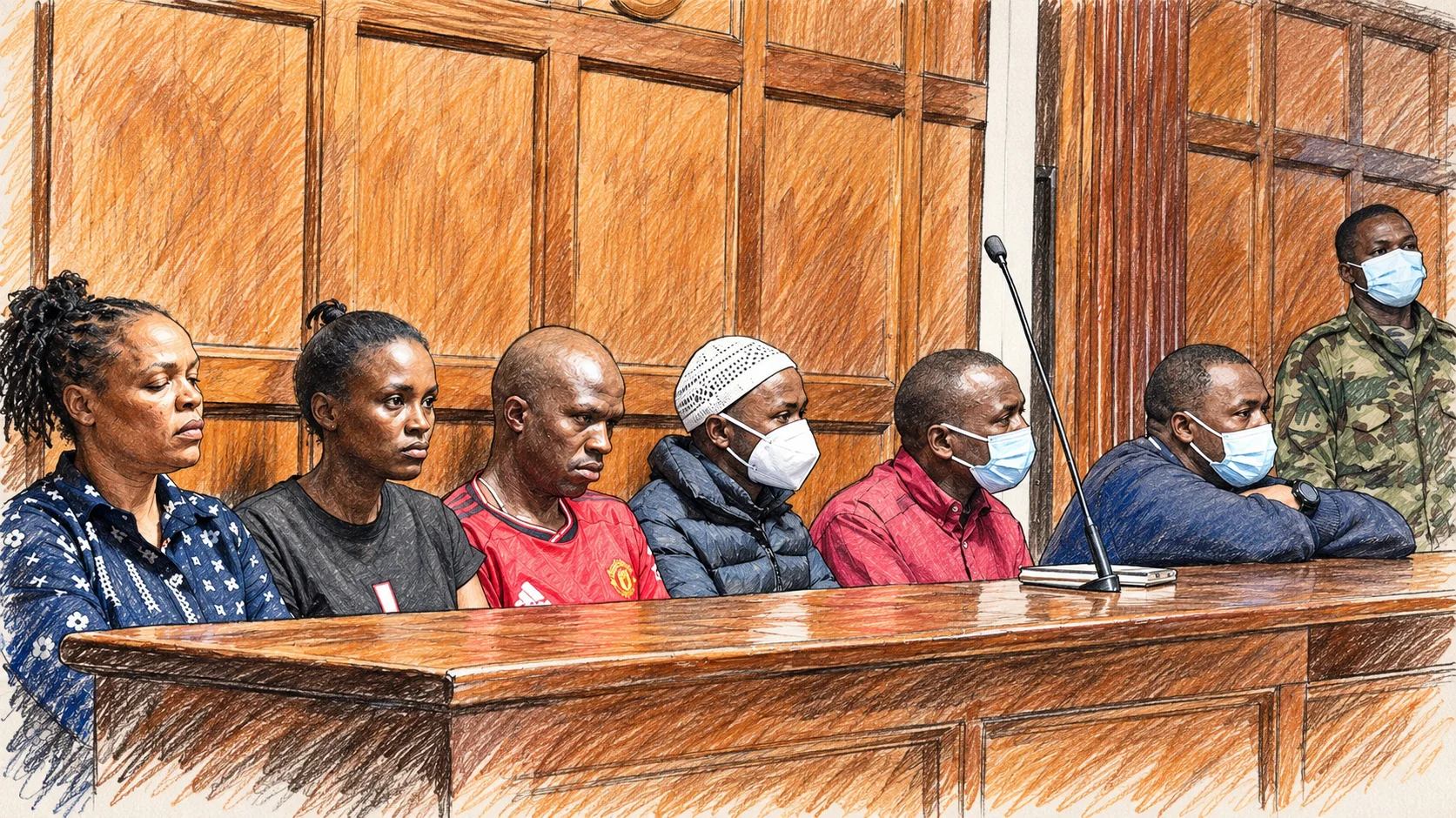
Kenya High Court Convicts George Muchai Murderers: Landmark Ruling
Summary
- Four men were convicted by the Kenya High Court on September 29 for the 2015 murders of former Kabete MP George Muchai and his three aides.
- The convicted individuals are Erick Munyera, Raphael Kimani, Mustafa Kimani, and Stephen Asitiva.
- This murder trial ran separately from a prior robbery-with-violence case where the same four men received death sentences in April for offenses linked to February 2015 incidents.
- Justice Kanyi Kimondo had earlier ruled that the prosecution presented sufficient evidence to require the four accused to mount a defense, while three others were acquitted.
- The High Court determined that the prosecution successfully proved the murder charges to the necessary legal standard, with sentencing proceedings now pending.
High Court Delivers Verdict in Muchai Murder Case
The High Court meticulously reviewed all submissions and ultimately concluded that the prosecution had successfully met the stringent legal threshold for proving the murder charges, leading to the convictions of the four individuals.
On September 29, the Kenya High Court delivered a landmark judgment, convicting four individuals for the 2015 murders of former Kabete Member of Parliament George Muchai and his three associates. This significant ruling brings a close to the murder trial that has been closely watched across the nation. The victims, who tragically lost their lives along Nairobi's Kenyatta Avenue in February 2015, included Muchai himself, his two police bodyguards, Constable Samuel Kimathi and Constable Samuel Lekakeny, and his driver, Stephen Ituu Wambugu.
The four men found guilty in this high-profile case are Erick Munyera, Raphael Kimani, Mustafa Kimani, and Stephen Asitiva. Each faced separate counts related to the deaths of the four victims. This conviction by the High Court marks a critical development in the pursuit of justice for the brutal killings that shocked the country nearly a decade ago, affirming the state's commitment to resolving complex criminal matters.
Dual Legal Battles and Prior Convictions
Notably, this murder conviction follows a separate but related legal process where the same four individuals had already faced judgment. Earlier this year, in April, Chief Magistrate Lucas Onyina presided over a distinct robbery-with-violence case, ultimately sentencing Munyera, Kimani, Mustafa Kimani, and Asitiva to death. This prior ruling stemmed from their involvement in a series of violent robberies and associated offenses that occurred on the nights of February 6 and 7, 2015.
The magistrates' court proceedings detailed incidents where victims were deprived of property valued at approximately Sh1.1 million, encompassing a range of items such as vehicles, mobile phones, a laptop, a gas cylinder, and cash. In that case, two other co-accused received ten-year prison sentences. Furthermore, firearms and ammunition presented as evidence in the robbery trial were ordered to be forfeited to the State, an order slated for implementation only after the conclusion of the separate High Court murder proceedings. This dual prosecution underscores the multifaceted nature of the criminal acts committed.
Evidentiary Scrutiny and Judicial Determination
The High Court's murder trial, which commenced with seven accused persons, involved an extensive judicial process. Justice Kanyi Kimondo, presiding over the case, made a pivotal ruling earlier in September 2025, determining that the prosecution had presented sufficient evidence to require four of the accused—Munyera, Kimani, Mustafa Kimani, and Asitiva—to be placed on their defense. Conversely, three other individuals initially implicated in the murder proceedings were released after the court found the evidence against them to be insufficient to warrant a response to the charges.
Throughout the High Court proceedings, the prosecution meticulously built its case, calling 37 witnesses to testify. The defense, in turn, vigorously challenged the evidence presented and consistently denied the allegations leveled against the accused. In its recent judgment, the High Court meticulously reviewed all submissions and ultimately concluded that the prosecution had successfully met the stringent legal threshold for proving the murder charges, leading to the convictions of the four individuals. The court is now poised to move to the sentencing phase, where the final penalties for these grave offenses will be determined.
Practical Implications
This High Court conviction provides a contemporary example of the evidentiary standards and procedural handling for complex murder cases in Kenya, particularly noting the distinct prosecution of related robbery with violence charges. Criminal lawyers may find this case relevant for understanding judicial expectations in similar high-profile matters.
Source
How does this affect you?
Get an AI analysis of this article grounded in your jurisdictions, practice areas, and any policy documents you've uploaded to Wansom.
Finish Reading the Full Story and the Expert Analysis.
Get the latest legal & regulatory intelligence in Kenya
Wansom is AI and can make mistakes.