
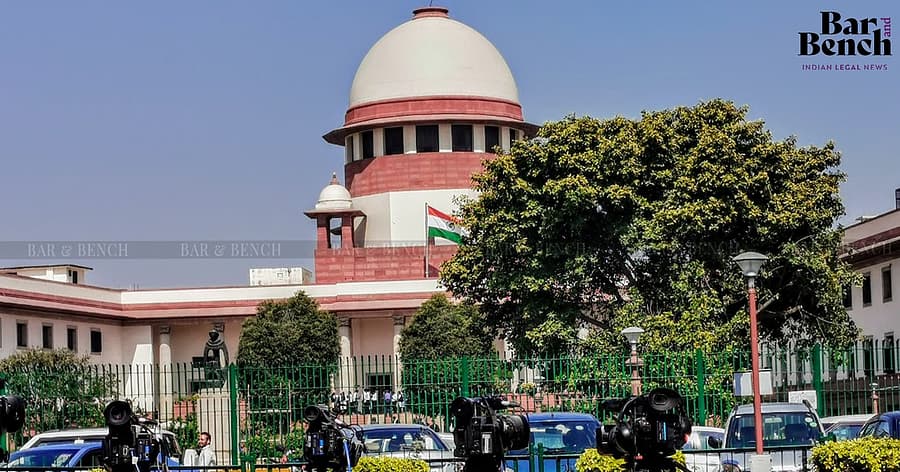
Supreme Court: Jharkhand DGP Appointment Rules Conflict Prakash Singh Guidelines
Summary
- The Supreme Court observed that Jharkhand's DGP appointment regulations appear to conflict with the Prakash Singh v. Union of India guidelines.
- The Central government challenged the Selection and Appointment of Director General and Inspector General of Police, Jharkhand (Head of Police Force) Regulations, 2025 and related appointments.
- The core issue is the Jharkhand regulations permitting officers with less than six months until retirement to be appointed as DGP.
- The Supreme Court's March 2019 order in the Prakash Singh case mandated that only officers with at least six months of service remaining should be recommended for DGP.
- The appointment of incumbent Jharkhand DGP Tadasha Mishra, who was appointed a day before her retirement, was flagged as a violation of this rule.
Recent Supreme Court Observations
The Court's recent statement indicates that such an appointment appears to be at odds with the Prakash Singh ruling, underscoring the judiciary's concern over adherence to its directives regarding senior police leadership roles.
The Supreme Court recently highlighted a potential conflict between Jharkhand's regulations for appointing its Director General of Police (DGP) and the established judicial guidelines from the landmark Prakash Singh v. Union of India case. A bench comprising Chief Justice of India Surya Kant, Justice Joymalya Bagchi, and Justice V Mohana made this significant observation on Thursday while reviewing an application submitted by the Central government. This application specifically challenged the Selection and Appointment of Director General and Inspector General of Police, Jharkhand (Head of Police Force) Regulations, 2025, alongside all appointments made under these new rules.
At the heart of the Central government's contention is a provision within the Jharkhand regulations that permits police officers with less than six months remaining until their retirement to be considered for the DGP position. This directly contravenes a crucial directive issued by the apex court in 2019, which mandates a minimum service period. The Centre specifically pointed to the appointment of the current Jharkhand DGP, Tadasha Mishra, as an instance where this principle was allegedly violated.
Ms. Mishra was appointed to the top police post for a two-year term just one day before her scheduled retirement from service. The Court's recent statement indicates that such an appointment appears to be at odds with the Prakash Singh ruling, underscoring the judiciary's concern over adherence to its directives regarding senior police leadership roles. The Jharkhand DGP appointment Prakash Singh conflict thus centers on this critical service tenure requirement.
The Prakash Singh Mandate
The Prakash Singh v. Union of India judgment, a pivotal ruling on Supreme Court India police reforms, laid down comprehensive guidelines aimed at insulating police forces from undue political influence and ensuring professional leadership. A key clarification arising from this case came in March 2019, when the Supreme Court explicitly stated that only officers possessing at least six months of service remaining prior to their retirement should be recommended for the Director General of Police position. This DGP six months service rule was designed to ensure stability and continuity in the leadership of state police forces, preventing short-term appointments that could undermine long-term strategic planning and operational effectiveness.
The Central government's challenge to the Jharkhand DGP Regulations 2025 stems directly from this established precedent. By allowing officers nearing retirement to be appointed, the state's regulations appear to bypass the spirit and letter of the Supreme Court's directive. This discrepancy forms the core of the legal dispute, questioning whether state-level rules can supersede or dilute national judicial mandates concerning critical public service appointments. The court's consistent emphasis on these guidelines reflects a broader commitment to systemic improvements in police administration across the country.
Implications for State Governance
The Supreme Court's observation carries significant weight, signaling a continued judicial scrutiny over appointments to key public offices, particularly within law enforcement. The Jharkhand DGP appointment Prakash Singh conflict highlights the imperative for state governments to align their internal regulations with directives issued by the highest court. Failure to do so not only invites legal challenges, as seen with the Central government's application, but also risks undermining the integrity and independence of institutions like the police force.
This situation underscores the importance of strict adherence to established judicial precedents, especially those aimed at systemic reforms. The case involving Tadasha Mishra DGP appointment serves as a concrete example of how specific appointments can come under judicial scanner if they do not conform to the DGP six months service rule. The Supreme Court's firm stance reinforces the principle that its judgments, particularly those concerning national public interest and good governance, must be respected and implemented without deviation by all state authorities.
Practical Implications
Lawyers advising state governments or police departments must note the Supreme Court's reaffirmation of the Prakash Singh guidelines, particularly the 'six months service remaining' rule for DGP appointments. This ongoing scrutiny highlights the need for strict compliance to avoid legal challenges to appointments and ensure adherence to established judicial precedents in public service roles.
Source
How does this affect you?
Get an AI analysis of this article grounded in your jurisdictions, practice areas, and any policy documents you've uploaded to Wansom.
Finish Reading the Full Story and the Expert Analysis.
Get the latest legal & regulatory intelligence in India
Wansom is AI and can make mistakes.