
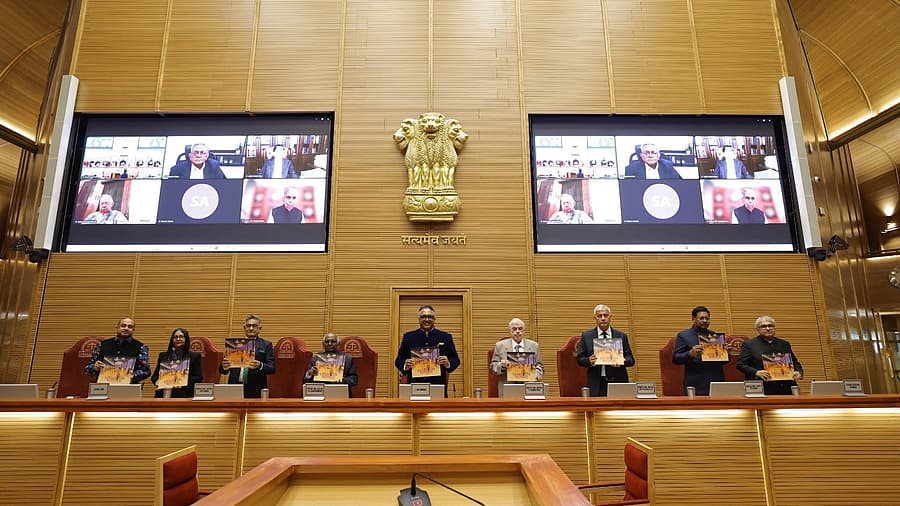
JGU Opens India's First CJI Museum: Honoring Judicial Legacy
Summary
- India's first Chief Justices of India Museum was inaugurated at OP Jindal Global University on the eve of Constitution Day.
- Ten former Chief Justices of India attended the inauguration, either in person or virtually.
- The museum, envisioned as "Guardians of the Republic," features five galleries with over 280 judge busts, 25 High Court models, and 20 defining judgments.
- Interactive elements include biographical pillars, language tapestries, and a holographic courtroom.
- Naveen Jindal, JGU's Founding Chancellor, highlighted the museum's role in honoring the Supreme Court's guardianship of constitutional values.
A Landmark Inauguration
He stated that the Constitution is not merely an abstract document but a vibrant, living promise, continuously upheld and invigorated by an independent judiciary.
On the eve of Constitution Day, a significant event unfolded at OP Jindal Global University (JGU) with the official opening of the nation's inaugural Chief Justices of India Museum. This pioneering institution, conceived as the "Guardians of the Republic," marks a pivotal moment in preserving and presenting the rich legacy of India's judiciary. The ceremony itself was graced by the presence of ten distinguished former Chief Justices of India, who participated either in person or through virtual means, underscoring the importance of this new cultural and educational landmark. Their collective attendance highlighted the museum's role in honoring the individuals who have shaped the country's legal landscape.
Among the eminent jurists who joined the inauguration were MN Venkatachaliah, BN Kirpal, S Rajendra Babu, KG Balakrishnan, P Sathasivam, RM Lodha, Dipak Misra, SA Bobde, UU Lalit, and BR Gavai. Their presence lent considerable weight to the occasion, signifying a collective endorsement of the museum's mission to chronicle the contributions of India's highest judicial office. The establishment of this facility at JGU provides a dedicated space to explore the evolution of justice within the nation, connecting historical legal decisions with their profound impact on society and individual liberties.
Exploring Judicial Heritage
The Chief Justices of India Museum at JGU is meticulously designed to immerse visitors in the country's judicial narrative, blending historical accounts with contemporary interpretive methods. Spanning five distinct galleries, the museum offers a comprehensive journey through the annals of Indian legal history. It houses an impressive collection of over 280 busts, each representing a judge of the Supreme Court, alongside detailed models of 25 High Courts from across the country. These exhibits provide a tangible connection to the institutions and individuals that form the bedrock of India's legal system.
Further enhancing the visitor experience, the museum incorporates 22 tapestries depicting various languages, 20 interactive biographical pillars that delve into the lives of key legal figures, and presentations on 20 seminal judgments that have defined the nation's legal trajectory. A unique holographic courtroom offers an innovative way to engage with judicial proceedings, while an extensive array of artworks, sculptures, and installations contribute to a multi-sensory exploration of justice. The museum's approach is to foster a dialogue between judicial history, artistic expression, technological innovation, and personal narratives, illustrating how the pursuit of justice influences both individual lives and the broader destiny of the nation.
Upholding Constitutional Values
Naveen Jindal, the Founding Chancellor of OP Jindal Global University, articulated the profound significance of the new museum during its inauguration. He emphasized that the Constitution of India serves as the unwavering bedrock of the Republic, embodying fundamental principles such as justice, liberty, equality, and fraternity. Jindal highlighted that this new museum, dedicated to the Chief Justices, expands upon the vision of the existing Constitution Museum by specifically acknowledging the Supreme Court's crucial role in safeguarding these core constitutional values. His remarks underscored the judiciary's indispensable function in upholding the democratic framework.
Reflecting on his personal journey, particularly his efforts to secure every citizen's right to display the national flag, Jindal shared a powerful insight. He stated that the Constitution is not merely an abstract document but a vibrant, living promise, continuously upheld and invigorated by an independent judiciary. This perspective reinforces the idea that the museum is not just a repository of historical artifacts but a testament to the ongoing vitality of India's constitutional principles and the dedicated individuals who have served to protect them. The museum, therefore, stands as a beacon celebrating the enduring strength and independence of the Indian judicial system.
Practical Implications
This article reports on the inauguration of a museum dedicated to the Chief Justices of India. While it provides valuable insight into the history and legacy of the Indian judiciary, it does not present any direct actionable legal or compliance implications for lawyers or compliance officers.
Source
How does this affect you?
Get an AI analysis of this article grounded in your jurisdictions, practice areas, and any policy documents you've uploaded to Wansom.
Finish Reading the Full Story and the Expert Analysis.
Get the latest legal & regulatory intelligence in India
Wansom is AI and can make mistakes.