
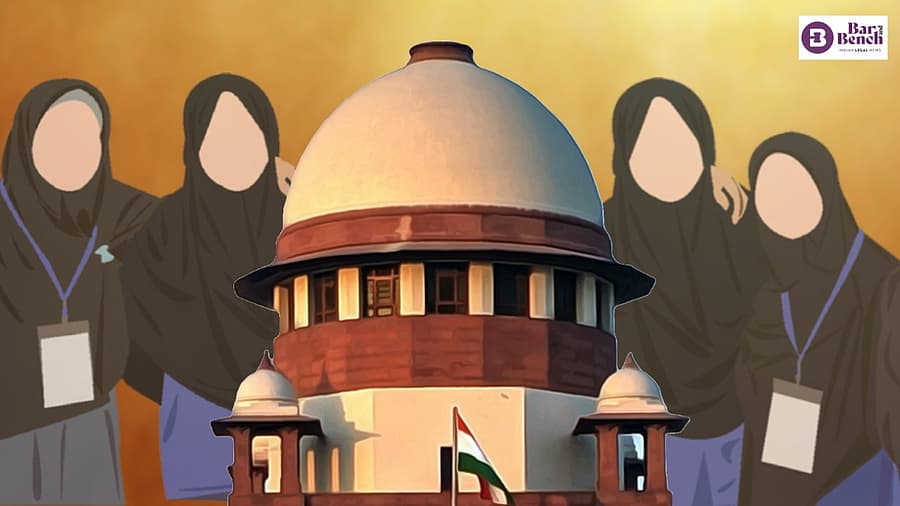
Supreme Court: Allahabad Hijab Ruling Not Precedent, Tagged With Karnataka
Summary
- The Supreme Court has declared that the Allahabad High Court's August 21 judgment upholding a school's hijab ban is not to be considered a precedent.
- This ruling was made by Justices Aravind Kumar and Vipul M Pancholi while issuing notice on an appeal against the High Court's decision.
- The Supreme Court has tagged this case, Muslim Womens Study Circle vs. State of Uttar Pradesh & Ors., with the pending appeals from the Karnataka hijab ban case.
- The Allahabad High Court had previously ruled that wearing a hijab is not an essential religious practice in Islam.
- The High Court's decision stemmed from a student, Sukaina Rizvi, being denied Class XI admission at Tagore Public School for wearing a headscarf.
What Happened
The Supreme Court's explicit instruction that the Allahabad High Court's judgment is not to be treated as a precedent carries significant weight for legal practitioners and educational institutions alike.
The Supreme Court of India recently clarified that a judgment issued by the Allahabad High Court on August 21, which affirmed a school's prohibition on wearing a hijab in classrooms, should not be considered a binding precedent. This directive came from a bench comprising Justices Aravind Kumar and Vipul M Pancholi while they were issuing notice to the State of Uttar Pradesh concerning an appeal challenging the High Court's verdict. The apex court's order, dated November 20, explicitly stated, "Permission to file the petition is granted. Issue notice. Tag with Civil Appeal No. 7095/2022 and this judgment shall not be treated as precedent."
The Supreme Court further decided to consolidate this matter, identified as Muslim Womens Study Circle vs. State of Uttar Pradesh & Ors., with a series of ongoing appeals. These appeals originate from the contentious Karnataka hijab ban case, which has been a subject of significant legal debate across the country. By tagging these cases, the Supreme Court signals its intent to address the broader legal questions surrounding the wearing of headscarves in educational institutions.
The High Court's Ruling
The appeal brought before the Supreme Court directly contested the Allahabad High Court's August 21 decision. In that ruling, a Division Bench of the Allahabad High Court, consisting of Justices JJ Munir and Indrajeet Shukla, had upheld a school's policy banning headscarves within its classrooms. A central tenet of the High Court's judgment was its determination that the wearing of a hijab does not constitute an essential religious practice within Islam.
This specific High Court ruling arose from a petition filed by Sukaina Rizvi, a Muslim student. Ms. Rizvi had sought judicial intervention to permit her to wear a headscarf alongside the prescribed uniform at Tagore Public School, located in Attarsuiya, Prayagraj. She had maintained that she had worn a headscarf since her enrollment in Class VI at the institution. However, she was subsequently denied admission to Class XI on the grounds of her continued adherence to wearing the headscarf, leading to her legal challenge.
Legal Implications
The Supreme Court's explicit instruction that the Allahabad High Court's judgment is not to be treated as a precedent carries significant weight for legal practitioners and educational institutions alike. This directive effectively prevents the Allahabad High Court's ruling, which found the hijab not to be an essential religious practice, from being cited as a definitive legal authority in other similar cases across India. It underscores that the legal position regarding the wearing of headscarves in schools remains unsettled at the highest judicial level.
By tagging the appeal with the ongoing Karnataka hijab case, the Supreme Court indicates that it intends to provide a comprehensive and authoritative resolution to the complex constitutional questions surrounding religious attire in educational settings. Lawyers involved in such cases are thus advised that arguments must focus on the broader constitutional principles and the essential religious practice doctrine, rather than relying on the specific findings of the Allahabad High Court. The ultimate determination from the Supreme Court will shape the future legal landscape on this sensitive issue.
Practical Implications
Lawyers should note that the Allahabad High Court's decision upholding a school's hijab ban cannot be cited as binding precedent in other cases. This indicates the legal position on hijab in schools remains unsettled pending the Supreme Court's final determination, particularly in light of the tagged Karnataka hijab ban appeals. Therefore, arguments must focus on the broader constitutional questions rather than relying on this specific High Court ruling.
Source
How does this affect you?
Get an AI analysis of this article grounded in your jurisdictions, practice areas, and any policy documents you've uploaded to Wansom.
Finish Reading the Full Story and the Expert Analysis.
Get the latest legal & regulatory intelligence in India
Wansom is AI and can make mistakes.