
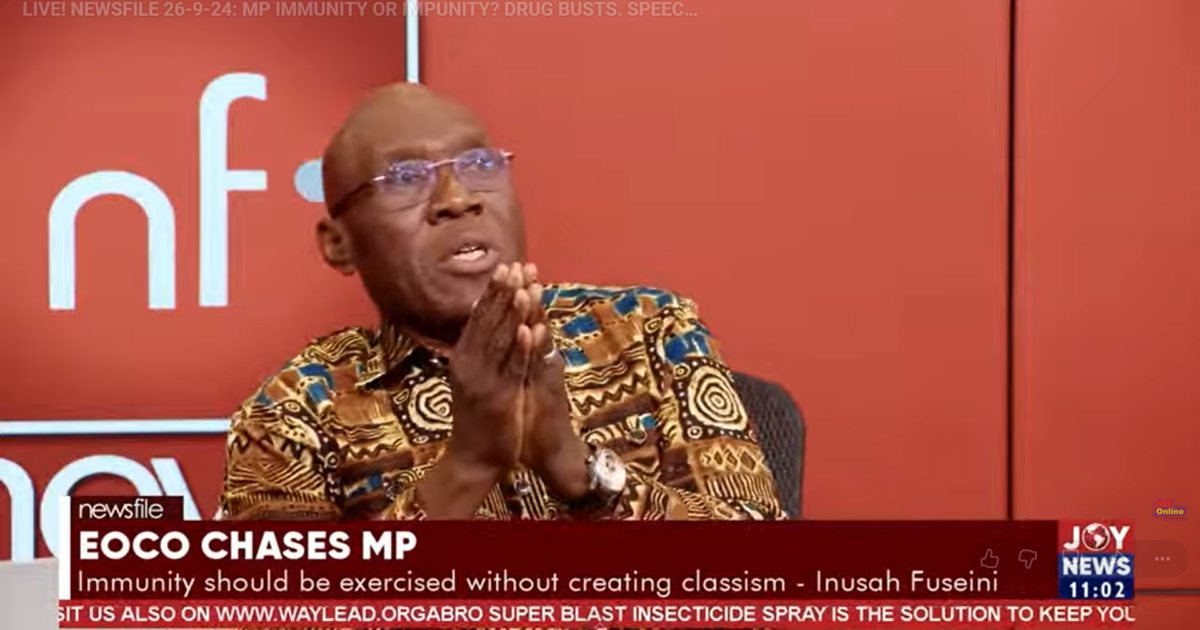
Inusah Fuseini: EOCO Act Lacuna Section 41 Needs Constitutional Cure
Summary
- Former MP Inusah Fuseini questioned the legal basis for compelling attendance at the Economic and Organised Crime Office (EOCO) if an invitation is refused.
- His concerns arose after a confrontation between Manhyia South MP Nana Agyei Baffour Awuah and EOCO personnel at the Accra High Court on September 23.
- Fuseini highlighted a `lacuna` in Section 19 of the EOCO Act, 2010 (Act 804), which grants EOCO invitation powers but lacks explicit enforcement for refusal.
- He specifically asked if Section 41 of the Constitution could be used to address this gap in the law.
- Despite his legal questions, Fuseini agreed with EOCO's interpretation of parliamentary rules and stated that an EOCO letter is not a court process.
The Incident and Initial Concerns
He therefore posed a pivotal question: could Section 41 of the Constitution be invoked to cure this perceived legal gap, thereby providing a mechanism to enforce attendance?
The confrontation involving Manhyia South Member of Parliament, Nana Agyei Baffour Awuah, and personnel from the Economic and Organised Crime Office (EOCO) at the Accra High Court on Wednesday, September 23, has ignited a significant public debate. This incident prompted former Tamale Central MP Inusah Fuseini to voice his concerns on JoyNews’ Newsfile, where he described the legal issues arising from the encounter as "disturbing" and deserving of thorough examination.
Mr. Fuseini specifically questioned the underlying legal authority for compelling an individual to appear before the Economic and Organised Crime Office when an initial invitation for investigative questioning has been declined.
The Legal Lacuna in EOCO's Powers
Central to Mr. Fuseini's analysis is Section 19 of the Economic and Organised Crime Office Act, 2010 (Act 804), which explicitly grants the EOCO Executive Director the power to invite or require a person to present themselves for investigative purposes. However, Fuseini identified a critical `lacuna` within the `EOCO Act` itself: it does not clearly stipulate the course of action when an individual refuses to honor such an invitation.
He therefore posed a pivotal question: could `Section 41` of the Constitution be invoked to `cure` this perceived legal gap, thereby providing a mechanism to enforce attendance? This inquiry highlights a key aspect of `Ghana constitutional law Section 41` in relation to `Ghana investigative powers legal limits` and the `EOCO Act 804 Section 19 powers`.
Fuseini's Agreement Amidst Legal Scrutiny
Despite his probing legal questions regarding the `Inusah Fuseini EOCO Act lacuna Section 41` interplay, Mr. Fuseini also expressed areas of agreement with EOCO's position. He stated his concurrence with the agency's interpretation of Parliament’s Standing Orders, established practices, conventions, and the relevant legal framework.
Furthermore, he clarified that a communication from EOCO requesting an individual's attendance should not be equated with a court process, as it does not originate from a judicial body. Recalling the `Nana Agyei Baffour Awuah EOCO confrontation`, Fuseini also offered his interpretation of the initial video footage, suggesting that the EOCO security personnel were attempting to explain to the Member of Parliament why his presence was required at the agency.
Broader Implications for Ghana's Investigative Framework
The `Ghana EOCO compel attendance MP` incident and the subsequent commentary by `Inusah Fuseini` have sparked a wider national discussion concerning the `Ghana investigative powers legal limits`, particularly those exercised by the Economic and Organised Crime Office. This ongoing debate encompasses the appropriate procedures for issuing EOCO invitations and the delicate balance between the agency's statutory authority and the established parliamentary rules and privileges.
The fundamental questions raised by Fuseini underscore the necessity for greater clarity regarding the precise scope and enforcement mechanisms of the `EOCO Act 804 Section 19 powers`, especially when individuals, including Members of Parliament, opt not to comply with an invitation for questioning. The article, published on September 26, 2026, reflects the timeliness of these legal considerations.
Practical Implications
This debate highlights a critical ambiguity in EOCO's power to compel attendance, requiring lawyers to carefully assess the legal basis for EOCO invitations and advise clients on their rights and obligations under Act 804. Practitioners should monitor for legislative amendments or judicial rulings that clarify the interplay between Section 19 of the EOCO Act and constitutional provisions regarding compelling testimony.
Source
How does this affect you?
Get an AI analysis of this article grounded in your jurisdictions, practice areas, and any policy documents you've uploaded to Wansom.
Finish Reading the Full Story and the Expert Analysis.
Get the latest legal & regulatory intelligence in Ghana
Wansom is AI and can make mistakes.