
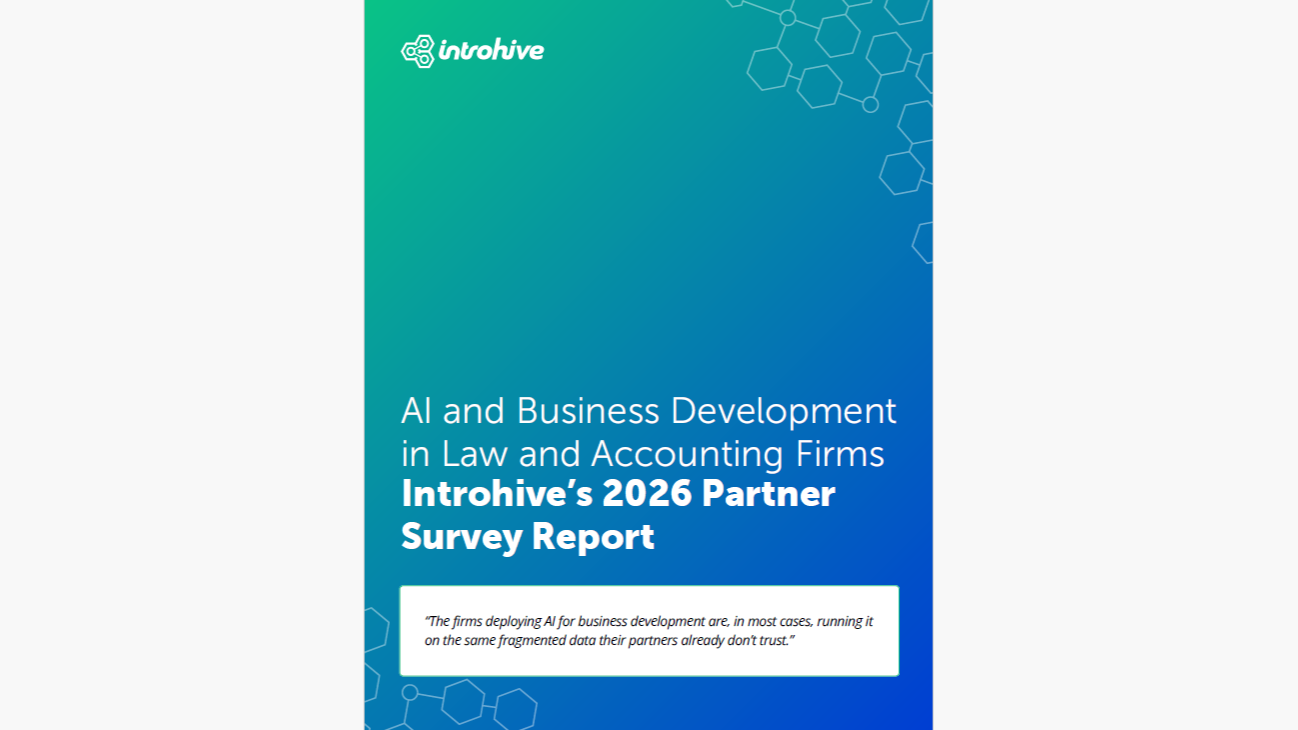
Introhive Survey: Law Firm AI Business Development Lacks Data
Summary
- A recent Introhive survey found that 78% of law and accounting firm partners struggle to act on their firms' relationship data, despite wanting AI to help find new business.
- Most partners using AI for business development rely on general-purpose chatbots that cannot access proprietary firm data.
- Only 22% of firms have a fully developed AI strategy, even though 51% believe strategy is the biggest driver of AI ROI.
- 57% of firms are in the early stages of business development maturity, yet 84% expect to reach advanced stages within two years.
- Partners most desire AI capabilities for surfacing new business opportunities and identifying cross-sell potential.
What the Survey Revealed
Blakemore described a 'frantic pace' of AI deployment, suggesting that while significant investment and progress in implementation have occurred, substantial work remains to ensure these tools genuinely add value and transform traditional work processes.
The Introhive survey, conducted by strategy firm Thinktiv, highlights a significant disconnect in the legal and accounting sectors regarding artificial intelligence (AI) in business development. Partners across these professional services firms express a primary desire for technology that can assist in identifying new business opportunities within their existing client relationships. However, a substantial 78% of these partners report that their firms' current relationship data is challenging to leverage effectively for such purposes.
This challenge is compounded by the prevalent use of general-purpose AI tools. The report indicates that most partners currently employing AI for business development rely on generic chatbots, which inherently lack the capability to access or analyze a firm's proprietary law firm relationship intelligence data. Lee Blakemore, CEO of Introhive, commented on this situation, noting that partners are tasked with expanding their client base using AI, yet often do so with tools that cannot interact with their firm's crucial relationship information. The survey gathered insights from 123 partners, with 42 responses specifically from legal services, 42 from accounting, and 39 from other professional service sectors.
The State of AI Adoption in Legal Business Development
Blakemore expressed mixed emotions regarding the survey's findings, observing a widespread perception that firms are more advanced in their AI adoption than they truly are. He described a 'frantic pace' of AI deployment, suggesting that while significant investment and progress in implementation have occurred, substantial work remains to ensure these tools genuinely add value and transform traditional work processes. The report categorizes firms into four stages of business development maturity: basic data hygiene (Stage 1), relationship visibility (Stage 2), structured BD programs (Stage 3), and AI-driven BD (Stage 4). A majority of the surveyed partners, 57%, indicated their firms are currently situated in the initial two stages.
Despite this foundational gap, there is a strong forward-looking expectation. An overwhelming 84% of partners anticipate their firms will advance to Stage 3 or 4 within the next 18 to 24 months. The number of respondents expecting to engage in AI-driven business development (Stage 4) is projected to increase fivefold, from eight to 40. However, Blakemore cautioned that while he wouldn't underestimate large law firms, the landscape of legal tech AI client acquisition is a continually evolving target, likening it to a 'land grab' where new challenges emerge as soon as current goals are met.
Why It Matters for Client Acquisition
The current reliance on generic AI tools is evident, with 68% of partners already utilizing AI for business development exclusively employing general-purpose options like ChatGPT, Copilot, or Gemini. Their satisfaction with these tools averages 6.7 out of 10. Furthermore, only 22% of firms report having a fully developed and implemented AI strategy, even though 51% of partners identify a clear strategy as the primary driver for AI return on investment. This highlights a critical need for a more tailored AI strategy legal business development.
When asked about the most desired weekly business development capability, 47% of partners prioritized surfacing new business opportunities. Other key capabilities included who-knows-whom mapping (24%) and automated data capture (17%). Combining firm-wide information was most valued for identifying cross-sell opportunities (54%), generating alerts for at-risk relationships (49%), and enhancing relationship mapping (46%), with credit attribution ranking last at 15%. The primary sources of friction in business development were identified as knowing where to focus BD time (50%), allocating sufficient time for BD activities (45%), and effectively identifying cross-sell opportunities (43%). The overall difficulty of business development was rated at 3.4 out of 5, underscoring the striking contrast, as noted by Lee Blakemore, between what partners AI tools new business aim to achieve and the practical limitations imposed by their current data infrastructure.
Practical Implications
Law firm leaders and partners should recognize that despite high expectations for AI in business development, most firms lack the foundational data infrastructure and strategic implementation necessary for effective use. This implies a need to prioritize data hygiene and develop a bespoke AI strategy beyond generic chatbots to truly leverage AI for client acquisition and cross-selling, rather than rushing into deployments that may not yield desired results.
Source
How does this affect you?
Get an AI analysis of this article grounded in your jurisdictions, practice areas, and any policy documents you've uploaded to Wansom.
Finish Reading the Full Story and the Expert Analysis.
Get the latest legal & regulatory intelligence in United States
Wansom is AI and can make mistakes.