
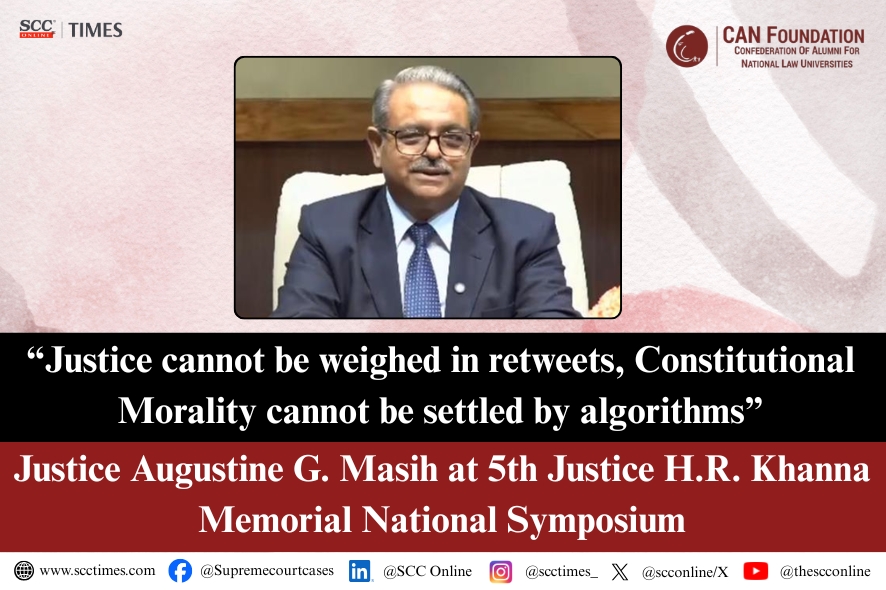
Supreme Court of India: Justice Masih Warns on Social Media Impact
Summary
- Justice Augustine G. Masih, a Judge of the Supreme Court of India, spoke at the 5th Justice H.R. Khanna Memorial National Symposium, addressing judicial independence and social media influence.
- The intersection of judicial independence and social media has become a pressing concern for Indian courts.
- Justice Masih emphasized that constitutional morality cannot be settled by algorithms.
What Happened
Justice cannot be weighed in retweets, Constitutional Morality cannot be settled by algorithms
Justice Augustine G. Masih, a Judge of the Supreme Court of India, recently spoke at the 5th Justice H.R. Khanna Memorial National Symposium, a prestigious event organized by the CAN Foundation. The symposium aimed to explore and celebrate Justice Khanna's enduring constitutional legacy. During his address, Justice Masih delved into the challenges facing judicial independence in an era dominated by social media, artificial intelligence, and digital visibility.
Relevant Legal/Regulatory Context
The intersection of judicial independence and social media influence has become a pressing concern for Indian courts. As Justice Masih noted, the increasing reliance on algorithms to settle constitutional morality raises questions about the role of judges in interpreting the law. This shift is particularly relevant given India's growing digital landscape and the expanding reach of social media platforms.
Why It Matters
Justice Masih's remarks at the symposium underscored the need for Indian courts to navigate the complexities of social media influence on judicial independence. As lawyers, it is essential to monitor these developments and consider their potential implications for clients' cases involving similar issues. The precedents set by Indian courts in this area may have far-reaching consequences for the judiciary's ability to uphold constitutional morality.
Practical Implications
Lawyers should watch for potential precedents set by Indian courts addressing the intersection of judicial independence and social media influence, which may inform their own clients' cases involving similar issues.
Source
Source: Original reporting via SCC Times
How does this affect your business?
Get an AI analysis of this article grounded in your jurisdictions, practice areas, and any policy documents you've uploaded to Wansom.
Wansom is AI and can make mistakes.