
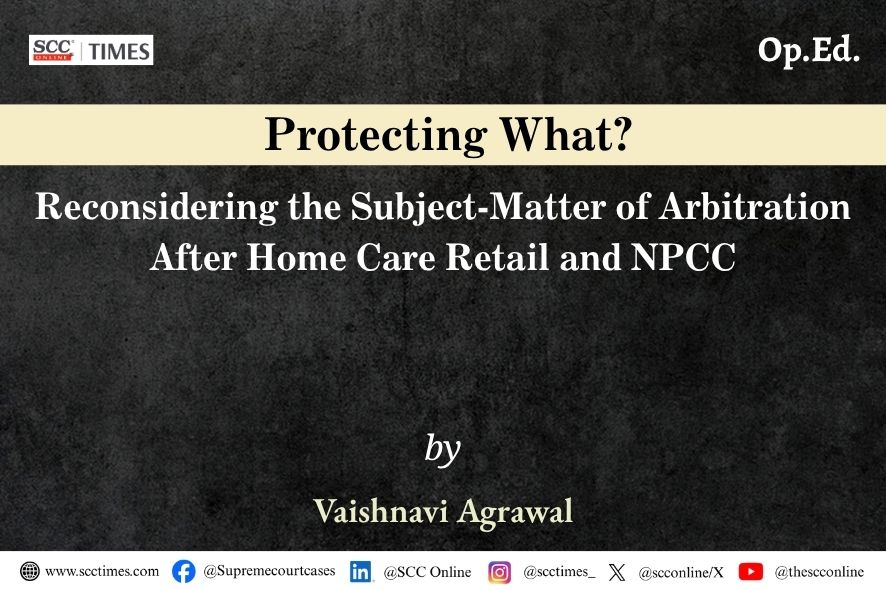
India Supreme Court: Broadens Section 9 Post-Award Relief Scope
Summary
- The Indian Supreme Court has significantly altered the scope of `Section 9 post-award relief` under the `Arbitration and Conciliation Act 1996`.
- In `Home Care Retail Marts v Haresh N Sanghavi`, the Court ruled that an `unsuccessful party` in arbitration is not automatically barred from seeking `interim measures arbitration India`.
- This decision overturned a decade-long practice that limited `post-award interim relief` to successful parties seeking to protect the 'fruits of the award'.
- The subsequent `NPCC Ltd v Ishvakoo India` case reinforced this new interpretation, requiring an award-holder to deposit funds pending a Section 34 challenge.
- Section 9 relief is now available when a specific, identifiable interest remains genuinely undetermined during the challenge to an arbitral award.
A Landmark Shift in Post-Award Relief
Lawyers and compliance officers must now advise clients that even an unsuccessful party in arbitration can seek interim relief under `Section 9` post-award, particularly if a specific, identifiable interest remains undetermined pending a `Section 34` challenge.
The Indian Supreme Court has recently introduced a significant change to the interpretation of `Section 9` of the `Arbitration and Conciliation Act 1996`, specifically concerning `post-award interim relief`. This development overturns a decade of established legal practice, broadening the scope of who can seek protective measures after an arbitral award has been rendered. The previous understanding limited such relief almost exclusively to the party that had successfully obtained an award, viewing `interim measures arbitration India` as a mechanism solely to safeguard the benefits of a favorable outcome.
This long-standing position was rooted in the 2013 Bombay High Court decision in `Dirk India (P) Ltd. v. Maharashtra State Electricity Generation Co. Ltd.`, which held that `Section 9` existed to protect the 'fruits of a successful conclusion' of arbitration. This perspective meant that a party whose claims were rejected could not logically seek enforcement. The Delhi High Court echoed this sentiment in `Nussli Switzerland Ltd. v. Organizing Committee Commonwealth Games`, and even the Supreme Court itself had previously cited this 'fruits of the proceedings' language without disapproval in `Hindustan Construction Co. Ltd. v. Union of India`. Consequently, `Section 9` was largely perceived as an enforcement aid, preventing debtors from rendering a creditor's award worthless before execution.
Redefining Eligibility: Home Care Retail and NPCC
The pivotal shift occurred on April 24, 2026, with the Supreme Court's ruling in `Home Care Retail Marts (P) Ltd. v. Haresh N. Sanghavi`. This landmark decision challenged the entrenched assumption, asserting that the statute's language, which refers to the 'subject-matter of arbitration' and the 'amount in dispute,' is broader than merely a single party's enforceable claim. Crucially, the Court determined that an `unsuccessful party` is not, by virtue of their lack of an enforceable award, automatically precluded from seeking `Section 9` relief.
Just weeks later, on August 11, 2026, the Supreme Court reinforced this new interpretation in `NPCC Ltd. v. Ishvakoo (India) (P) Ltd.`. In this case, the Court reiterated and applied the principles from `Home Care Retail`, upholding a High Court order that mandated an award-holder to deposit Rs 3.5 crores into court. This deposit was required pending a `Section 34` challenge initiated by the very party whose claims had been dismissed by the arbitrator. These two rulings, read together, unequivocally establish that the distinction between 'successful' and 'unsuccessful' parties no longer dictates eligibility to approach a court for `post-award interim relief unsuccessful party` under `Section 9`.
What 'Subject Matter' Now Protects
While `Home Care Retail` and `NPCC Ltd v Ishvakoo India` clarified *who* can seek `interim measures arbitration India`, they left open a crucial subsequent question: *what* precisely does `Section 9` protect once an arbitral award is in existence? The Court's analysis in `Home Care Retail Marts v Haresh N Sanghavi` rejected the narrow 'fruits of the award' interpretation on textual grounds, highlighting that `Section 9(1)(ii)` of the `Arbitration and Conciliation Act 1996` empowers courts to secure the 'amount in dispute' or protect the 'subject-matter of arbitration,' without mentioning 'fruits' at all. This broader language suggests a wider array of interests can be safeguarded.
The Supreme Court itself alluded to several categories of protectable interests, including revived contractual rights, the preservation of the status quo, confidentiality, and severable portions of an award. Synthesizing the implications of both `Home Care Retail` and `NPCC Ltd v Ishvakoo India`, the practical reality for legal professionals is that `Section 9 post-award relief` should be granted where a specific, identifiable interest remains genuinely undetermined or at risk, pending the outcome of a `Section 34` challenge to the arbitral award. This nuanced approach moves beyond a simple 'winner-takes-all' framework for interim protection.
Strategic Implications for Legal Practitioners
The Supreme Court's decisions in `Home Care Retail Marts v Haresh N Sanghavi` and `NPCC Ltd v Ishvakoo India` necessitate a fundamental re-evaluation of arbitration strategies in India. Lawyers and compliance officers must now advise clients that even an unsuccessful party in arbitration can seek interim relief under `Section 9` post-award, particularly if a specific, identifiable interest remains undetermined pending a `Section 34` challenge. This shifts strategic considerations for protecting assets or interests during the award challenge phase, requiring a re-evaluation of previous assumptions regarding who can access such relief.
The expanded scope means that parties who previously believed they had no recourse for interim protection after an adverse award now have a potential avenue to safeguard certain interests. Conversely, award-holders must now be prepared for the possibility that even a losing party might successfully petition the court for protective measures, potentially impacting the immediate enforceability or security of their award. This development underscores the evolving nature of `arbitration and conciliation act 1996 section 9` and its application in the Indian legal landscape, demanding a more comprehensive and proactive approach to managing risks and protecting interests throughout the arbitration process, including the post-award challenge phase.
Practical Implications
Lawyers and compliance officers in India must now advise clients that even an unsuccessful party in arbitration can seek interim relief under Section 9 post-award, particularly if a specific, identifiable interest remains undetermined pending a Section 34 challenge. This shifts strategic considerations for protecting assets or interests during the award challenge phase, requiring a re-evaluation of previous assumptions regarding who can access such relief.
Source
How does this affect you?
Get an AI analysis of this article grounded in your jurisdictions, practice areas, and any policy documents you've uploaded to Wansom.
Finish Reading the Full Story and the Expert Analysis.
Get the latest legal & regulatory intelligence in India
Wansom is AI and can make mistakes.