
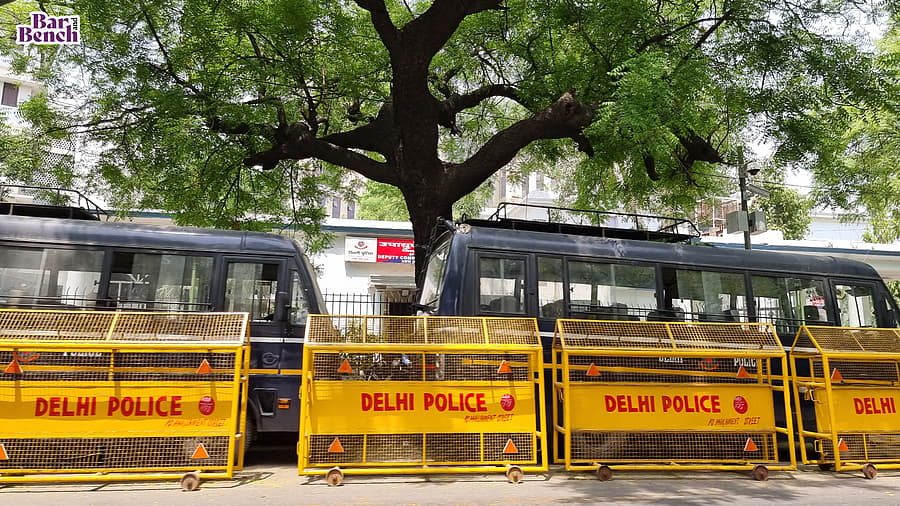
Supreme Court: Declines Section 163 BNSS Challenge to Prohibitory Orders
Summary
- The Supreme Court declined to challenge the constitutional validity of BNSS Section 163, which allows magistrates to restrict public gatherings.
- However, the Court will examine specific prohibitory orders issued under Section 163 related to recent Delhi protests.
- The constitutional validity of BNSS Section 172, concerning compliance with police directions and detention powers, is also under Supreme Court review.
- A bench of CJI Surya Kant and Justice Joymalya Bagchi sought responses from government and police authorities on the Section 172 challenge.
- Section 163 BNSS has replaced Section 144 of the former Code of Criminal Procedure.
What Happened
By declining to immediately question the constitutional validity of Section 163 itself, the Court acknowledges the state's need for mechanisms to prevent public unrest.
The Supreme Court of India recently opted not to entertain a direct challenge to the constitutional validity of Section 163 of the Bharatiya Nagarik Suraksha Sanhita (BNSS). This particular provision grants executive magistrates the authority to issue prohibitory orders aimed at restricting public gatherings, primarily to avert potential dangers or to uphold public peace. Despite this decision, the apex court has committed to scrutinizing specific prohibitory orders that were issued under Section 163 BNSS in connection with recent protests in Delhi.
Furthermore, the Court's attention extends to Section 172 of the BNSS, whose constitutional validity is also under examination. This section mandates individuals to comply with lawful directives from police officers and empowers law enforcement to detain those who disregard such instructions or obstruct police duties. A bench comprising Chief Justice of India Surya Kant and Justice Joymalya Bagchi has formally requested responses from several key entities, including the Central government, the Delhi government, the Delhi Commissioner of Police, and other relevant authorities, regarding the petition challenging Section 172. Senior Advocate Kapil Sibal, representing one of the petitioners, raised concerns during the hearing about how powers under these BNSS provisions were exercised during the restrictions imposed amidst the Delhi protests.
Legal Context
The Bharatiya Nagarik Suraksha Sanhita introduces significant changes to India's criminal procedure framework, with Section 163 serving as a direct replacement for Section 144 of the former Code of Criminal Procedure (CrPC). This new section empowers designated magistrates to issue urgent orders when necessary to prevent danger to human life, ensure public safety, or maintain peace. These orders are crucial tools for authorities to manage situations that could escalate into public disorder or pose risks to citizens.
Complementing Section 163, Section 172 of the BNSS outlines the duties of citizens to adhere to lawful directions issued by police officers. It also provides police with the explicit power to take individuals into custody if they fail to comply with these directions or actively impede police functions. Together, these sections establish a robust legal framework for maintaining public order and safety, granting considerable discretionary powers to both executive magistrates and police personnel in managing public assemblies and potential disturbances.
Why It Matters
The Supreme Court's nuanced approach to the BNSS provisions carries significant implications for public order and civil liberties in India. By declining to immediately question the constitutional validity of Section 163 itself, the Court acknowledges the state's need for mechanisms to prevent public unrest. However, its decision to specifically review prohibitory orders issued under this section during the Delhi protests indicates a clear intent to ensure that these powers are exercised judiciously and within constitutional bounds, rather than being used arbitrarily.
The concurrent examination of Section 172's constitutional validity further underscores the Court's commitment to balancing state authority with individual rights. This scrutiny will determine the legality of police powers to detain individuals for non-compliance with directives, potentially setting important precedents for how law enforcement interacts with citizens during public demonstrations. The outcome of these examinations will be critical for defining the scope of protest rights and police powers under the new legal regime, influencing future public assemblies and the enforcement of public order.
Practical Implications
Lawyers advising on public order, protest rights, or police powers in India should note that while the constitutional validity of BNSS Section 163 itself remains unchallenged by the Supreme Court for now, the Court is actively examining specific prohibitory orders issued under it and the validity of BNSS Section 172. This indicates ongoing judicial scrutiny of the application of these new provisions, requiring close monitoring for potential precedents affecting compliance and defense strategies related to public assembly and police directives.
Source
How does this affect you?
Get an AI analysis of this article grounded in your jurisdictions, practice areas, and any policy documents you've uploaded to Wansom.
Finish Reading the Full Story and the Expert Analysis.
Get the latest legal & regulatory intelligence in India
Wansom is AI and can make mistakes.