
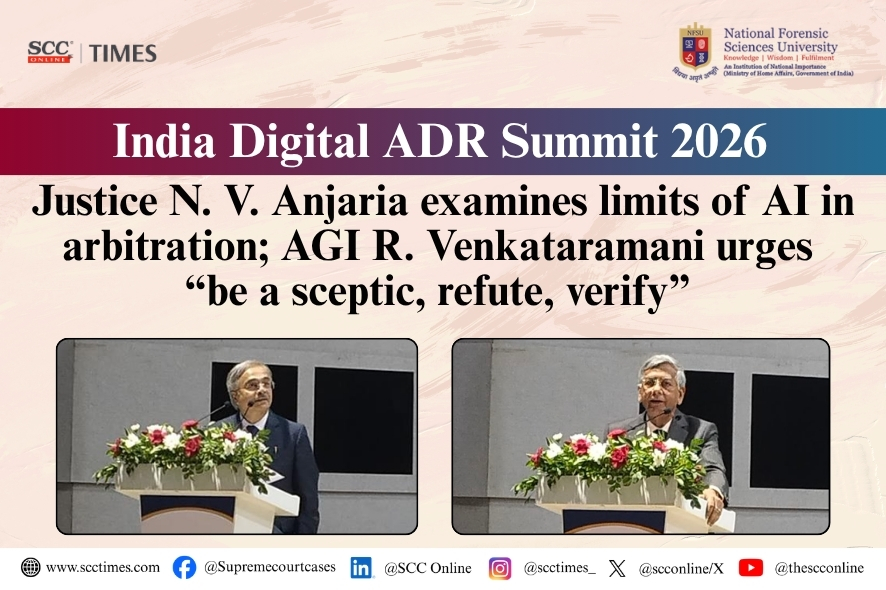
India Digital ADR Summit 2026: AI Arbitration Limits, Human Oversight Urged
Summary
- The India Digital ADR Summit 2026 focused on the role of artificial intelligence in arbitration.
- Attorney General R. Venkataramani and Justice N. V. Anjaria were key speakers at the event.
- Both speakers highlighted the potential of AI while stressing the critical need for human judgment, verification, fairness, confidentiality, and control.
- Justice N. V. Anjaria specifically examined the limitations of AI in arbitration processes.
- Attorney General R. Venkataramani urged practitioners to "be a sceptic, refute, verify" when dealing with AI outputs.
Summit Highlights AI in Arbitration
Their unified stance signals to the legal profession the critical need for human judgment, verification, fairness, confidentiality, and ultimate human control over AI-assisted decision-making.
The India Digital ADR Summit 2026 recently served as a critical platform for discussing the integration of artificial intelligence into the realm of dispute resolution. This significant event brought together leading legal minds to explore both the promising capabilities and the inherent challenges posed by advanced technological tools in arbitration.
Among the distinguished speakers who addressed the summit were Attorney General R. Venkataramani and Justice N. V. Anjaria. Their presentations underscored a balanced perspective on artificial intelligence in arbitration, acknowledging its potential while simultaneously advocating for robust safeguards and human oversight.
Judicial Perspective on AI's Limits
Justice N. V. Anjaria, a prominent voice at the India Digital ADR Summit 2026, dedicated his address to a thorough examination of the limitations of AI in arbitration. His insights highlighted the irreplaceable nature of human judgment, asserting that while AI can serve as a powerful aid, it cannot fully replicate the complex, nuanced decision-making required of human arbitrators.
Justice N. V. Anjaria's discussion on AI arbitration emphasized the paramount importance of preserving fairness and confidentiality throughout any process involving AI assistance. He stressed the imperative for human control over all AI-assisted decision-making, ensuring that technological advancements align with, rather than compromise, the foundational principles of justice and ethical considerations in AI legal tech arbitration ethics.
Attorney General's Call for Scrutiny
Attorney General R. Venkataramani also contributed significantly to the discourse at the India Digital ADR Summit 2026, advocating for a cautious and critical approach to the adoption of artificial intelligence in arbitration. His remarks conveyed a powerful message regarding the need for vigilance in this evolving field.
Venkataramani's directive to the legal community was clear and concise: practitioners must "be a sceptic, refute, verify." This guidance underscores the necessity for continuous human oversight and rigorous validation of any outputs generated by AI systems within dispute resolution. His emphasis on the R. Venkataramani AI arbitration limits serves as a foundational principle for maintaining the integrity and reliability of AI arbitration.
Ensuring Ethical AI Integration
The overarching message from both Attorney General R. Venkataramani and Justice N. V. Anjaria at the Digital ADR Summit India was unequivocal: while artificial intelligence in Indian arbitration offers considerable promise for enhancing efficiency and accessibility, its implementation must be meticulously balanced with a deep respect for established legal principles and ethical boundaries. The potential of AI in arbitration was recognized, but always within the framework of human accountability and responsibility.
Their unified stance signals to the legal profession the critical need for human judgment, verification, fairness, confidentiality, and ultimate human control over AI-assisted decision-making. This cautious approach aims to proactively mitigate potential challenges to the fairness and confidentiality of arbitration proceedings, thereby ensuring that technological tools genuinely serve the cause of justice without undermining the core tenets of AI legal tech arbitration ethics.
Practical Implications
This highlights the judiciary's cautious stance on AI in arbitration, signaling to lawyers and compliance officers the critical need for human oversight, verification, and adherence to ethical principles when deploying or encountering AI tools in dispute resolution, to avoid challenges to fairness and confidentiality.
Source
How does this affect you?
Get an AI analysis of this article grounded in your jurisdictions, practice areas, and any policy documents you've uploaded to Wansom.
Finish Reading the Full Story and the Expert Analysis.
Get the latest legal & regulatory intelligence in India
Wansom is AI and can make mistakes.