
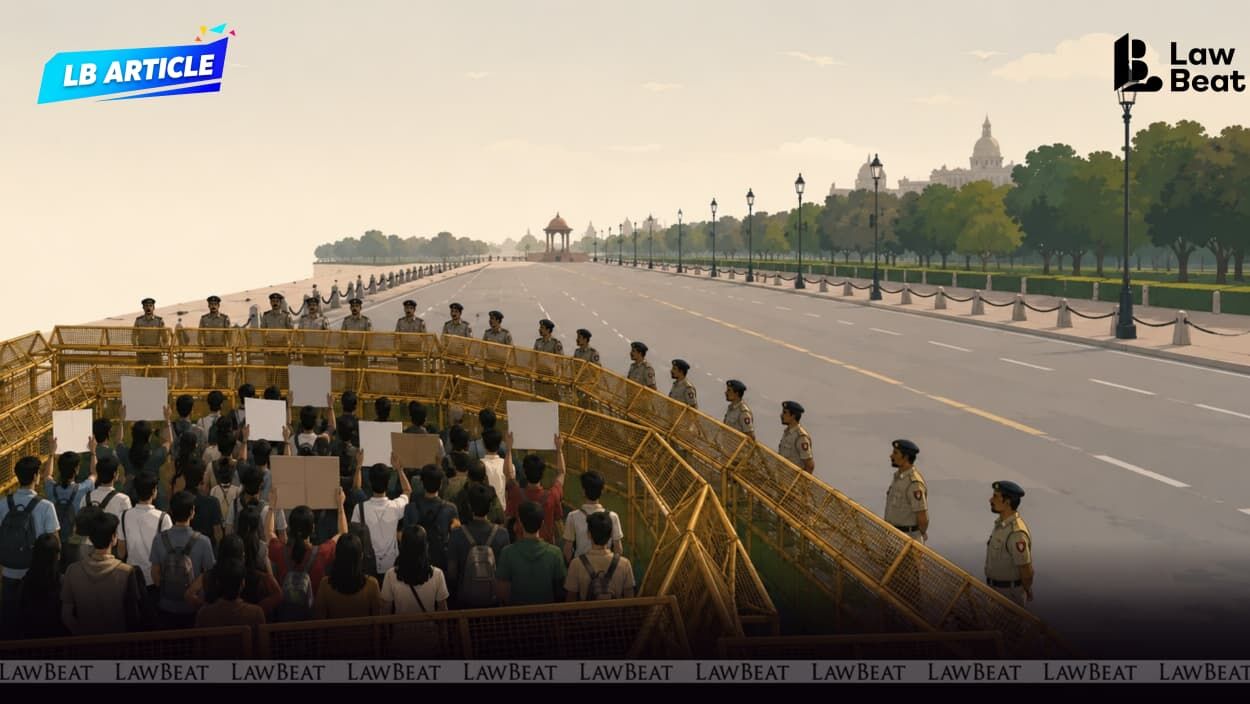
India Supreme Court Criticizes Delhi Police Protest Handling: Violation of Rights
Summary
- Delhi Police faced off against Gen-Z protesters using tear gas and lathi charges without a prohibitory order.
- Supreme Court criticizes Delhi Police handling, signaling formation of Special Investigation Team and release of detained students.
- Constitutional framework emphasizes strict interpretation of limitations on right to protest under Articles 19(2) and (3).
- Kaushal Kishor v. State of U.P. (2023) established that grounds listed in Article 19(2) are exhaustive, limiting authorities' discretion.
- Himat Lal K. Shah v. Commissioner of Police (1973) reinforced the right to assemble under Article 19(1)(b), which may be regulated but not prohibited.
Delhi Police Confronts Gen-Z Protesters
Chief Justice Surya Kant expressed concerns that the guidelines established by the Supreme Court in 2018 for handling protesters needed to be made more stringent in 2026.
On July 20, 2026, Delhi Police faced off against a group of young protesters demonstrating against the education system and calling for reform. Eyewitness accounts revealed that police used tear gas and lathi charges against the demonstrators. However, according to records presented to the Supreme Court by senior advocate Gopal Sankaranarayanan, no prohibitory order had been issued under Section 163 of the Bharatiya Nagarik Suraksha Sanhita (BNSS) for the protest site. Furthermore, Delhi Police's own standard operating procedure was not followed, which requires a loudspeaker warning and water-cannon stage before deploying lathis and tear gas.
Supreme Court Criticizes Delhi Police Handling
Chief Justice Surya Kant expressed concerns that the guidelines established by the Supreme Court in 2018 for handling protesters needed to be made more stringent in 2026. He signaled his intention to form a Special Investigation Team and ordered the release of detained students with no prior criminal record. This development comes on the heels of similar incidents, including Mumbai Police's invocation of Section 37 of the Maharashtra Police Act to ban gatherings across the city for two weeks without any protest having taken place.
Constitutional Framework and Limitations
The Indian Constitution's Articles 19(1)(a) and (b) enshrine the right to freedom of speech and peaceful assembly. However, these rights can be limited under Articles 19(2) and (3), which are narrow exceptions that require strict interpretation. The burden of justification falls on authorities seeking to restrict these rights, not on citizens exercising them. In Kaushal Kishor v. State of U.P. (2023), a five-judge bench held that the grounds listed in Article 19(2) are exhaustive and cannot be extended beyond those enumerated. This precedent has significant implications for protest management apparatuses across India.
Practical Implications
Lawyers should be aware that the Supreme Court's recent criticism of Delhi Police's handling of protests may lead to a re-examination of protest management apparatus in India, potentially resulting in stricter regulations and more stringent guidelines for law enforcement agencies.
Source
How does this affect you?
Get an AI analysis of this article grounded in your jurisdictions, practice areas, and any policy documents you've uploaded to Wansom.
Wansom is AI and can make mistakes.