
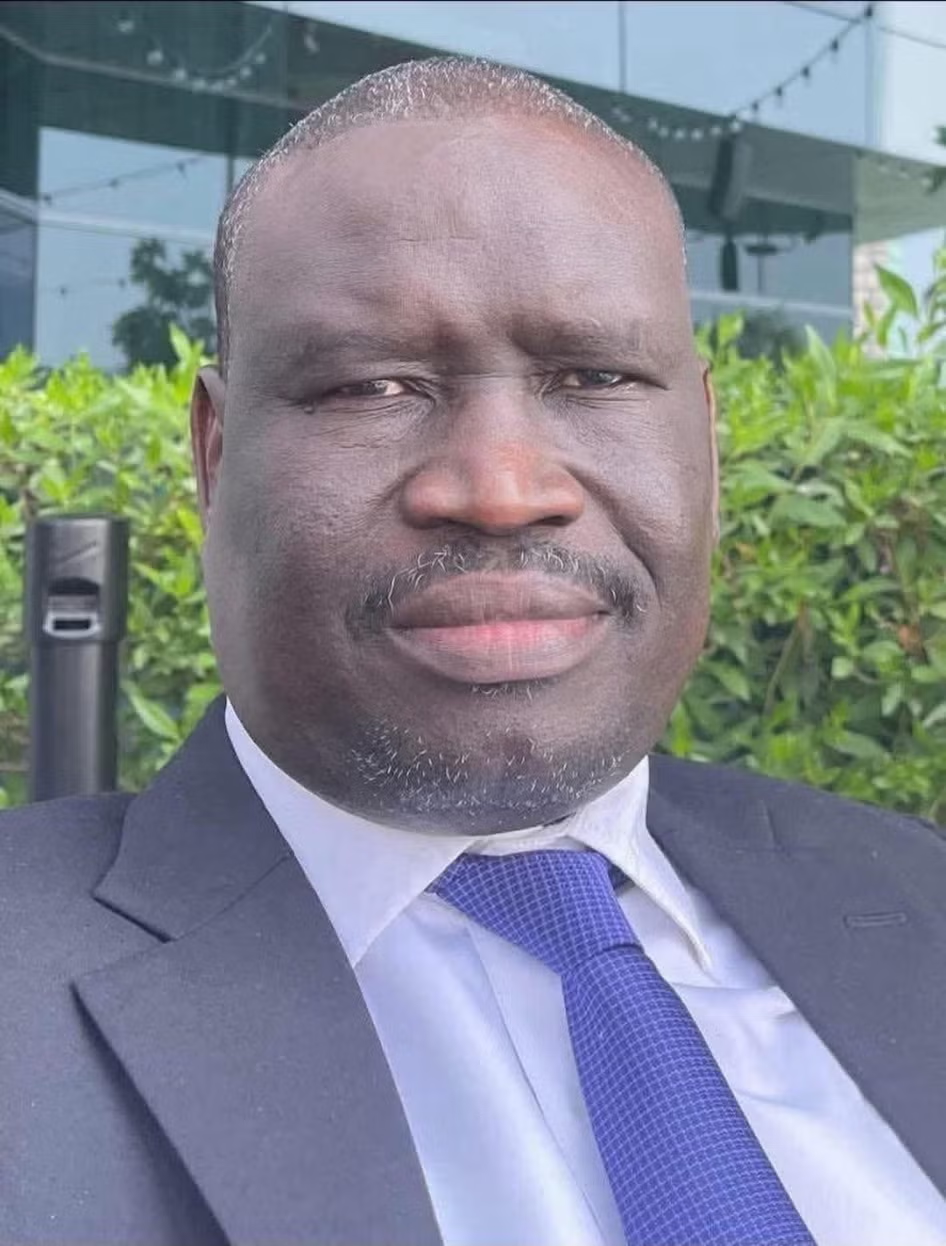
UAE: Samuel Peter Oyay Detained 1 Year Without Charge
Summary
- Samuel Peter Oyay, a South Sudanese political commentator, has been detained in the UAE for a year without charge.
- Emirati security forces arrested Oyay at his Dubai home on September 30, 2025, without presenting a warrant or disclosing charges.
- Oyay had regularly published articles criticizing the South Sudanese government, including a recent piece on a political trial.
- Human Rights Watch highlights concerns about the UAE's "zero-tolerance policy" toward critics of its foreign allies.
- The UAE's State Security Apparatus Law allows for prolonged detention without judicial oversight, contrasting with standard criminal procedure.
Prolonged Detention of a South Sudanese Critic
The lack of transparency surrounding his case and the conditions of his confinement raise significant concerns about due process.
Samuel Peter Oyay, a South Sudanese political commentator, has been held in the United Arab Emirates for a full year without any formal charges, according to a recent report by Human Rights Watch. Emirati authorities have consistently failed to inform Oyay's family of the legal basis for his arrest or the specific accusations against him. Oyay, who sought refuge in the UAE in 2014 due to safety concerns in his home country, had established a private business and regularly contributed articles to independent platforms focused on South Sudan, often criticizing its government for corruption and elite enrichment.
His detention began on September 30, 2025, when Emirati security forces, dressed in civilian attire, apprehended him at his Dubai residence in front of his four children. Prior to his arrest, his home was subjected to a two-hour search. Crucially, no arrest warrant was presented to his family, nor were they informed of any charges. While Oyay was permitted a phone call to his family two weeks after his apprehension, his precise whereabouts remained undisclosed for five months. He later informed a source on February 24, 2026, that he was being held at al-Wathba prison, before being transferred to another facility on March 3, 2026.
Despite the prolonged detention, contact with Oyay remains severely restricted, with prison authorities allowing only one brief phone call per week. His family's attempts to visit him have been fraught with difficulty; a scheduled visit for March 3, 2026, was thwarted by his transfer that very day. They eventually managed a single visit on July 8, 2026, following a call from authorities on July 1, but have been unable to see him since. The lack of transparency surrounding his case and the conditions of his confinement raise significant concerns about due process.
Political Context and International Scrutiny
Oyay's critical commentary, particularly his last published article on September 21, 2025, which critiqued the trial of Riek Machar as a political maneuver by President Kiir rather than a pursuit of justice, appears to be a key factor in his situation. This comes amidst strengthening bilateral relations between the UAE and South Sudan, including at least three visits by President Salva Kiir to the UAE in 2025. Furthermore, an Emirati company finalized a substantial €12 billion (US$12.9 billion) oil-for-cash agreement with South Sudan in April 2024, with much of South Sudan's crude being refined in Fujairah, one of the UAE's emirates, although exports have been affected by regional conflict.
Human Rights Watch has highlighted a troubling pattern, noting that the UAE government's "zero-tolerance policy toward peaceful criticism is increasingly targeting critics of Abu Dhabi’s foreign allies who live in the UAE." Joey Shea, a senior researcher at Human Rights Watch specializing in the United Arab Emirates, has called for Oyay's immediate release. The organization has also previously documented instances where South Sudanese critics in exile have been forcibly returned or disappeared, sometimes with the backing of the South Sudanese government, underscoring the potential risks faced by individuals like Oyay.
Legal Framework and Human Rights Concerns
The circumstances of Samuel Peter Oyay's detention underscore significant concerns regarding the rule of law and human rights in the UAE, particularly the application of its security legislation. While Article 48 of the UAE’s criminal law of procedure stipulates that detainees must be brought before a public prosecutor within 48 hours, this provision appears to be overridden in cases involving state security. The UAE's 2003 State Security Apparatus Law grants extensive powers to state security officers, enabling them to hold individuals for prolonged periods without judicial oversight.
Specifically, Article 28 of the State Security Apparatus Law, when read in conjunction with Article 14, permits the head of the state security apparatus to authorize detention for up to 106 days. This authority can be invoked if there are "sufficient reasonable causes" to believe an individual is involved in "activities that undermine the state," "jeopardize national unity," or are otherwise "deemed harmful." The lack of disclosed charges or a legal basis for Oyay's year-long detention, far exceeding even the 106-day provision, exemplifies the concerns about Emirati arbitrary detention and UAE due process concerns. Human Rights Watch has extensively documented the UAE's record of such practices, including enforced disappearances, torture, denial of medical care, prolonged solitary confinement, and detention beyond completed sentences, further contextualizing the serious nature of Oyay's ongoing confinement.
Practical Implications
This case highlights the significant risks of arbitrary detention and lack of due process under the UAE's State Security Apparatus Law, particularly for individuals perceived as political critics. Lawyers advising clients on travel, residence, or business operations in the UAE should emphasize these human rights concerns and the potential for prolonged detention without charge or judicial oversight, especially for those with any history of political commentary or perceived opposition.
Source
How does this affect you?
Get an AI analysis of this article grounded in your jurisdictions, practice areas, and any policy documents you've uploaded to Wansom.
Finish Reading the Full Story and the Expert Analysis.
Get the latest legal & regulatory intelligence in South Sudan
Wansom is AI and can make mistakes.