
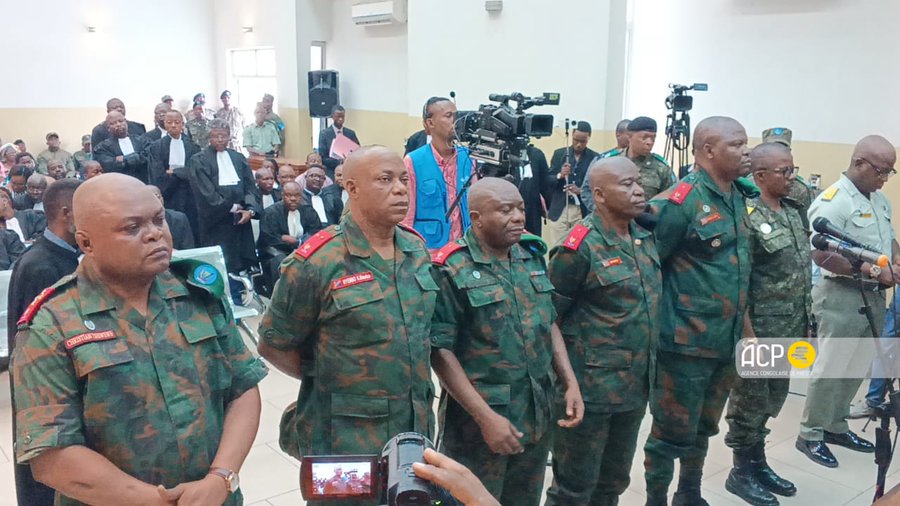
Haute Cour Militaire: General Tshiwewe Challenges Investigator Quality
On Tuesday, before the Haute Cour Militaire in Kinshasa, the defense of General Christian Tshiwewe challenged the quality of investigators from the Conseil National de Cyberdéfense (CNC) who conducted certain investigative acts, specifically regarding the alleged discovery of weapons at his client's home.
This challenge carries significant legal weight for practitioners in the Democratic Republic of Congo, as it directly questions the procedural integrity and legal authority of an investigative body. A successful challenge could lead to the exclusion of crucial evidence, potentially undermining the prosecution's case and setting a precedent for how evidence gathered by specialized, newer agencies like the CNC is scrutinized. It underscores the fundamental right to a fair trial and the importance of due process, particularly in high-profile military justice cases where the stakes are exceptionally high for both the accused and the state.
The legal context for this matter is rooted in the DRC's criminal procedure, specifically the Code de Procédure Pénale Militaire, which governs proceedings before military courts. This code, alongside general principles of criminal law, mandates strict adherence to investigative protocols, including the legal qualifications and jurisdictional boundaries of those authorized to conduct searches, seizures, and other investigative acts. The Haute Cour Militaire, as the highest military court, plays a critical role in interpreting and enforcing these procedural safeguards. The Conseil National de Cyberdéfense (CNC) is a relatively recent institution, and its mandate, particularly concerning traditional criminal investigations involving physical evidence like weapons, may be subject to judicial interpretation regarding its scope and the specific qualifications required for its personnel to perform such tasks.
The key parties involved are General Christian Tshiwewe, the accused, whose defense team initiated the challenge; the Haute Cour Militaire, the judicial body presiding over the case; and the Conseil National de Cyberdéfense (CNC), the investigative agency whose personnel's qualifications are being contested. The prosecution, though not explicitly named, is implicitly involved as the party presenting the evidence gathered by the CNC. The outcome of this specific challenge regarding the quality of the investigators is not reported in the excerpt.
Practitioners, particularly those engaged in criminal defense or military law in the DRC, should closely monitor the developments and eventual ruling on this procedural challenge. It highlights the critical necessity of meticulously reviewing the legal basis for all investigative actions, the chain of custody for evidence, and the statutory authority and qualifications of all law enforcement and investigative personnel involved in a case. Businesses and individuals should also be aware that the scope and authority of emerging specialized bodies like the CNC are subject to judicial scrutiny, and any interaction with such bodies should be approached with a clear understanding of their legal mandate and potential limitations.
How does this affect you?
Get an AI analysis of this article grounded in your jurisdictions, practice areas, and any policy documents you've uploaded to Wansom.
Finish Reading the Full Story and the Expert Analysis.
Wansom is AI and can make mistakes.