
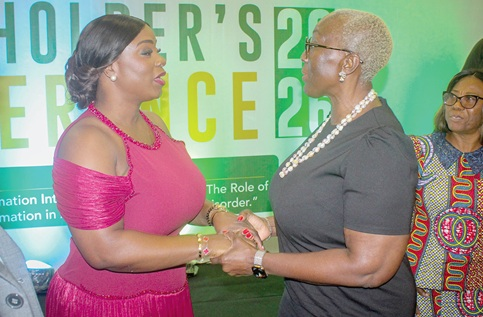
Ghana President's Legal Advisor: Media Fact-Checking Crucial for Information Integrity
Summary
- Marietta Agyeiwaa Brew, Legal Advisor to Ghana's President, urged media to strengthen fact-checking to combat information disorder in the digital age.
- She emphasized journalists' responsibility to verify information before publishing, especially given public trust in media content.
- The call was made at the 2026 Stakeholders’ Conference by the RTI Commission, focusing on Ghana’s Right to Information Act, 2019 (Act 989).
- Government officials stressed that timely information disclosure by public institutions is crucial to prevent misinformation from filling vacuums.
- The conference highlighted the RTI Act as a vital tool for upholding information integrity and helping citizens distinguish facts from falsehoods.
Emphasizing Media's Role in Combating Misinformation
The rapid dissemination of content across online platforms makes it imperative for journalists to confirm facts before releasing any information, thereby preventing the public from being misinformed.
Marietta Agyeiwaa Brew, the Legal Advisor to the President of Ghana, recently underscored the critical need for robust media fact-checking to counter the pervasive issue of information disorder in the digital era. Speaking at the 2026 Stakeholders’ Conference hosted by the Right to Information (RTI) Commission in Accra on September 24, Ms. Brew, who also previously served as Attorney-General and Minister of Justice, highlighted the media's inherent responsibility to meticulously verify all information prior to publication. This emphasis by the Ghana President's Legal Advisor on media fact-checking comes amidst a landscape where much of the public tends to regard content disseminated through traditional and social media channels as inherently truthful.
The rapid dissemination of content across online platforms makes it imperative for journalists to confirm facts before releasing any information, thereby preventing the public from being misinformed. Ms. Brew articulated that a failure to ensure the accuracy of published material allows false or misleading narratives to spread quickly, which inevitably erodes public trust. She specifically advised journalists to scrutinize their writing style before publishing, verify their sources, and exercise extreme caution when relying on information sourced from social media and other digital platforms.
The Right to Information Act as a Shield Against Disorder
The 2026 Stakeholders’ Conference, where Ms. Brew represented the President, served as a crucial forum to move beyond theoretical discussions on misinformation and disinformation. Instead, it focused on practical, legislative, and institutional strategies available under Ghana’s Right to Information Act, 2019 (Act 989). The event, themed “Upholding information integrity in the digital age: The role of access to information in addressing information disorder,” explored how the effective implementation of the Ghana Right to Information Act 2019 could significantly bridge existing information gaps and bolster public confidence in credible sources.
A key aspect of the conference's agenda was the examination of proactive disclosure obligations for public institutions. Discussions centered on enhancing the accuracy, timeliness, accessibility, and usability of information released to the public. The Legal Advisor stressed that the media bears a fundamental duty to furnish citizens with precise and verified information, empowering them to make well-informed decisions. This proactive approach by public institutions information disclosure Ghana is seen as vital in preventing the vacuum that misinformation often fills.
Government's Commitment to Transparency and Accountability
The government's perspective on media scrutiny and information dissemination was articulated by Deputy Presidential Spokesperson Shamima Muslim. She conveyed the administration's expectation that the media would uphold accountability through fair and factual examination of public affairs. Ms. Muslim affirmed the government's dedication to providing information promptly, recognizing that delays in releasing public data can inadvertently create opportunities for misinformation to proliferate.
Ms. Muslim explicitly stated that the government does not shy away from media scrutiny or questions, but rather anticipates fairness to the facts. She further urged public institutions to diligently respond to Right to Information (RTI) requests and to provide clear justifications when information cannot be lawfully disclosed. Dr. James Kwaku Asante, the Board Chairman of the RTI Commission, reinforced this sentiment, emphasizing that access to accurate and credible information from public institutions is paramount for citizens to discern facts from falsehoods in the digital age. He highlighted the Ghana RTI as a powerful instrument in this endeavor, crucial for maintaining media integrity Ghana digital age.
Fostering a Collaborative Environment for Truth
The call for enhanced fact-checking extends beyond journalistic practices to a broader collaborative effort. Ms. Brew advocated for partnerships among media organizations, educators, civil society groups, and digital practitioners. The objective of such collaboration is to equip the public with the skills to identify manipulation, while simultaneously safeguarding the essential tenets of legitimate debate and dissent.
The overarching message from the conference underscored that the rapid spread of information through digital platforms poses a significant challenge, allowing false claims to gain widespread traction before factual verification can occur. Therefore, the collective responsibility of all stakeholders, from government bodies ensuring public institutions information disclosure Ghana to media outlets practicing rigorous fact-checking, is crucial in fostering an environment where accurate information prevails over information disorder.
Practical Implications
This article highlights the Ghanaian government's emphasis on the Right to Information Act (Act 989) as a tool to combat information disorder. Lawyers and compliance officers advising public institutions should note the reinforced expectation for proactive disclosure and timely, accurate responses to RTI requests, as delays can be seen as contributing to misinformation. For those seeking information from public bodies, it underscores the legal framework supporting demands for verified data.
Source
How does this affect you?
Get an AI analysis of this article grounded in your jurisdictions, practice areas, and any policy documents you've uploaded to Wansom.
Finish Reading the Full Story and the Expert Analysis.
Get the latest legal & regulatory intelligence in Ghana
Wansom is AI and can make mistakes.