
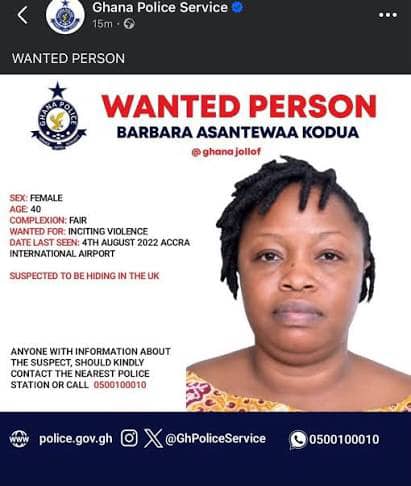
Ghana Police: Ghana Jollof Barbara Kodua Wanted Over False News
Summary
- The Ghana Police Service has declared 40-year-old Barbara Asantewaa Kodua, known as "Ghana Jollof," wanted.
- She is sought in connection with investigations into alleged false news, inciteful comments, and offensive content circulated on social media.
- Ms. Kodua operates a popular TikTok account known for political commentary and criticism of public officials.
- Her identity was previously unknown to the public despite her significant online presence.
- This action signals increased enforcement by Ghanaian authorities against alleged online misinformation and incitement.
Ghana Police Seek Prominent TikTok Commentator
This move by the Ghana Police to declare Barbara Asantewaa Kodua wanted for alleged false news and incitement on social media platforms like TikTok signals a heightened enforcement posture.
The Ghana Police Service has recently taken a significant step in its efforts to regulate online discourse, declaring a prominent social media personality, Barbara Asantewaa Kodua, as a wanted individual. Known widely by her online moniker "Ghana Jollof," the 40-year-old has been identified as the operator of a highly visible TikTok account that has garnered considerable attention for its political commentary and sharp critiques of public officials. This development marks the first public revelation of her identity, which had remained anonymous despite her widespread online presence.
Authorities are seeking Ms. Kodua in connection with an ongoing investigation into the dissemination and publication of what they allege to be false news, inciteful comments, and offensive content across various social media platforms. The declaration by the Ghana Police Service underscores a growing focus on accountability for online speech, particularly concerning content perceived to undermine public order or spread misinformation. The "Ghana Jollof" account has been a fixture in Ghanaian political discussions on TikTok for several months, attracting a substantial following.
This move by the Ghana Police to declare Barbara Asantewaa Kodua wanted for alleged false news and incitement on social media platforms like TikTok signals a heightened enforcement posture. It highlights the increasing scrutiny faced by individuals who engage in political commentary online, particularly when their content is deemed by authorities to cross legal boundaries. The investigation focuses on specific types of content that Ghanaian law seeks to regulate, emphasizing the potential legal repercussions for online expression.
Legal Context of Online Content Regulation
This incident involving "Ghana Jollof" unfolds against a backdrop of evolving Ghana online content regulation and increasing governmental attention to digital platforms. Ghanaian law provides frameworks to address issues such as the spread of false information, defamation, and incitement to violence, which can be applied to online activities. The Police Service's action suggests a more proactive approach to enforcing these existing statutes in the digital realm, moving beyond traditional media to encompass social media platforms like TikTok.
The legal landscape in Ghana, much like in many other jurisdictions, grapples with balancing freedom of expression with the need to maintain public order and protect individuals from harm caused by misinformation or hate speech. Cases like that of Barbara Asantewaa Kodua serve as a stark reminder that online political commentary in Ghana is subject to legal oversight, and individuals can face serious consequences if their content is found to violate these regulations. This increased enforcement signals a tightening environment for online speech.
Lawyers in Ghana are increasingly advising clients on the potential legal risks associated with their online presence, particularly regarding political commentary. The specific allegations of false news, inciteful comments, and offensive content are serious and fall under categories of speech that are typically restricted under Ghanaian law. This situation underscores the importance for social media users to be aware of the legal boundaries governing public communication in Ghana, especially when discussing political matters.
Implications for Digital Discourse
The declaration of Barbara Asantewaa Kodua, known as "Ghana Jollof," as wanted by the Ghana Police Service carries significant implications for the future of online political discourse in the country. It sends a clear message that authorities are prepared to identify and pursue individuals behind anonymous or pseudonymous accounts, particularly those whose content attracts substantial public attention and is perceived as problematic. This could potentially lead to a chilling effect, where other online commentators might self-censor to avoid similar legal entanglements.
This development highlights the ongoing tension between the right to free expression and the government's mandate to prevent the spread of misinformation and incitement. For citizens, it underscores the necessity of understanding the legal ramifications of their online posts, especially when engaging in political commentary or criticism of public officials. The case serves as a crucial precedent, indicating that the Ghana Police Service is actively monitoring social media for content that allegedly breaches national laws.
Ultimately, this situation emphasizes the critical need for individuals and legal professionals alike to navigate the complexities of Ghana's legal framework concerning online content. As social media platforms continue to be central to political discussions, the enforcement actions taken by the Ghana Police Service against figures like "Ghana Jollof" will shape the boundaries of acceptable online speech and influence how political commentary is conducted in the digital space moving forward.
Practical Implications
This development signals increased enforcement by Ghanaian authorities against individuals publishing alleged false news or inciteful content on social media. Lawyers should advise clients on the potential legal risks of online political commentary and ensure compliance with Ghana's laws on public communication, particularly regarding defamation and incitement.
Source
How does this affect you?
Get an AI analysis of this article grounded in your jurisdictions, practice areas, and any policy documents you've uploaded to Wansom.
Finish Reading the Full Story and the Expert Analysis.
Get the latest legal & regulatory intelligence in Ghana
Wansom is AI and can make mistakes.