
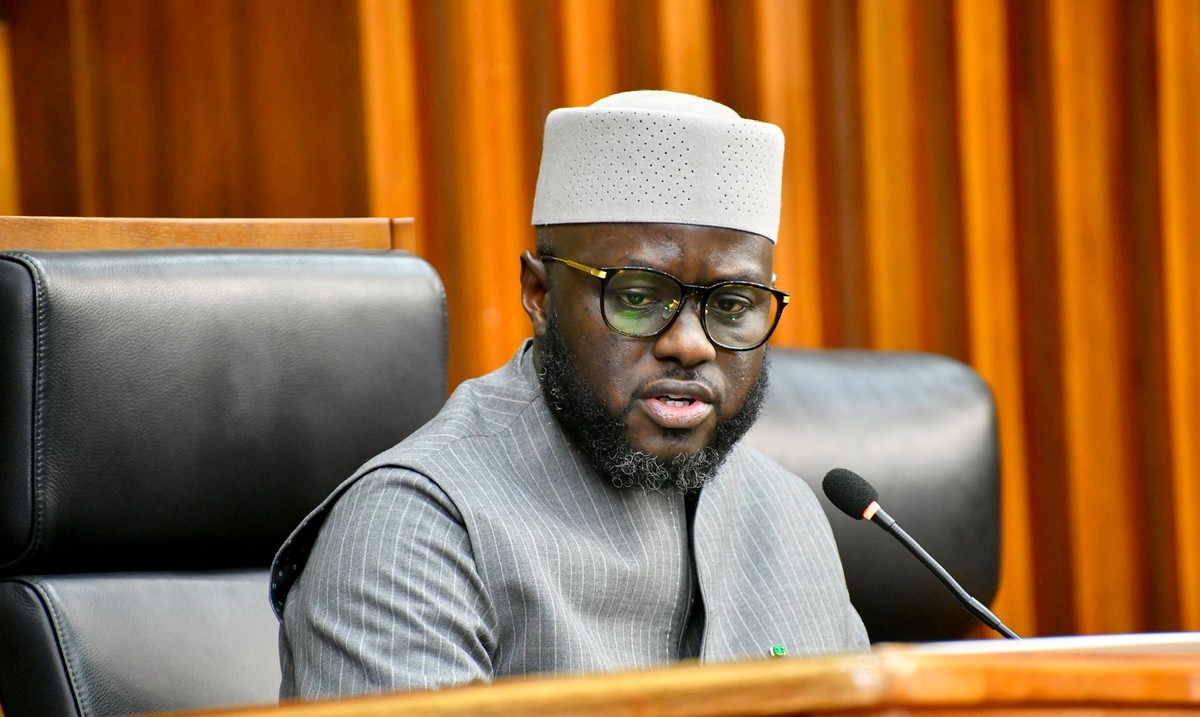
El Malick Ndiaye: Article 82 Convocation Députés Defended For Finance Law
Summary
- El Malick Ndiaye, then First Vice-President, defended the urgent convocation of deputies for a session on the 2026 rectified finance law.
- The session addressed a presidential decree that enacted a finance law previously rejected by the National Assembly on November 3, 2026.
- Deputies initiated a resolution to uphold parliamentary constitutional prerogatives and the separation of powers.
- Ndiaye justified the convocation by citing Article 82, paragraph 3, of the National Assembly's internal regulations, which permits urgent scheduling.
- Convocation documents were initially sent to parliamentary leaders on a Saturday evening and later re-sent via email.
The Dispute and Parliamentary Response
This application of Article 82 règlement intérieur Assemblée Nationale was central to his defense of the expedited parliamentary procedure.
El Malick Ndiaye, then the First Vice-President of the Senegalese National Assembly, recently addressed criticisms surrounding the urgent convocation of deputies for a plenary session. This session was convened to deliberate on a resolution concerning the executive's implementation of a decree related to the 2026 rectified finance law (LFR). The core of the controversy stems from the presidential administration's decision to enact, via decree, a financial text that the National Assembly had explicitly rejected during a plenary session held on November 3, 2026.
Deputies who initiated the resolution sought to uphold the constitutional prerogatives of the Parliament, emphasizing the critical principle of the separation of powers within the Senegalese governance structure. Their efforts also aimed to reinforce the essential requirements for transparency and sincerity in the management of public finances, a cornerstone of democratic accountability. The parliamentary action underscored a fundamental tension between the executive's authority to implement and the legislature's role in approving financial legislation.
Defense of the Convocation Procedure
A significant point of contention revolved around the specific procedure used for the El Malick Ndiaye Article 82 convocation députés. Mr. Ndiaye firmly refuted these criticisms, stating that the convocation documents were dispatched to members on a Saturday evening, precisely at 7:45 PM. He detailed that the general secretariat of the Assembly was responsible for transmitting these essential documents to the presidents of the various parliamentary groups, the representative for non-registered members, the Assembly's bureau, and its specialized commissions.
To substantiate the legitimacy of the convocation process, El Malick Ndiaye invoked Article 82, paragraph 3, of the institution's internal regulations. This particular provision outlines that in instances where urgency is formally declared, the National Assembly is empowered to immediately establish the dates for both the relevant competent commission meeting and the subsequent plenary session. This application of Article 82 règlement intérieur Assemblée Nationale was central to his defense of the expedited parliamentary procedure.
Constitutional and Procedural Implications
This parliamentary episode highlights crucial aspects of constitutional law and parliamentary procedure in Senegal. The deputies' resolution to challenge the executive's decree, particularly concerning the loi de finances rectificative 2026 Sénégal, underscores the ongoing assertion of prérogatives constitutionnelles Parlement Sénégal. By seeking to overturn or scrutinize an executive action that bypassed a prior legislative rejection, the National Assembly was actively demonstrating its oversight function and its commitment to the séparation des pouvoirs Sénégal.
El Malick Ndiaye further articulated that the work undertaken by the Assembly in this context falls squarely within its mandate of controlling governmental action. He clarified that while the executive branch is tasked with the execution of decisions, the Parliament retains its distinct and vital prerogatives of oversight and control. This interaction between the branches of government, particularly regarding financial legislation, serves as a significant precedent for future interpretations of legislative authority and executive accountability in Senegal.
Procedural Details and Acknowledgment
Beyond the initial distribution of documents to parliamentary leaders, it was also reported that a subsequent transmission of these materials occurred via electronic mail. This additional step aimed to ensure all relevant parties had access to the necessary information for the upcoming session. Before concluding the plenary session, El Malick Ndiaye extended his commendations to Deputy Ayib Daffé and the other members of parliament who were instrumental in initiating the resolution that was ultimately adopted. Their proactive stance in defending legislative authority against executive overreach was publicly acknowledged, reinforcing the significance of their actions in the context of Sénégal convocation parlement and its procedural integrity.
Practical Implications
Lawyers advising on constitutional law or parliamentary procedure in Senegal should note this interpretation and application of Article 82 of the National Assembly's internal regulations regarding the urgent convocation of deputies. This precedent could be relevant for future challenges to legislative processes, particularly concerning the executive's interaction with a rejected finance law and the assertion of parliamentary control.
Source
How does this affect you?
Get an AI analysis of this article grounded in your jurisdictions, practice areas, and any policy documents you've uploaded to Wansom.
Finish Reading the Full Story and the Expert Analysis.
Get the latest legal & regulatory intelligence in Senegal
Wansom is AI and can make mistakes.