
Dubai Arbitration Week 2026: Advancing Integrated Dispute Resolution
Summary
- Dubai Arbitration Week 2026 featured discussions on integrating arbitration, mediation, and court proceedings for efficient dispute resolution.
- Experts identified a lack of understanding and the perception of weakness as key barriers to mediation's formal adoption in the Middle East.
- The region is seeing a shift, with mediation gaining favor among SMEs due to its speed, cost-effectiveness, and ability to preserve commercial relationships.
- Panelists highlighted the critical role of legal counsel in educating stakeholders and integrating mediation into strategic dispute management.
- The Singapore Convention on Mediation and new national mediation laws are expected to further encourage the use of mediation in the Middle East.
Dubai Arbitration Week Highlights Integrated Dispute Resolution
Noradele Ghubril Radjai, a Partner at Lalive, emphasized that mediation should be viewed as an integral component of a disciplined dispute management strategy, rather than an indication of a party's lack of confidence in its case.
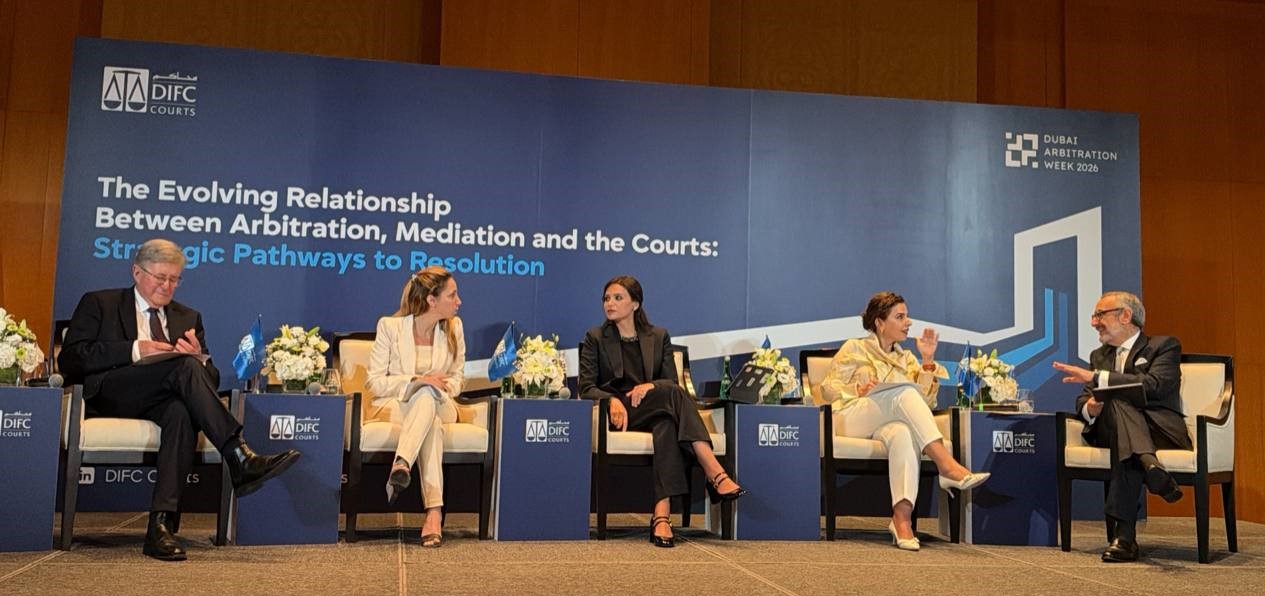
The Dubai International Arbitration Centre (DIAC) hosted its flagship Annual Conference as part of Dubai Arbitration Week 2026, which ran from November 9 to 13, 2026. This significant event brought together international arbitration stakeholders for crucial dialogue, knowledge exchange, and networking opportunities. A key session on November 11, titled "The Evolving Relationship Between Arbitration, Mediation and the Courts: Strategic Pathways to Resolution," delved into how arbitration, mediation, and traditional court proceedings can be strategically combined to achieve efficient, commercially sound, and enforceable outcomes in increasingly complex cross-border disputes.
The discussion at Dubai Arbitration Week 2026 explored several critical aspects of integrated dispute resolution. Panelists examined the strategic application of mediation both before and during arbitration, the supportive role courts and tribunals can play in facilitating settlements, the necessary authority for effective negotiations, and the enforceability of mediated agreements. The session, moderated by Justice Michael Black of the Dubai International Financial Centre Courts, also looked ahead to the future of integrated dispute resolution, emphasizing a holistic approach to managing commercial disagreements.
Addressing Barriers to Mediation in the Middle East
Justice Michael Black initiated the session by noting that while mediation has deep roots in Middle Eastern culture, its formal adoption for commercial dispute resolution has progressed more slowly. Panelists identified several reasons for this historical resistance, including a general lack of understanding regarding the mediation process itself. Rozana ALTayyar, an International Arbitrator and Mediator and CEO of Taswea, highlighted that parties and their legal representatives often lack familiarity with the distinct roles of the mediator, the parties, and counsel, as well as the unique value a mediator can bring to negotiations.
Another significant barrier discussed was the perception that proposing mediation signals weakness, deterring parties from initiating the process. Corporate decision-makers frequently express concerns about justifying settlements internally, while issues of confidentiality and enforceability also remain key considerations. Despite these challenges, ALTayyar observed a shift in attitudes, particularly within Saudi Arabia and among small and medium-sized enterprises, where mediation is gaining traction as a quicker, more cost-effective method that helps preserve commercial relationships.
The Evolving Role of Counsel and Regulatory Support
The panel underscored the crucial role of legal professionals in promoting the strategic use of mediation. Rima Hadid, General Counsel at Emirates Investment Authority, stressed the importance of in-house counsel and external advisors in educating internal stakeholders about what mediation entails, how it differs from litigation, and what outcomes parties can realistically expect. She advocated for a comprehensive assessment of dispute resolution options that extends beyond mere litigation costs to include the internal resources consumed by a dispute and its broader impact on business operations.
Noradele Ghubril Radjai, a Partner at Lalive, emphasized that mediation should be viewed as an integral component of a disciplined dispute management strategy, rather than an indication of a party's lack of confidence in its case. She pointed out that arbitration is increasingly being perceived in a similar light to litigation, making it essential to recognize the broader spectrum of available processes that exist between initial negotiation and a final award or judgment. Radjai advocated for a tailored, dispute-specific approach, acknowledging that disputes evolve and the most suitable mechanism depends on the specific obstacle to resolution at any given stage. The introduction of new mediation rules by the Saudi Center for Commercial Arbitration (SCCA) in August 2026 and the impact of the Singapore Convention on Mediation were also cited as factors likely to further encourage the use of mediation.
Practical Implications
Lawyers and compliance officers should note the growing emphasis on integrating mediation with arbitration and court proceedings, particularly in the Middle East, as discussed at Dubai Arbitration Week 2026. This signals a need to strategically advise clients on mediation's benefits for efficient, commercially sensible, and enforceable outcomes in cross-border disputes, moving beyond perceptions of weakness and leveraging developments like the Singapore Convention and new mediation laws.
Source
How does this affect you?
Get an AI analysis of this article grounded in your jurisdictions, practice areas, and any policy documents you've uploaded to Wansom.
Finish Reading the Full Story and the Expert Analysis.
Get the latest legal & regulatory intelligence in India
Wansom is AI and can make mistakes.