
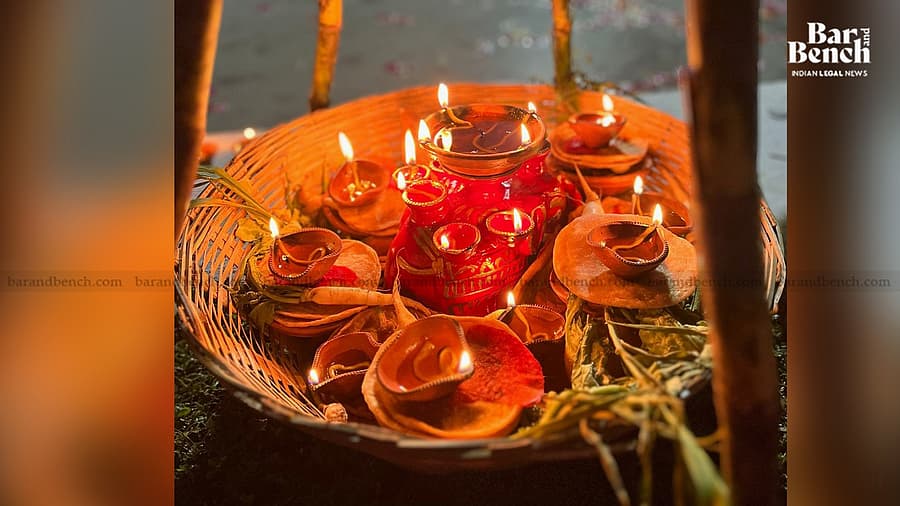
Calcutta High Court: Chhath Puja Allowed on Private Property
Summary
- The Calcutta High Court permitted Chhath Puja worship on private property for thousands of devotees.
- The permission was granted under strict supervision by police and volunteers.
- The ruling stemmed from a public interest litigation filed by women seeking to celebrate Chhath Puja at the Shib Krishna Debutter estate in Bally, Howrah.
- The court framed specific guidelines for crowd management and safe prayer observance.
- The decision balances religious freedom with property rights and public safety concerns.
What Happened
This ruling by the Calcutta High Court regarding "Chhath Puja worship Calcutta High Court" on private property sets a noteworthy precedent for religious gatherings in India.
The Calcutta High Court recently issued a significant ruling, permitting thousands of devotees to conduct Chhath Puja worship on private property. This decision, delivered by a bench comprising Chief Justice Ravindra Vithalrao Ghuge and Justice Om Narayan Rai, came with a crucial caveat: the religious observance must proceed under the stringent oversight of both police personnel and volunteers. The case, formally known as Kanchan Dubey and Ors v. The State of West Bengal and Ors, centered on a public interest litigation (PIL) initiated by a group of women.
These petitioners sought judicial approval for a large-scale Chhath Puja celebration, anticipating the participation of several thousand individuals. The chosen location for this gathering was a private estate, specifically the Shib Krishna Debutter property, situated along the Ganga river bank at Rashbari ghat in Bally, Howrah. Despite the court's ultimate approval, there was initial reluctance from the bench regarding the use of private land for such a public event. The judges questioned the legal basis for compelling access to private property, asking, "How can we pass a writ of mandamus allowing people to barge into private property?" They even suggested an alternative, proposing that the State government consider acquiring the property through compensation to the estate, thereby facilitating the devotees' right to worship. Ultimately, the court opted to allow the event under strict regulatory measures.
Legal Context and Court's Rationale
The public interest litigation brought forth by the women petitioners highlighted a history of similar permissions granted by the High Court over previous years, allowing their community to perform these rituals. Counsel for the petitioners further assured the court that the entire ritualistic process would be concluded within a compact 19-hour timeframe. A critical element of their argument involved public safety: they presented a list of other available ghats in the vicinity, asserting that these alternative locations were in such dilapidated condition that accommodating a large crowd of devotees would inevitably lead to serious casualties. This concern for public safety, coupled with the precedent of past permissions, likely influenced the court's final decision.
In response to the complexities of allowing a large religious gathering on private land, the Calcutta High Court took an active role in establishing a framework for the event. The bench meticulously framed a series of guidelines specifically designed to manage the anticipated crowd and ensure the devotees could perform their prayers safely and without incident. This proactive approach by the court underscores its commitment to balancing religious freedom with the practical considerations of public order and safety, particularly when dealing with "private land religious worship India" scenarios. The court's initial hesitation, followed by its detailed guidelines, demonstrates a careful consideration of property rights versus the right to religious observance.
Why It Matters
This ruling by the Calcutta High Court regarding "Chhath Puja worship Calcutta High Court" on private property sets a noteworthy precedent for religious gatherings in India. It clarifies that while courts may initially be wary of mandating access to private land for public religious ceremonies, they are prepared to facilitate such events when compelling reasons, such as public safety and established community practice, are presented. The emphasis on strict supervision by police and volunteers, along with the court's detailed guidelines, illustrates a judicial willingness to craft bespoke solutions that accommodate religious rights without infringing unduly on property ownership or compromising public welfare.
The case of "Kanchan Dubey v State of West Bengal" demonstrates how a "public interest litigation religious rights" can successfully navigate the complexities of land use for religious purposes. By allowing the Chhath Puja on the Shib Krishna Debutter estate at "Rashbari ghat Bally Howrah," the court has provided a pathway for large-scale religious observances to occur on private land, provided robust safety and crowd management protocols are in place. This decision offers valuable insights for property owners, religious organizations, and local authorities grappling with similar requests, suggesting that judicial intervention can provide a structured framework for balancing diverse interests in such situations.
Practical Implications
This ruling clarifies that religious worship, even for large gatherings like Chhath Puja, can be permitted on private property under strict court-mandated supervision, balancing religious freedom with public safety and property rights. Lawyers advising property owners, religious organizations, or local authorities should note the court's willingness to frame specific guidelines for such events, which could serve as a precedent for similar requests concerning religious gatherings on private land.
Source
How does this affect you?
Get an AI analysis of this article grounded in your jurisdictions, practice areas, and any policy documents you've uploaded to Wansom.
Finish Reading the Full Story and the Expert Analysis.
Get the latest legal & regulatory intelligence in India
Wansom is AI and can make mistakes.