
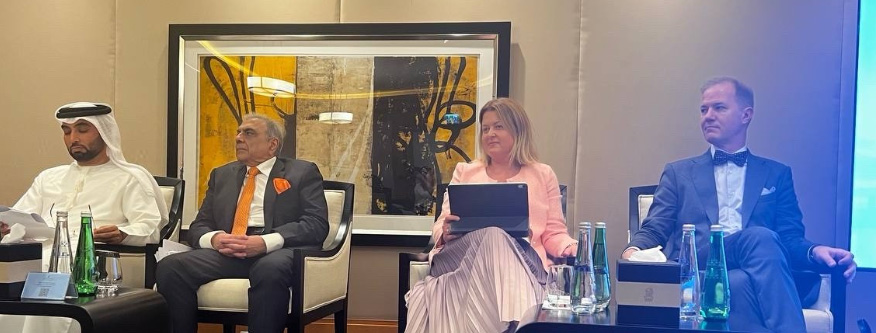
Dubai Arbitration Week 2026: De-dollarisation Challenges in Cross-Border Payments
Summary
- Arbitration practitioners at Dubai Arbitration Week 2026 discussed challenges arising from the increasing use of alternative currencies.
- The discussions focused on contractual, commercial, and enforcement issues related to de-dollarisation.
- Specific attention was given to disrupted payment routes and inaccessible funds within the India–UAE–Russia trade corridor.
- Businesses are actively exploring payment channels that move away from the traditional US dollar.
Key Discussions at Dubai Arbitration Week 2026
Lawyers and compliance officers should review and update contractual clauses related to currency, payment methods, and dispute resolution for cross-border transactions, particularly those involving the India-UAE-Russia corridor.
Dubai Arbitration Week 2026 served as a critical forum for legal professionals, with a central focus on the growing trend of de-dollarisation. This pivotal shift involves businesses increasingly exploring alternatives to conventional US dollar-based payment channels in international trade. Arbitration practitioners convened to dissect the complex issues emerging from this financial evolution, specifically examining the contractual, commercial, and enforcement challenges that arise when alternative currencies are employed.
Discussions during the week thoroughly examined the impact of disrupted payment routes and the problem of inaccessible funds, which are becoming more prevalent in the current global economic climate. These challenges are not merely theoretical but represent tangible obstacles for companies engaged in cross-border transactions, necessitating a re-evaluation of existing legal and commercial frameworks.
The Evolving Landscape of Cross-Border Payments
The global economic landscape is witnessing a significant pivot as various entities seek payment channels beyond the conventional US dollar, introducing a new layer of complexity for international commerce. A particular area of concern highlighted during Dubai Arbitration Week 2026 was the India–UAE–Russia trade corridor, which exemplifies the challenges faced by businesses operating in regions where traditional financial pathways are becoming less reliable or accessible. This corridor is a prime example of where de-dollarisation legal implications are acutely felt.
The shift towards de-dollarisation brings with it substantial legal and commercial complexities. These include the need for robust contractual frameworks that can accommodate diverse payment methods and currencies, as well as strategies for managing commercial risks associated with currency fluctuations and payment processing. Furthermore, the discussions underscored the increasing prevalence of enforcement disputes alternative currencies, where the enforceability of awards or judgments denominated in non-traditional currencies can become a significant hurdle, necessitating a proactive approach to dispute resolution clauses in cross-border payments arbitration.
Why It Matters for Legal Practitioners
The insights shared at Dubai Arbitration Week 2026 underscore a pivotal moment in international commerce and dispute resolution. The move away from the US dollar, driven by various geopolitical and economic factors, is not merely a financial adjustment but a fundamental shift with profound legal and operational consequences. These evolving international arbitration trends 2026 demand immediate attention from legal and compliance professionals globally.
Lawyers and compliance officers should review and update contractual clauses related to currency, payment methods, and dispute resolution for cross-border transactions, particularly those involving the India-UAE-Russia corridor. This proactive approach is crucial to anticipate and mitigate risks associated with de-dollarisation, disrupted payment routes, and potential enforcement challenges arising from the use of alternative currencies. Failing to adapt could lead to significant commercial disruptions and protracted legal battles, making robust contractual drafting and strategic dispute resolution planning more vital than ever in this changing global financial environment.
Practical Implications
Lawyers and compliance officers should review and update contractual clauses related to currency, payment methods, and dispute resolution for cross-border transactions, particularly those involving the India-UAE-Russia corridor. This is crucial to anticipate and mitigate risks associated with de-dollarisation, disrupted payment routes, and potential enforcement challenges arising from the use of alternative currencies.
Source
Source: Original reporting via SCC Times
How does this affect you?
Get an AI analysis of this article grounded in your jurisdictions, practice areas, and any policy documents you've uploaded to Wansom.
Finish Reading the Full Story and the Expert Analysis.
Get the latest legal & regulatory intelligence in India
Wansom is AI and can make mistakes.