
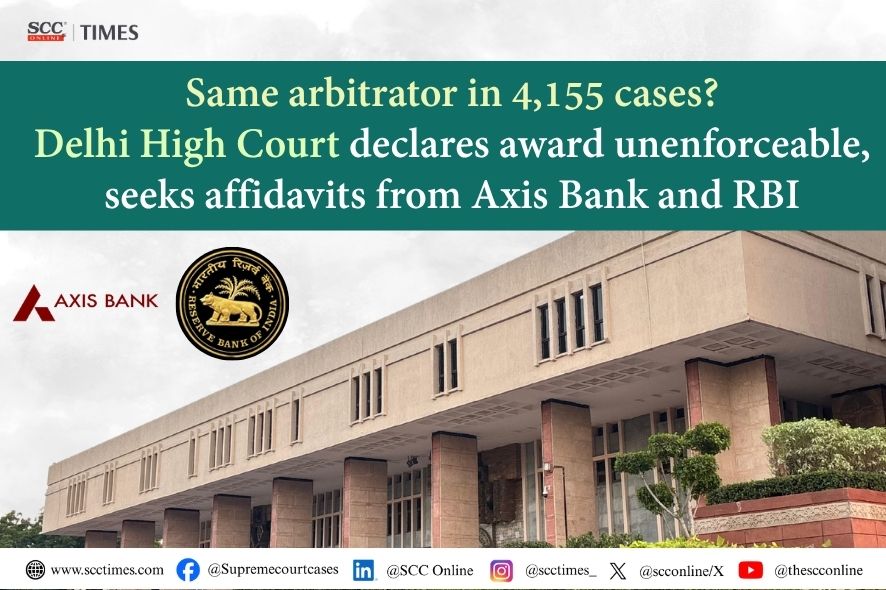
Delhi High Court: Repeated Arbitrator Appointment for Axis Bank Nullifies Award
Summary
- The Delhi High Court declared an arbitration award unenforceable due to the repeated appointment of the same arbitrator.
- A single arbitrator was found to have been appointed in 4,155 cases, primarily involving Axis Bank.
- The court ruled that this practice violates the principle of neutrality and Section 12 read with Schedule V of the Arbitration & Conciliation Act, 1996.
- The High Court has requested affidavits from both Axis Bank and the Reserve Bank of India regarding their arbitration practices.
What Happened
The court's ruling underscores a critical concern regarding the integrity of the arbitration process when an institutional party consistently selects the same individual to adjudicate disputes.
The Delhi High Court recently rendered an arbitration award unenforceable, citing a significant breach of impartiality due to the repeated appointment of the same arbitrator. This landmark decision arose from a situation where a single arbitrator had been engaged in an astonishing 4,155 cases, primarily involving Axis Bank. The court's ruling underscores a critical concern regarding the integrity of the arbitration process when an institutional party consistently selects the same individual to adjudicate disputes.
The specific award in question was nullified on the grounds that such a pattern of appointments inherently compromises the arbitrator's independence and neutrality, which are foundational pillars of fair dispute resolution. This judicial intervention highlights a potential systemic issue within the arbitration practices of certain financial institutions, directly addressing the problem of Delhi High Court repeated arbitrator appointment Axis Bank.
Legal Context
The High Court's declaration that the award was unenforceable directly stems from a violation of the principle of neutrality, as enshrined in India's Arbitration & Conciliation Act, 1996. Specifically, the court pointed to Section 12 of the Act, which mandates the disclosure of circumstances that might give rise to justifiable doubts about an arbitrator's independence or impartiality. This section is to be read in conjunction with Schedule V of the Arbitration & Conciliation Act 1996, which enumerates various grounds that could lead to such doubts.
The consistent engagement of a single arbitrator across thousands of cases for one party, like Axis Bank, falls squarely within the scope of concerns outlined in Schedule V, which aims to prevent situations where an arbitrator might develop a financial or professional dependency on a repeat appointing party, thereby compromising their ability to render an unbiased decision. The court's interpretation reinforces the stringent requirements for arbitrator independence, ensuring that the arbitration process remains fair and impartial.
Why It Matters
This ruling by the Delhi High Court carries substantial implications for arbitration in India, particularly for financial institutions and other entities that frequently engage in arbitration. The decision to declare an arbitration award unenforceable due to a lack of arbitrator independence sends a clear message about the judiciary's commitment to upholding the sanctity of the arbitration process, thereby preventing an unenforceable arbitration award India.
Furthermore, the court has taken a significant step by seeking affidavits from both Axis Bank and the Reserve Bank of India (RBI). This request for detailed information from Axis Bank regarding its arbitration practices and from the RBI, as the primary regulator of financial institutions, indicates a broader concern about potential systemic issues in how arbitrators are appointed and whether these practices align with the spirit of the Arbitration & Conciliation Act 1996. The outcome of these RBI arbitration affidavits could lead to revised guidelines or increased scrutiny over institutional arbitration appointments, ensuring greater transparency and fairness in future proceedings and impacting Axis Bank arbitration practices.
Practical Implications
Lawyers and compliance officers should immediately review arbitration clauses and appointment procedures in ongoing and future contracts, especially those involving institutional or repeat appointments, to ensure strict adherence to Section 12 and Schedule V of the Arbitration & Conciliation Act, 1996, to prevent awards from being challenged and declared unenforceable on grounds of arbitrator neutrality.
Source
How does this affect you?
Get an AI analysis of this article grounded in your jurisdictions, practice areas, and any policy documents you've uploaded to Wansom.
Finish Reading the Full Story and the Expert Analysis.
Get the latest legal & regulatory intelligence in India
Wansom is AI and can make mistakes.