
Delhi High Court: Refers CJP Protest Compensation PIL to Supreme Court
Summary
- The Delhi High Court directed advocate Rakesh Kumar Saini to approach the Supreme Court with his plea.
- Saini sought ₹50 crore in interim compensation from the Cockroach Janta Party (CJP) for protest-related disruptions.
- The High Court cited judicial discipline, noting the Supreme Court is already handling similar issues.
- The PIL alleged CJP protests at Jantar Mantar caused traffic congestion and inconvenience.
- The court disposed of the public interest litigation, avoiding conflicting orders.
Court Directs Petitioner to Supreme Court
The judicial discipline warrants that, in such an eventuality, this court must stay its hands away from the proceedings and should not pass conflicting orders.
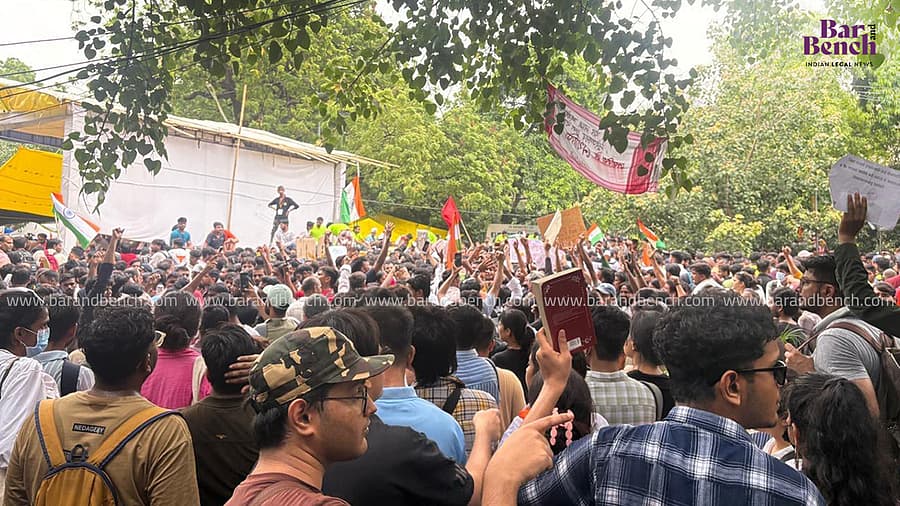
The Delhi High Court recently instructed an advocate to present his case before the Supreme Court, rather than proceeding in the High Court. This directive came in response to a public interest litigation (PIL) filed by advocate Rakesh Kumar Saini, which sought to compel the Cockroach Janta Party (CJP) to deposit an interim compensation of ₹50 crore. The compensation was requested due to alleged widespread inconvenience and disruption caused to residents of the national capital by the CJP's protest activities.
Saini's petition specifically accused the CJP and its affiliates of breaching the established conditions for demonstrations held at Jantar Mantar. These alleged violations, according to the PIL, led to significant traffic congestion, interrupted daily routines for many, and created considerable difficulties for various groups, including local traders, daily commuters, office workers, and schoolchildren. The advocate's filing aimed to secure directives for the Central government and other relevant authorities to initiate proceedings against the CJP, seeking both a collective or community fine and financial redress for the affected public.
Emphasis on Judicial Discipline
A Division Bench, comprising Acting Chief Justice Nitin Wasudeo Sambre and Justice Sanjay Sharma, delivered the ruling, citing a crucial principle of judicial conduct. The court's decision was heavily influenced by the fact that the Supreme Court is already actively addressing analogous legal questions. This point was further corroborated by Solicitor General Tushar Mehta, who confirmed that the apex court is indeed seized of similar matters, reinforcing the need for jurisdictional deference.
In its order, the High Court explicitly articulated that "The judicial discipline warrants that, in such an eventuality, this court must stay its hands away from the proceedings and should not pass conflicting orders." This statement underscores the court's commitment to avoiding contradictory judgments and ensuring a streamlined judicial process, particularly when a higher court is already deliberating on comparable issues. Consequently, the public interest litigation brought by Rakesh Kumar Saini was formally disposed of by the Delhi High Court.
Implications for Protest-Related Claims
This ruling by the Delhi High Court establishes a significant precedent regarding the handling of compensation claims arising from public protests, particularly those alleging widespread disruption. By referring the Rakesh Kumar Saini PIL to the Supreme Court, the High Court has signaled that such complex and potentially far-reaching issues, especially when involving public order and large-scale inconvenience, may be more appropriately adjudicated by the nation's highest judicial body. This approach highlights a clear deference to the Supreme Court's ongoing engagement with similar matters.
The emphasis on "judicial discipline Delhi High Court" in this context suggests that future attempts to seek compensation for protest-related disruptions, such as those attributed to the Cockroach Janta Party compensation demands, are likely to face similar jurisdictional guidance. Lawyers and activists should note that the High Court's stance indicates a preference for a unified judicial approach on these sensitive issues, thereby channeling cases with national implications or those touching upon broader constitutional questions to the Supreme Court for resolution. This decision reinforces the hierarchical structure of the Indian judiciary and its commitment to preventing fragmented legal outcomes.
Practical Implications
Lawyers should note the Delhi High Court's emphasis on judicial discipline, indicating that claims for protest-related compensation, particularly those involving public disruption, are likely to be directed to the Supreme Court for resolution, setting a precedent for jurisdictional deference in such matters.
Source
How does this affect you?
Get an AI analysis of this article grounded in your jurisdictions, practice areas, and any policy documents you've uploaded to Wansom.
Finish Reading the Full Story and the Expert Analysis.
Wansom is AI and can make mistakes.