
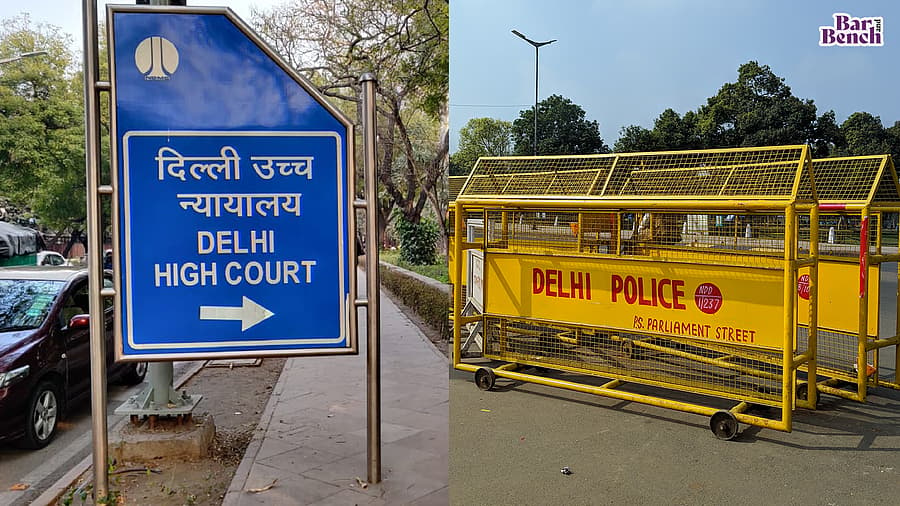
Delhi High Court Questions Police Over Activist Confinement
Summary
- The Delhi High Court questioned police actions concerning activist Nadeem Khan's alleged confinement to his home.
- Police reportedly restricted Khan's movement to prevent his participation in a Jantar Mantar protest scheduled for September 29.
- A Division Bench, including Acting Chief Justice Nitin Wasudeo Sambre and Justice Sanjay Sharma, challenged the police's legal basis for entering Khan's residence and confining him.
- The court issued a notice to the Delhi Police, demanding a status report within two weeks regarding the incident.
- Police provided assurance to the court that Khan would not be disturbed further by phone calls.
What Transpired
The High Court emphasized that while the Delhi Police possesses the authority to deny permission for a protest, and to perform its duties, this prerogative does not extend to confining an individual within their home without clear legal grounds.
The Delhi High Court recently initiated a sharp inquiry into the actions of the Delhi Police, specifically regarding the alleged confinement of activist Nadeem Khan. The court's questioning arose after reports indicated that Khan was restricted to his residence, effectively preventing his participation in a planned protest at Jantar Mantar on September 29. This intervention by the High Court, following representation by Khan's counsel, Advocate Shahrukh Alam, underscores a judicial concern over the methods employed by law enforcement in managing public demonstrations.
During the proceedings, legal counsel representing the Delhi Police acknowledged that permission for Khan to protest at Jantar Mantar had been denied. The police further stated that they had received intelligence suggesting Khan intended to proceed with the protest despite the denial. In their defense, the police counsel clarified that their presence at Khan's home was solely to "restrict his movement," asserting that there was "no detention." They described their officers as "sitting at the reception" and confirmed that subsequent visits had not occurred. This explanation aimed to differentiate their actions from a formal arrest or detention, characterizing it instead as a preventative measure.
Judicial Scrutiny of Police Powers
A Division Bench, comprising Acting Chief Justice Nitin Wasudeo Sambre and Justice Sanjay Sharma, critically examined the police's justification, particularly challenging the legality of their entry into Khan's private dwelling. The High Court emphasized that while the Delhi Police possesses the authority to deny permission for a protest, and to perform its duties, this prerogative does not extend to confining an individual within their home without clear legal grounds. The judges directly questioned the police counsel, demanding to know the legal basis for such confinement and how they were authorized to enter the activist's residence in the first place.
The court's pointed remarks highlighted a crucial distinction: the right of the police to deny permission for a gathering is separate from, and does not automatically confer, the power to physically restrict a person's liberty or ingress into their private space. The bench sought explicit legal provisions that would permit such an intervention, stating, "Denying permission is within your rights. Please show us in law where is your..." This line of questioning directly addresses the scope of Delhi Police protest restriction powers and the potential for unlawful confinement police India.
Implications for Fundamental Rights
Following its rigorous questioning, the Delhi High Court issued a formal notice to the Delhi Police, requiring them to submit a comprehensive status report on the matter within two weeks. This directive signals the court's intent to thoroughly investigate the circumstances surrounding Nadeem Khan's alleged confinement and to ensure accountability. Furthermore, the court officially recorded a statement from the police, assuring that Khan would not be subjected to further disturbance through phone calls, addressing another aspect of potential harassment.
This judicial intervention by the India High Court carries significant implications for the right to protest India High Court and the protection of individual liberties against potential overreach by law enforcement. The ruling by ACJ Nitin Wasudeo Sambre and Justice Sanjay Sharma underscores the judiciary's role in safeguarding fundamental rights, even when authorities cite preventative measures. It serves as a reminder that police actions, even those aimed at preventing public gatherings like the Jantar Mantar protest, must operate strictly within the bounds of the law, particularly concerning the freedom of movement and protection from arbitrary confinement.
Practical Implications
Lawyers advising activists or organizations involved in public protests should note the Delhi High Court's strong questioning of police powers to restrict movement and confine individuals, even when denying protest permission. This indicates a judicial inclination to scrutinize police actions that impinge on fundamental rights, providing potential grounds for challenging similar future interventions.
Source
How does this affect you?
Get an AI analysis of this article grounded in your jurisdictions, practice areas, and any policy documents you've uploaded to Wansom.
Finish Reading the Full Story and the Expert Analysis.
Get the latest legal & regulatory intelligence in India
Wansom is AI and can make mistakes.