
Delhi High Court: Chahat Raghav v Union of India Body Cameras Mandate Declined
Summary
- The Delhi High Court refused to directly order Delhi Police and RAF personnel to wear body cameras during crowd control.
- The court directed the government to treat the Public Interest Litigation (PIL) as a representation and decide on a body camera SOP within six months.
- Petitioners can approach the court again if the government fails to act satisfactorily after the six-month period.
- The PIL was filed by Chahat Raghav following clashes at a July 2026 Jantar Mantar protest that injured both student demonstrators and over 50 police personnel.
- Senior Advocate Akhil Sibal's request for a shorter government response timeframe was denied by the court, citing the Home Ministry's workload.
Delhi High Court Defers Body Camera Mandate
The Delhi High Court recently declined to issue a direct order compelling Delhi Police and Rapid Action Force (RAF) personnel to wear body cameras consistently during crowd control or protest management duties.
The Delhi High Court recently declined to issue a direct order compelling Delhi Police and Rapid Action Force (RAF) personnel to wear body cameras consistently during crowd control or protest management duties. Instead of a definitive mandate, the court instructed the government to consider the Public Interest Litigation (PIL) on the matter as a formal representation.
This decision, delivered by a bench comprising Acting Chief Justice Nitin Wasudeo Sambre and Justice Arun Bhardwaj, places the onus on the government to formulate a Standard Operating Procedure (SOP) regarding the use of such cameras. The court has set a six-month deadline for the government to make a decision on this crucial issue.
Should the petitioners find themselves dissatisfied with the government's subsequent actions or inaction after this period, the bench explicitly stated that they retain the right to re-approach the court. This leaves open the possibility of future judicial intervention if the government fails to address the concerns raised in the PIL adequately.
Background to the Petition
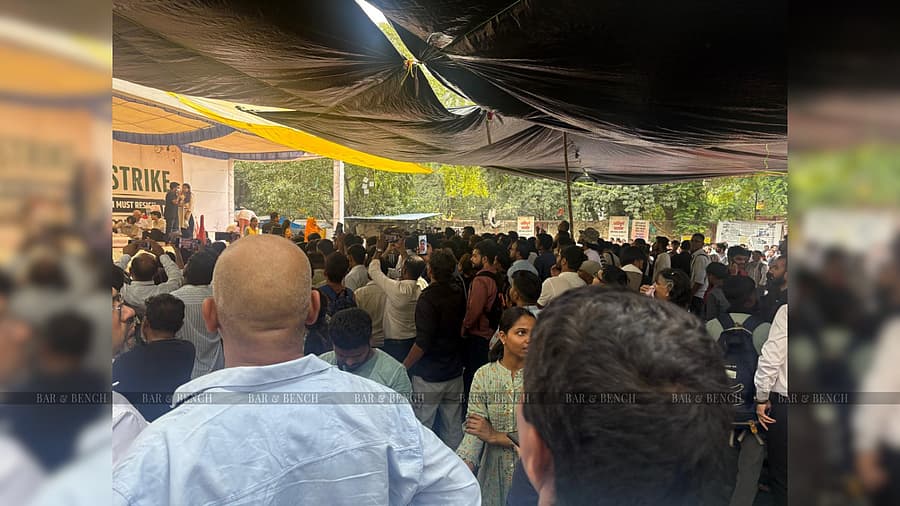
The Public Interest Litigation, titled Chahat Raghav v. Union of India and Ors., was initiated following significant demonstrations that took place in July 2026 at Jantar Mantar. These protests, which saw participation from the Cockroach Janata Party (CJP) and climate activist Sonam Wangchuk, escalated into clashes between demonstrators and law enforcement.
The events at Jantar Mantar resulted in injuries to student protesters, alongside more than 50 police and paramilitary personnel. It was in the aftermath of these violent confrontations that petitioner Chahat Raghav brought the PIL before the High Court, seeking greater accountability and transparency in police actions during public gatherings through the use of body cameras.
Court's Rationale and Petitioner's Arguments
During the proceedings, Senior Advocate Akhil Sibal, representing the petitioner, urged the court to impose a shorter timeframe for the government to act on the body camera SOP. However, this request for an expedited decision was denied by the High Court.
The court explained its reasoning for allowing a six-month period, noting that matters involving supervision, particularly those falling under the purview of the Home Ministry, often entail a substantial workload. This acknowledgment of the administrative burden influenced the court's decision to grant a more extended period for the government to deliberate and formulate its policy.
Ultimately, the High Court disposed of the PIL, effectively transferring the immediate responsibility for developing a body camera policy from the judiciary to the executive, albeit with a clear pathway for the petitioners to seek further recourse if necessary.
Implications for Police Accountability
The Delhi High Court's deferral of a direct order on police body cameras means that, for now, there is no immediate court-mandated requirement for Delhi Police or RAF personnel to wear these devices during protests. This outcome places the onus squarely on the government to develop a Standard Operating Procedure within the stipulated six-month period.
While the court did not issue an immediate directive, its decision to treat the PIL as a representation and set a timeline for government action signals an expectation for policy development. This implies that future changes in police accountability measures, particularly concerning protest management, remain a distinct possibility, contingent on the government's response. Therefore, ongoing monitoring of the government's progress in framing this SOP will be crucial for stakeholders advocating for greater transparency and oversight in law enforcement.
Practical Implications
Lawyers advising on protest-related matters or police accountability in Delhi should note that the Delhi High Court has deferred a decision on mandatory police body cameras, placing the onus on the government to frame an SOP within six months. This means no immediate court-mandated evidence from body cameras is available, but future policy changes are possible, requiring ongoing monitoring of government action.
Source
How does this affect you?
Get an AI analysis of this article grounded in your jurisdictions, practice areas, and any policy documents you've uploaded to Wansom.
Finish Reading the Full Story and the Expert Analysis.
Get the latest legal & regulatory intelligence in India
Wansom is AI and can make mistakes.