
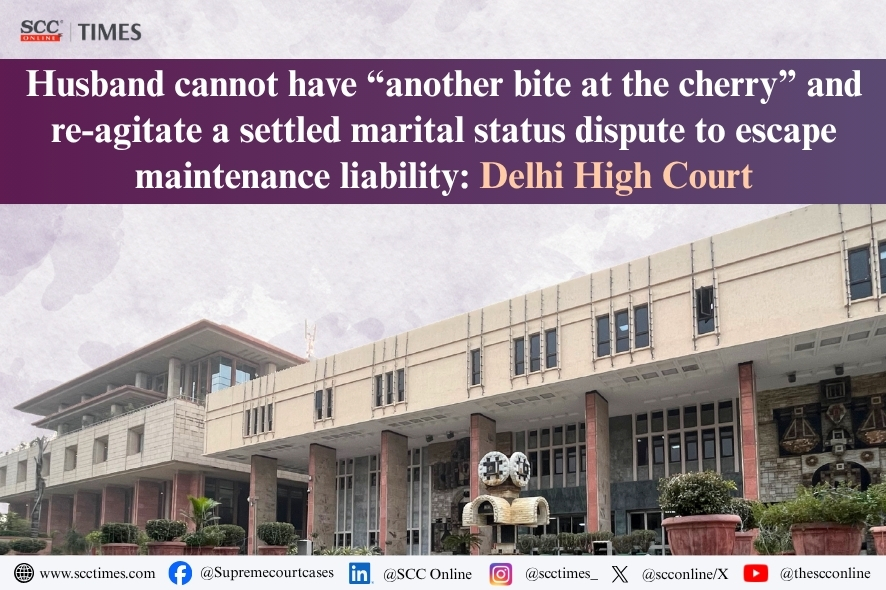
Delhi High Court: Husband Cannot Re-Agitate Settled Marital Dispute for Maintenance
Summary
- The Delhi High Court ruled that a husband cannot re-litigate a settled marital dispute to avoid maintenance payments.
- The court affirmed that a husband has a 'legal debt' to maintain his wife, which is non-negotiable under Indian law.
- This decision reinforces the finality of settled marital status disputes and associated maintenance liabilities.
- The ruling prevents individuals from attempting to 're-agitate' resolved matters merely to escape financial obligations.
Delhi High Court Upholds Finality in Maintenance Disputes
The court explicitly characterized this obligation as a 'legal debt,' emphasizing its non-negotiable nature under Indian law.
The Delhi High Court recently delivered a significant ruling concerning marital disputes and maintenance obligations, firmly stating that a husband cannot attempt to re-litigate a marital status dispute that has already been settled, especially when the motive is to evade financial responsibility towards his wife. This decision, which reinforces the principle of finality in legal proceedings, underscores the judiciary's commitment to ensuring that agreements reached in family matters are respected and upheld. The court's unequivocal stance prevents parties from endlessly challenging outcomes to avoid their financial duties.
The case specifically involved a petitioner, identified as the husband, who sought to challenge a previously resolved marital status. His clear objective was to circumvent his established obligation to provide maintenance to the respondent, his wife. By attempting to re-open a settled matter, the husband aimed to escape his ongoing financial liability. However, the court's pronouncement serves as a strong deterrent against such attempts to undermine judicial processes and evade legitimate financial responsibilities, thereby protecting the rights of the dependent spouse.
The Legal Obligation to Maintain a Spouse in India
Central to the Delhi High Court's judgment was the affirmation of a husband's inherent legal duty to support his wife. The court explicitly characterized this obligation as a 'legal debt,' emphasizing its non-negotiable nature under Indian law. This principle is deeply embedded in the country's family law statutes, aiming to protect financially dependent spouses following marital separation or divorce, ensuring they are not left without means of sustenance. The ruling reiterates that this duty is a fundamental aspect of marital relationships, even after disputes arise.
This Delhi High Court maintenance settled marital dispute ruling reinforces the established legal framework surrounding spousal maintenance in India. It highlights that once a marital dispute reaches a settlement regarding status, the associated financial liabilities, such as maintenance, are generally considered binding and difficult to challenge. The court's stance prevents individuals from exploiting legal loopholes or procedural delays to avoid their responsibilities, thereby ensuring that wives are not left in a precarious financial position after a settlement has been reached and agreed upon. This contributes significantly to the finality of maintenance orders India.
Preventing Re-litigation and Ensuring Judicial Efficiency
The Delhi High Court's ruling directly addresses the issue of parties attempting to 're-agitate' or re-open disputes that have already been definitively settled. This practice, often metaphorically referred to as seeking 'another bite at the cherry,' is strongly discouraged by courts to maintain judicial efficiency, prevent the abuse of process, and avoid endless litigation that can cause immense emotional and financial strain on all parties involved. The judgment makes it unequivocally clear that once a marital status dispute is resolved, it cannot be revisited merely to escape a maintenance order.
This Delhi HC family law ruling sets a significant precedent, reinforcing the principle of res judicata – the legal doctrine that a matter once judged cannot be re-litigated – in the context of family law. It ensures that individuals cannot repeatedly challenge outcomes simply because they are dissatisfied with the financial implications or wish to avoid their husband maintenance liability India. The court's firm stance protects the integrity of judicial settlements and provides certainty for parties involved in divorce and maintenance proceedings, particularly regarding the finality of maintenance orders India, thereby promoting stability and justice in family law matters.
Practical Implications
This Delhi High Court ruling reinforces the finality of maintenance orders and marital dispute settlements, providing a strong precedent against attempts to re-litigate settled matters to avoid financial obligations. Lawyers advising clients on divorce or maintenance claims should emphasize that such settlements are generally binding and difficult to challenge.
Source
Source: Original reporting via SCC Times
How does this affect you?
Get an AI analysis of this article grounded in your jurisdictions, practice areas, and any policy documents you've uploaded to Wansom.
Finish Reading the Full Story and the Expert Analysis.
Wansom is AI and can make mistakes.