
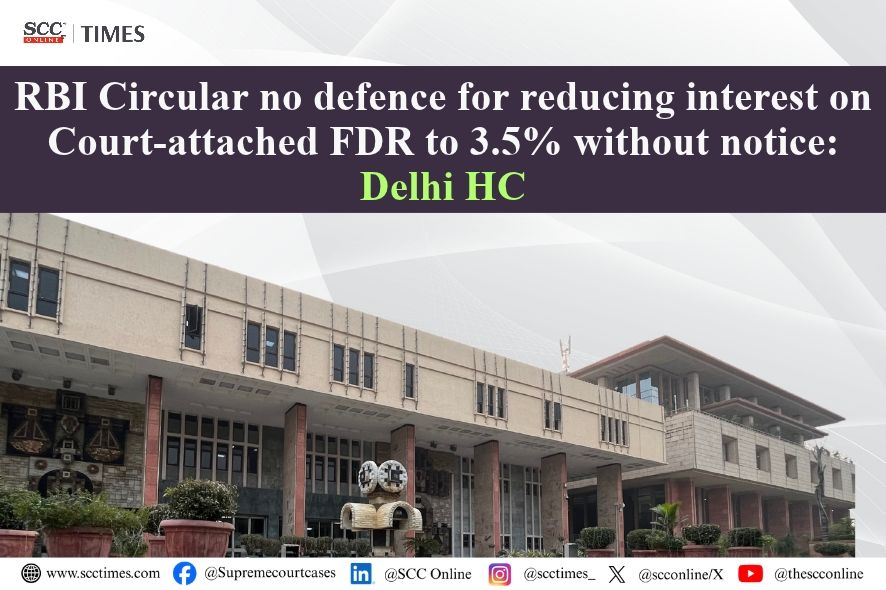
Delhi High Court: Banks Cannot Unilaterally Reduce Court-Attached FDR Interest
Summary
- The Delhi High Court ruled that banks cannot unilaterally reduce interest rates on court-attached fixed deposits.
- Such reductions are prohibited without notifying affected parties or obtaining court directions.
- The court upheld a Single Judge's order to pay interest at the higher, original rate.
- An RBI Circular was deemed an insufficient defense for the bank's unilateral action.
- The specific interest rate reduction challenged was to 3.5%.
The Court's Ruling
The court unequivocally stated that banks are prohibited from unilaterally decreasing the fixed deposit attachment interest rate on such deposits.
The Delhi High Court has delivered a significant judgment regarding the management of "court-attached FDR interest", establishing clear boundaries for financial institutions. The court explicitly ruled that a bank is not permitted to unilaterally decrease the "fixed deposit attachment interest rate" on funds held in fixed deposits under judicial attachment. This prohibition applies unless the bank has first provided notification to all affected parties or has secured specific directions from the presiding court. The case in question involved a bank that had reduced the interest rate on such a deposit to 3.5% without adhering to these procedural requirements.
In its decision, the Delhi High Court upheld an earlier order issued by a Single Judge, which had directed the bank to pay interest at the higher, original rate. This affirmation by the High Court reinforces the principle that the terms governing judicially-attached funds cannot be altered arbitrarily by the holding institution. The ruling ensures that the financial interests of litigants, whose assets are placed in these specific types of fixed deposits, are protected against unexpected reductions in their expected returns.
Legal and Regulatory Framework
A pivotal element of the Delhi High Court's reasoning was its dismissal of the bank's argument that an "RBI Circular FDR interest Delhi HC" provided a legitimate basis for its actions. The court determined that a general RBI Circular could not serve as a defense for unilaterally reducing the "interest on court-attached deposits" without prior notice to the relevant parties or explicit court authorization. This aspect of the judgment clarifies that while regulatory guidelines from the Reserve Bank of India are important, they do not override the specific legal obligations and procedural requirements associated with funds held under judicial attachment.
The court's stance underscores the unique legal status of "court-attached FDRs". These deposits are not merely standard banking products but are instruments managed under judicial oversight, demanding a higher degree of procedural adherence from financial institutions. The ruling effectively establishes that a "bank unilateral interest reduction court FDR" is legally untenable when it bypasses the necessary steps of communication and judicial approval, irrespective of broader banking regulations.
Broader Implications and Precedent
This "Delhi High Court FDR ruling" sets a crucial precedent, impacting both the operational protocols of financial institutions and the strategic approaches of legal professionals. For banks, the judgment serves as a definitive mandate: any proposed changes to the "fixed deposit attachment interest rate" on court-attached funds must be transparently communicated to all involved parties and must receive explicit judicial sanction. Failure to comply could lead to legal challenges and orders to compensate beneficiaries at the original, higher rate.
For lawyers, particularly those managing litigation involving attached assets, this decision provides a powerful tool. It strengthens their ability to advocate for their clients by challenging any unauthorized reductions in "interest on court-attached deposits". The ruling ensures that the financial integrity of court-ordered deposits is maintained, safeguarding the interests of litigants and reinforcing the judiciary's authority over funds placed under its protective custody. This legal clarity is vital for ensuring fairness and predictability in the handling of such sensitive financial instruments.
Practical Implications
Lawyers representing clients with funds held in court-attached fixed deposits should be aware that banks cannot unilaterally reduce interest rates on these deposits without prior notice or court direction. This ruling provides a strong precedent to challenge such actions by banks, ensuring clients receive the agreed-upon interest. Compliance officers in financial institutions must review their procedures for managing court-attached FDRs to ensure adherence to this judicial directive, preventing potential legal challenges and liabilities.
Source
Source: Original reporting via SCC Times
How does this affect you?
Get an AI analysis of this article grounded in your jurisdictions, practice areas, and any policy documents you've uploaded to Wansom.
Wansom is AI and can make mistakes.