
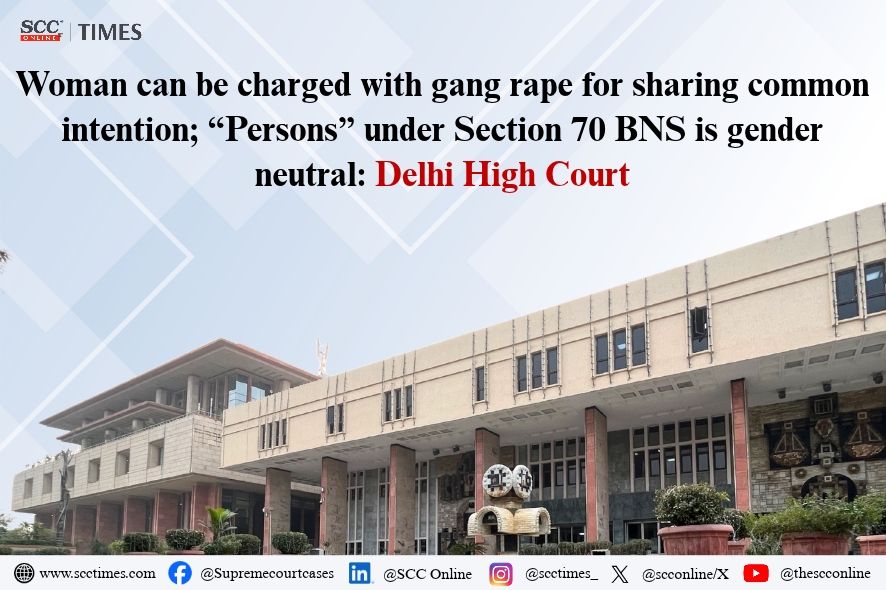
Delhi High Court: Woman Gang Rape Common Intention Liability Clarified
Summary
- The Delhi High Court dismissed a petition challenging an order on charge in a POCSO Act case.
- The court ruled that the term "persons" in gang rape provisions (Section 376-D IPC/Section 70 BNS) is gender-neutral.
- A woman can be charged with gang rape if she acts with common intention as part of a group.
- A woman cannot be charged with gang rape if she acts alone.
- This decision clarifies the scope of liability for women in group sexual offenses.
Court Clarifies Gang Rape Liability for Women
A woman can be charged with gang rape if she is part of a group or acts in furtherance of a common intention to facilitate or ensure that rape is committed on a victim.
The Delhi High Court recently issued a significant ruling, dismissing a petition that challenged an order on charge in a case involving offenses under the Protection of Children from Sexual Offences (POCSO) Act. This decision clarifies the scope of liability for women in gang rape cases, particularly concerning their involvement when acting with a shared intent.
The High Court's pronouncement centered on the interpretation of the term "persons" within the relevant gang rape provisions. The court affirmed that this term is gender-neutral, thereby expanding the potential pool of individuals who can be charged with the offense, even if they cannot physically commit the act of rape themselves. This interpretation has direct implications for how group sexual offenses are prosecuted in India.
Gender-Neutral Interpretation of Gang Rape Provisions
Central to the Delhi High Court's ruling is the determination that the gang rape provisions, specifically Section 70 of the Bharatiya Nyaya Sanhita (BNS), which replaced Section 376-D of the Indian Penal Code (IPC), apply to all genders. The court explicitly stated that the word "persons" in these sections is to be understood as gender-neutral, a crucial aspect of the Delhi High Court gang rape interpretation.
This means that a woman can be charged with gang rape if she is part of a group or acts in furtherance of a common intention to facilitate or ensure that rape is committed on a victim. However, the court maintained a critical distinction: while a woman can be implicated for her role in a group offense due to common intention, she cannot be charged with gang rape if she acts alone. This nuance underscores the importance of the collective element and shared criminal purpose in such charges.
Implications for Common Intention in Sexual Offenses
The ruling by the Delhi High Court on woman gang rape common intention has substantial implications for the prosecution of group sexual offenses. It firmly establishes that a woman's involvement in a gang rape scenario, even without direct physical perpetration, can lead to charges under Section 70 BNS (and previously Section 376-D IPC) if a common intention is proven. This expands the understanding of criminal liability beyond direct physical acts to include active participation through shared purpose.
This decision reinforces the principle that all individuals contributing to a crime, whether through direct action or by forming a common intention, can be held accountable. The case, which originated from offenses under the POCSO Act, highlights how the concept of common intention underpins the legal framework for addressing severe sexual crimes, ensuring that those who facilitate or conspire in such acts face appropriate legal consequences, irrespective of their gender.
Practical Implications
This ruling clarifies that women can be charged with gang rape under Section 70 BNS (and previously 376-D IPC) if they share a common intention, even if they cannot commit the act alone. Lawyers must be aware of this expanded scope of liability when advising clients or prosecuting cases involving group sexual offenses, as it broadens the potential pool of accused persons.
Source
Source: Original reporting via SCC Times
How does this affect you?
Get an AI analysis of this article grounded in your jurisdictions, practice areas, and any policy documents you've uploaded to Wansom.
Finish Reading the Full Story and the Expert Analysis.
Get the latest legal & regulatory intelligence in India
Wansom is AI and can make mistakes.