
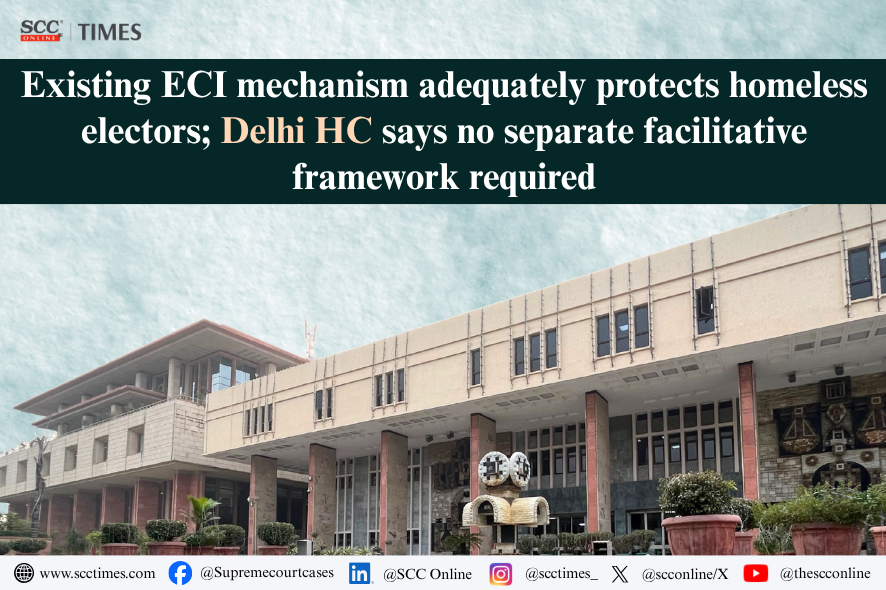
Delhi High Court: ECI Mechanism Sufficient for Homeless Electors
Summary
- The Delhi High Court has ruled that the existing Election Commission of India (ECI) mechanism adequately protects homeless electors.
- The court determined that no separate facilitative framework is required for the electoral inclusion of homeless individuals.
- Evidence from the Draft Electoral Roll demonstrated the inclusion of homeless persons within the current system.
- Individuals affected by demolition can seek enrollment on the electoral roll by utilizing the standard Form 6.
- The ruling affirms the sufficiency of the ECI's established procedures for ensuring voter inclusion for vulnerable populations.
Court Upholds Existing ECI Mechanism for Homeless Electors
The Delhi High Court has affirmed that the existing framework provided by the Election Commission of India is fully adequate to ensure the electoral inclusion of homeless individuals, negating the necessity for any distinct facilitative measures.
The Delhi High Court has recently issued a significant ruling affirming the sufficiency of the current Election Commission of India (ECI) framework for registering homeless electors. This judicial pronouncement clarifies that no separate facilitative mechanism is deemed necessary to ensure the voting rights of individuals without a fixed abode, reinforcing the existing procedural safeguards.
The court's decision was predicated on its observation that the Draft Electoral Roll already reflects the inclusion of homeless persons. This finding suggests that the established processes are, in practice, accommodating this vulnerable demographic. The ruling specifically addresses the **Delhi HC homeless electors ECI mechanism**, concluding that it provides adequate protection and avenues for participation in the electoral process.
Furthermore, the High Court explicitly noted that individuals affected by demolition drives, who may consequently find themselves without stable housing, retain the ability to seek enrolment on the electoral roll through the standard application process, specifically by utilizing Form 6. This provision underscores the accessibility of the existing system for various categories of marginalized citizens seeking **voter inclusion demolition affected**.
Legal Framework and Voter Registration
The Election Commission of India's robust system for voter registration, including the widely used Form 6, serves as the primary gateway for citizens to enroll in the electoral roll. Form 6 is a crucial document designed for new voter registration or transfer of registration, making it an essential tool for **ECI Form 6 homeless voter registration** and other eligible citizens.
The court's reliance on the Draft Electoral Roll as evidence of inclusion highlights the transparency and effectiveness of the ECI's periodic revision processes. These rolls are provisional lists of voters published for public scrutiny, allowing for additions, deletions, and corrections before the final electoral roll is published. The fact that the Draft Electoral Roll already demonstrated the presence of **Delhi High Court electoral roll homeless** individuals was a key factor in the court's assessment of the **Election Commission of India mechanism adequacy**.
This ruling effectively validates the ECI's existing procedures as comprehensive enough to address the unique challenges faced by **homeless persons voting rights India**, without requiring the creation of bespoke, additional frameworks.
Implications for Voter Inclusion and Legal Practice
The Delhi High Court's judgment carries significant implications for voter inclusion efforts, particularly for marginalized communities. By confirming the adequacy of the existing ECI mechanism, the court has set a precedent that emphasizes leveraging established legal and administrative channels rather than advocating for new, distinct systems for specific vulnerable groups.
For legal professionals advising clients on voter registration, especially those working with vulnerable populations, this ruling clarifies the strategic approach. Lawyers should focus on guiding individuals through the existing ECI framework, including the proper completion and submission of Form 6, and engaging with the Draft Electoral Roll process. The emphasis is now firmly on navigating these established procedures to ensure electoral participation.
This judicial stance reinforces the principle that the current electoral system is designed to be universally accessible, even for those facing socio-economic disadvantages. It underscores the judiciary's confidence in the Election Commission of India's ability to facilitate the voting rights of all eligible citizens, including homeless individuals, through its standard operational protocols.
Practical Implications
This ruling clarifies that the existing ECI framework, including Form 6 and the Draft Electoral Roll, is deemed adequate for registering homeless electors. Lawyers advising clients on voter registration for vulnerable populations should focus on navigating these established procedures rather than advocating for new, separate facilitative frameworks.
Source
Source: Original reporting via SCC Times
How does this affect you?
Get an AI analysis of this article grounded in your jurisdictions, practice areas, and any policy documents you've uploaded to Wansom.
Finish Reading the Full Story and the Expert Analysis.
Wansom is AI and can make mistakes.