
Delhi High Court: Questions DUSU Women Reservation, Violence Link
Summary
- The Delhi High Court issued notice to the Central government, UGC, and Delhi University regarding a plea for 50% women's reservation in DUSU and College Students’ Union elections.
- A Division Bench, including Chief Justice Devendra Kumar Upadhyaya, questioned the petitioner's argument that women's reservation would reduce election violence.
- The PIL, filed by Shabana Hussain, argues that despite over 1 lakh female students at DU, their representation in student bodies is disproportionately low.
- The petitioner claims underrepresentation leads to neglect of women's issues like sexual harassment, hostel curfews, and safety.
- The next hearing for the case is scheduled for November 27, 2026.
Judicial Scrutiny of Reservation Rationale
The court specifically challenged the petitioner's assertion that instituting a 50 percent quota for women would inherently lead to a reduction in electoral violence, questioning the underlying premise.
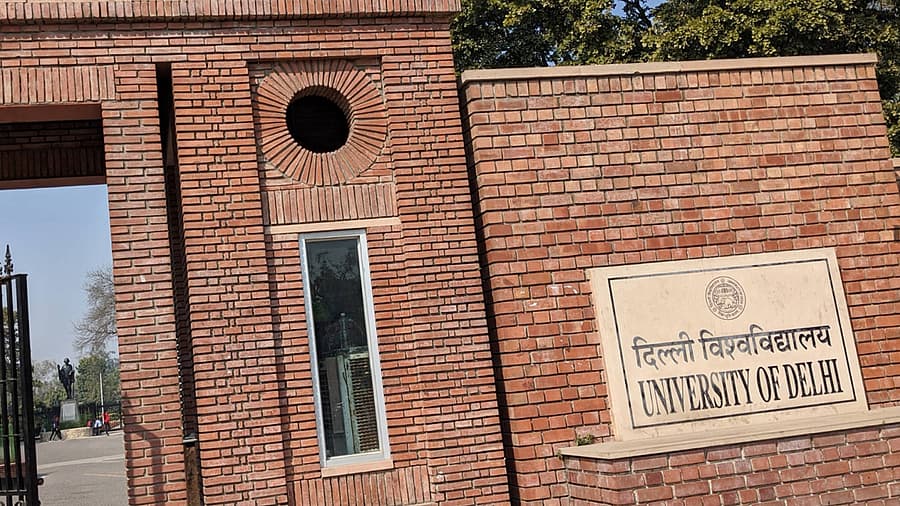
The Delhi High Court recently issued a formal notice to the Central government, the University Grants Commission (UGC), and Delhi University concerning a petition advocating for a 50 percent reservation for female students in elections for the Delhi University Students’ Union (DUSU) and College Students’ Unions. A Division Bench, comprising Chief Justice Devendra Kumar Upadhyaya and Justice Tejas Karia, has directed the named respondents to submit their replies to the plea.
During the proceedings, the court expressed significant skepticism regarding a central argument presented by the petitioner. The bench pointedly questioned the assertion that implementing a women's quota would effectively mitigate the violence often associated with student body elections. The judges specifically challenged the logical connection, asking, "Are you suggesting that by providing 50 percent reservation [for women], the violence will abate? Are you saying they are less violent? What is this argument?" This line of questioning underscores the court's demand for robust justification for policy interventions.
This development signals the Delhi High Court's critical scrutiny of the stated justifications for policy interventions, particularly in public interest litigation. Lawyers advising on policy changes or engaging in PILs should note the court's emphasis on robust, evidence-based arguments rather than speculative claims, especially when linking policy outcomes (like reservation) to broader societal impacts (like reduced violence).
Petitioner's Case for Enhanced Representation
The High Court's examination stems from a public interest litigation (PIL) filed by Shabana Hussain. Her petition highlights a significant disparity in representation within student governance, despite the substantial female student population at the University of Delhi, which exceeds one lakh individuals. The plea contends that despite these numbers, women's presence in elected student bodies remains disproportionately low.
The petitioner's counsel further argued that this underrepresentation directly impacts the attention given to critical issues affecting women students. Specific concerns cited include sexual harassment, hostel curfew timings, and overall safety, which allegedly do not receive adequate focus or resolution when women are not sufficiently represented in student unions. To bolster her argument for a Delhi University Students’ Union women's quota, the petitioner's counsel also referenced a law passed by Parliament that provides for a 33 percent reservation, implicitly for women, in other contexts.
The court's engagement with the arguments for student body reservation indicates a careful balancing act between addressing calls for equitable representation and ensuring that proposed solutions are grounded in clear, demonstrable outcomes. The next hearing for this matter is scheduled for November 27, 2026.
Implications for Public Interest Litigation
The Delhi High Court's pointed questions regarding the causal link between women's reservation and reduced election violence carry broader implications for how public interest litigations are framed and argued. The court's stance suggests a requirement for petitioners to present more than just a perceived societal benefit; they must provide a well-reasoned and evidence-backed rationale for how a proposed policy change, such as a women's quota, will achieve its stated objectives.
This judicial approach emphasizes that while the goal of increasing women's representation in bodies like the DUSU is often seen as laudable, the specific mechanisms proposed to achieve it must withstand rigorous logical and evidentiary scrutiny. The court is not merely assessing the desirability of the outcome but the efficacy and justification of the means. This could set a precedent for future PILs, demanding a higher standard of proof and analytical rigor from those advocating for policy shifts.
The ongoing proceedings, particularly the directive for the Central government, UGC, and Delhi University to file their responses, will further shape the discourse around women's representation in student politics and the judicial interpretation of policy interventions aimed at societal change. The Chief Justice Devendra Kumar Upadhyaya DUSU case highlights the judiciary's role in ensuring that policy proposals, even those with seemingly positive intentions, are built upon sound and defensible premises.
Source
How does this affect you?
Get an AI analysis of this article grounded in your jurisdictions, practice areas, and any policy documents you've uploaded to Wansom.
Finish Reading the Full Story and the Expert Analysis.
Wansom is AI and can make mistakes.