
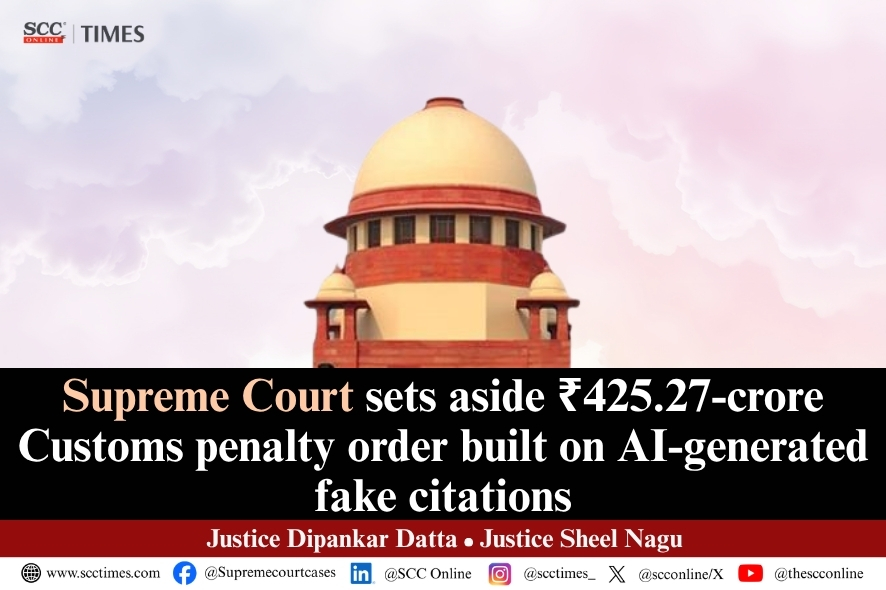
India Supreme Court: Overturns ₹425 Cr Penalty Citing AI Fake Citations
Summary
- The India Supreme Court set aside a ₹425.27 crore Customs penalty order.
- The penalty was overturned because it relied on dubious AI-generated fake citations.
- The Court cautioned that AI can assist adjudication but cannot substitute it.
- This ruling highlights the critical need for verifying all legal citations, especially those from AI tools.
What Happened: A Landmark Ruling on AI Reliability
The Court explicitly cautioned that while AI possesses the potential to assist adjudication by streamlining research and analysis, it can never be substituted for adjudication itself.
The Supreme Court of India recently delivered a pivotal judgment, setting aside a substantial Customs penalty order valued at ₹425.27 crore. This significant financial reversal was necessitated by the discovery that the original penalty order had been predicated on fabricated legal precedents, specifically identified as dubious case laws generated by artificial intelligence. This ruling by the India Supreme Court AI fake citations case highlights a critical vulnerability in the increasing integration of AI tools within legal and administrative processes, particularly concerning the reliability of AI legal tools for accurate research and citation.
The decision to invalidate such a considerable financial imposition underscores the severe repercussions that can arise from an uncritical reliance on AI-produced information. This incident serves as a stark and immediate warning regarding the imperative for rigorous scrutiny of all legal sources, irrespective of their generation method, to maintain the integrity of judicial proceedings and administrative determinations. The fact that a Customs penalty AI citations overturned by the nation's highest court sends an unequivocal message across the entire legal and regulatory landscape about the need for caution and verification.
Judicial Caution on AI Adjudication
In its comprehensive ruling, the Supreme Court articulated a crucial and nuanced distinction regarding the appropriate role of artificial intelligence within the legal domain. The Court explicitly cautioned that while AI possesses the potential to assist adjudication by streamlining research and analysis, it can never be substituted for adjudication itself. This authoritative pronouncement from the India Supreme Court AI fake citations case establishes a fundamental principle for the ethical and responsible integration of AI into legal practice, unequivocally emphasizing the indispensable role of human oversight and ultimate accountability.
This judicial stance directly addresses growing concerns about AI legal research ethics India and the inherent potential for AI tools to inadvertently introduce inaccuracies, misinterpretations, or even outright fabrications into legal arguments and decisions. The Court's pointed warning is a direct consequence of the incident where a significant financial penalty was rendered invalid due to its foundation on non-existent legal precedents, thereby illuminating the tangible AI in legal practice risks when robust verification protocols are absent or insufficient. It advocates for a balanced and judicious approach, encouraging the leveraging of AI for enhanced efficiency while steadfastly maintaining human judgment as the ultimate arbiter of legal truth and application.
Why Verification is Paramount for Legal Integrity
The overturning of the ₹425.27 crore Customs penalty order, directly attributable to AI fake case law India, unequivocally underscores the critical and urgent need for exceptionally robust verification mechanisms in all facets of legal research and practice. This high-profile incident demonstrates conclusively that even seemingly authoritative legal documents and administrative orders can be compromised by erroneous or fabricated outputs from AI systems, thereby necessitating a fundamental re-evaluation of current practices within legal departments, law firms, and compliance offices nationwide. The Supreme Court's decisive action effectively mandates a significantly heightened level of diligence and skepticism when incorporating any AI-generated content into legal submissions, judicial opinions, or administrative directives.
This pivotal development carries profound implications for legal professionals, regulatory bodies, and technology developers alike. It powerfully reinforces the enduring principle that the ultimate responsibility for the accuracy, authenticity, and legal validity of all citations and precedents rests squarely with the human practitioners involved in the legal process. The Supreme Court caution AI adjudication serves as a potent and timely reminder that while AI tools can undoubtedly augment and accelerate research capabilities, they are not infallible. Consequently, their outputs must invariably be subjected to stringent, independent human review and cross-verification to prevent similar costly, reputation-damaging, and legally unsound errors from occurring in the future. This incident highlights the ongoing tension between technological advancement and the foundational principles of legal due diligence.
Practical Implications
This ruling underscores the critical need for lawyers and compliance officers to rigorously verify all legal citations, especially those generated by AI tools, to avoid orders being overturned due to reliance on fabricated precedents. It mandates caution in adopting AI for legal research and calls for robust verification protocols within legal and compliance departments.
Source
How does this affect you?
Get an AI analysis of this article grounded in your jurisdictions, practice areas, and any policy documents you've uploaded to Wansom.
Finish Reading the Full Story and the Expert Analysis.
Wansom is AI and can make mistakes.