
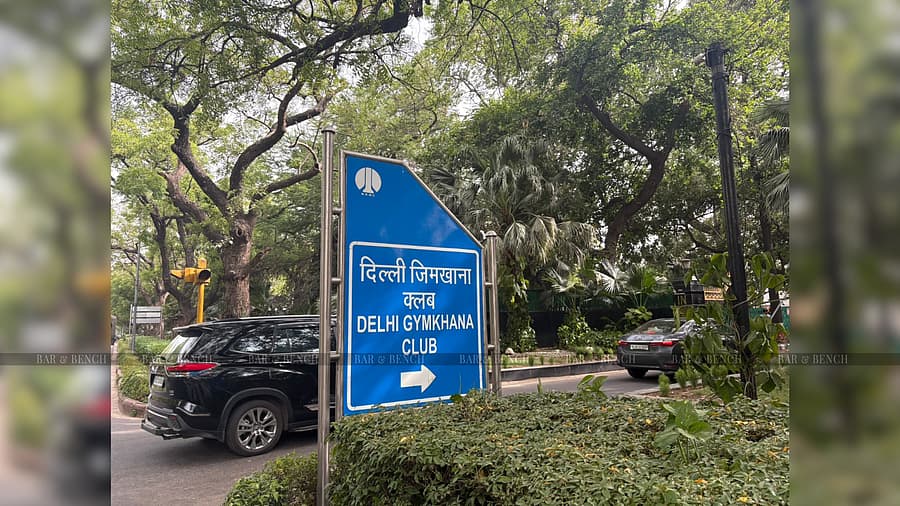
Supreme Court: Bars Final Order in Delhi Gymkhana Club Eviction
Summary
- The Supreme Court permitted eviction proceedings against the Delhi Gymkhana Club to continue.
- The Estate Officer is prohibited from issuing a final eviction order without the Supreme Court's prior consent.
- This interim directive was issued by Justices Dipankar Datta and Sheel Nagu during appeals related to the club's management and land, under the case Atul Dev v Union of India.
- The Court questioned its Article 142 jurisdiction regarding a 203-day delayed cross-appeal by the Union government.
- The matter is scheduled for a final hearing on December 10.
What Happened
The Supreme Court's decision to allow eviction proceedings to continue while simultaneously barring a final order without its express permission holds significant implications for the Delhi Gymkhana Club dispute.
The Supreme Court recently issued a significant interim directive concerning the ongoing eviction proceedings against the Delhi Gymkhana Club. A bench comprising Justices Dipankar Datta and Sheel Nagu permitted the continuation of the eviction process initiated by the Central government but imposed a crucial restriction: the Estate Officer is prohibited from issuing any final order without explicit prior authorization from the apex court. This decision came during the hearing of connected appeals, which stem from a protracted legal battle over the administration and land reclamation of the historic institution situated in Lutyens' Delhi.
The specific directive from the Court stated that while "Proceedings before the Estate Officer may continue, but no final order may be passed without the permission of this Court." This ruling, delivered on a Monday, effectively keeps the eviction process in motion while reserving the ultimate decision-making power for the Supreme Court itself. The case, formally known as Atul Dev & Ors. v. Union of India & Ors., has been scheduled for a comprehensive final hearing on December 10, indicating the Court's intent to address the substantive issues in due course.
Legal Background
The appeals currently before the Supreme Court originate from various challenges to a judgment delivered by the National Company Law Appellate Tribunal (NCLAT). Both former members of the club's general committee and the Central government have lodged appeals, each contesting different facets of the NCLAT's decision. During the recent hearing, a specific application was brought before the bench, seeking the recall of an earlier order. This previous order had granted condonation for a substantial delay of 203 days in the Union government's cross-appeal, a procedural point that drew particular scrutiny from the Court.
The Supreme Court specifically raised questions regarding the scope of its powers under Article 142 of the Constitution. The justices pondered whether this constitutional provision allowed them to entertain an appeal that was statutorily time-barred. They further pointed out that the Union government had an alternative procedural avenue, suggesting it could have filed a cross-objection within the main appeal that was already pending before the apex court, rather than pursuing a separate, delayed cross-appeal. The Attorney General, R Venkataramani, was noted as being involved in the proceedings.
Significance of the Interim Order
The Supreme Court's decision to allow eviction proceedings to continue while simultaneously barring a final order without its express permission holds significant implications for the Delhi Gymkhana Club dispute. It signifies the Court's intent to maintain oversight over the resolution of this high-profile case, preventing any premature or unilateral finalization of the eviction process by the Estate Officer. This approach ensures that all legal and factual complexities, particularly those arising from the Delhi Gymkhana Club NCLAT appeal judgment and the various appeals, can be thoroughly examined at the highest judicial level before any definitive action is taken regarding the club's future.
This interim measure underscores the Supreme Court's role in managing complex litigation, especially when it involves public bodies and assets of historical significance. By reserving the right to approve any final order, the Court effectively places a procedural safeguard, ensuring that the broader legal and constitutional questions, including those related to its own Article 142 jurisdiction over time-barred appeals, are fully addressed. The December 10 listing for a final hearing indicates that while immediate action is paused, the substantive resolution of the dispute remains a priority for the apex court.
Practical Implications
Lawyers advising on corporate governance disputes or government-initiated evictions, particularly those involving public bodies or significant assets, should note the Supreme Court's direct intervention to control the finality of proceedings. This indicates that even where lower tribunals allow proceedings to continue, the apex court may impose procedural safeguards, requiring its explicit permission before any final order is passed, thus prolonging the dispute resolution process and increasing legal uncertainty for parties involved.
Source
How does this affect you?
Get an AI analysis of this article grounded in your jurisdictions, practice areas, and any policy documents you've uploaded to Wansom.
Finish Reading the Full Story and the Expert Analysis.
Get the latest legal & regulatory intelligence in India
Wansom is AI and can make mistakes.