
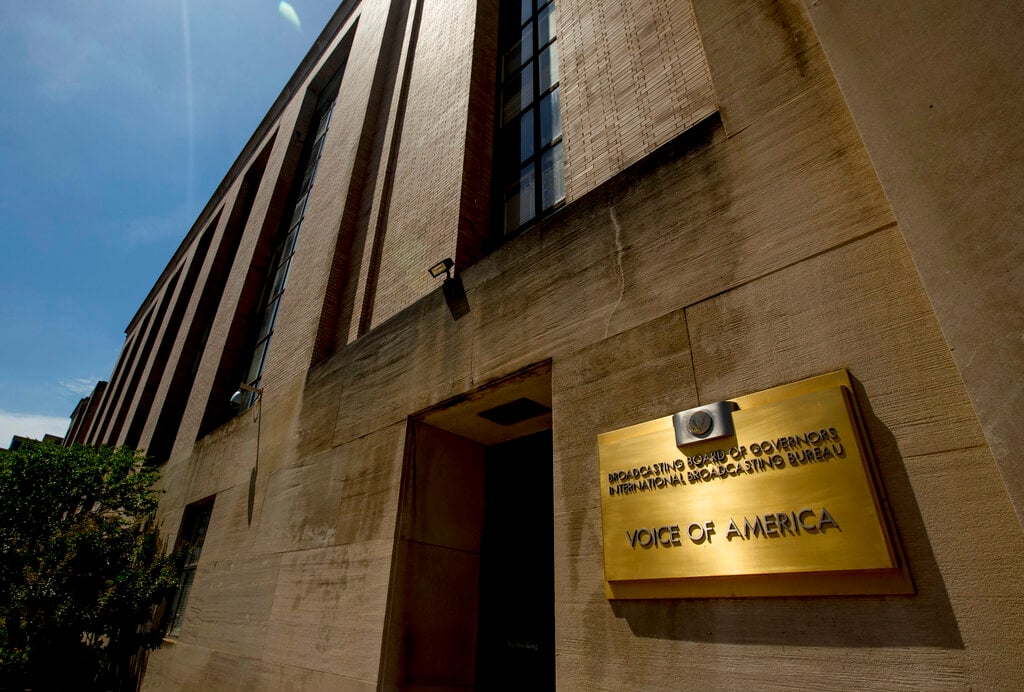
D.C. Circuit: Voice of America Director Removal Needs Board Approval
Summary
- The D.C. Circuit Court of Appeals ruled that the U.S. Agency for Global Media cannot unilaterally remove the Voice of America director.
- Michael Abramowitz's termination requires approval from the International Broadcasting Advisory Board, which has lacked a quorum since 2025.
- The court affirmed that Congress has the constitutional authority to vest removal power in the advisory board, despite the director being an "inferior officer."
- The Justice Department's argument that board approval violates separation of powers was rejected.
- The ruling clarifies the limits of presidential power in removing certain federal officials when Congress has specified removal procedures.
What Happened
Congress possesses the constitutional authority to vest the power over Abramowitz's removal in the Broadcasting Board.
The D.C. Circuit Court of Appeals recently upheld a lower court's decision, affirming that the U.S. Agency for Global Media (USAGM) lacks the authority to unilaterally dismiss Michael Abramowitz, the director of Voice of America (VOA). This ruling mandates that any termination of the VOA director must receive approval from the International Broadcasting Advisory Board. The three-judge panel specifically affirmed a permanent injunction previously issued by U.S. District Judge Royce Lamberth, which prohibited Abramowitz's removal without a majority vote from this advisory board.
This legal challenge arose after Kari Lake, who served as USAGM's acting CEO (a role later ruled illegal), placed Abramowitz on administrative leave, alongside 1,300 other employees, and reassigned his responsibilities to another individual. Abramowitz was subsequently fired when he declined to accept a reassignment to a different station. The advisory board, central to this dispute, has been without a quorum since 2025, complicating the process for obtaining the required majority vote for such personnel actions.
Legal Context
The core of the D.C. Circuit's decision hinges on the interpretation of congressional authority regarding the removal of "inferior officers." While the VOA director is "undisputedly an inferior officer," a category typically subject to presidential appointment and removal powers under Article II of the U.S. Constitution, the appellate court determined that the advisory board functions as the true head of the news agency. U.S. Circuit Judge Cornelia Pillard, an appointee of Barack Obama, articulated that Congress possesses the constitutional authority to vest the power over Abramowitz's removal in the Broadcasting Board.
Judge Pillard's opinion outlined two distinct pathways for removing a network head. The first requires the "only" approval of a "majority" of the Broadcasting Board to authorize the agency CEO to appoint or remove a network head. The second pathway allows "five or more members" of the Broadcasting Board to "unilaterally remove" a network head "after consulting with the agency CEO," even without the CEO's initiation or agreement. The Justice Department had argued that requiring board approval for Abramowitz's dismissal infringed upon the separation of powers, contending it "unduly interfer[ed] with the president’s authority to remove inferior officers." The department further asserted that the Constitution’s Appointments Clause necessitates Congress to grant control over inferior officers to the official who "actually employs" them, identifying Kari Lake, then USAGM's acting CEO, in this role. However, the court rejected these arguments, emphasizing Congress's role in dividing responsibilities between the advisory board, which holds final say on removals, and the CEO, who manages daily operations.
Why It Matters
This ruling carries significant implications for the balance of power between the executive branch and Congress, particularly concerning the removal of federal officials. It underscores the judiciary's role in upholding statutory frameworks that define the limits of presidential authority, even when an advisory body lacks a quorum. The International Broadcasting Advisory Board, which consists of seven members—six presidential appointees (with a limit of three from the same party) and the Secretary of State—lost its quorum in 2025 after President Donald Trump, upon taking office for his second term, fired six of its members, leaving only Secretary of State Marco Rubio.
The decision also highlights the ongoing efforts to maintain the independence of organizations like Voice of America, which was established over 80 years ago to counter Nazi propaganda. Concerns about the independence of VOA and other international broadcasters were heightened when Michael Pack, a former chief executive of U.S. global media, initiated personnel changes and reviewed visas for foreign employees, despite assuring Congress of the networks' independence. Furthermore, President Trump had targeted VOA and similar media entities in a March 2025 executive order titled "Continuing the Reduction of the Federal Bureaucracy," which aimed to eliminate their "nonstatutory components and functions" to the "maximum extent." Judge Pillard referenced a recent Supreme Court decision that barred the removal of Federal Reserve Board of Governors member Lisa Cook, noting how justices have affirmed the judiciary's ability to allow individuals to remain in office during litigation, reinforcing the D.C. Circuit's stance.
Practical Implications
This ruling clarifies the limits of presidential power in removing 'inferior officers' when Congress has vested removal authority in an advisory board, even if that board lacks a quorum. Lawyers advising federal agencies or presidential appointees should note this precedent regarding removal procedures and the interpretation of the Appointments Clause, particularly where statutory language specifies board approval for personnel actions.
Source
How does this affect you?
Get an AI analysis of this article grounded in your jurisdictions, practice areas, and any policy documents you've uploaded to Wansom.
Finish Reading the Full Story and the Expert Analysis.
Get the latest legal & regulatory intelligence in United States
Wansom is AI and can make mistakes.