
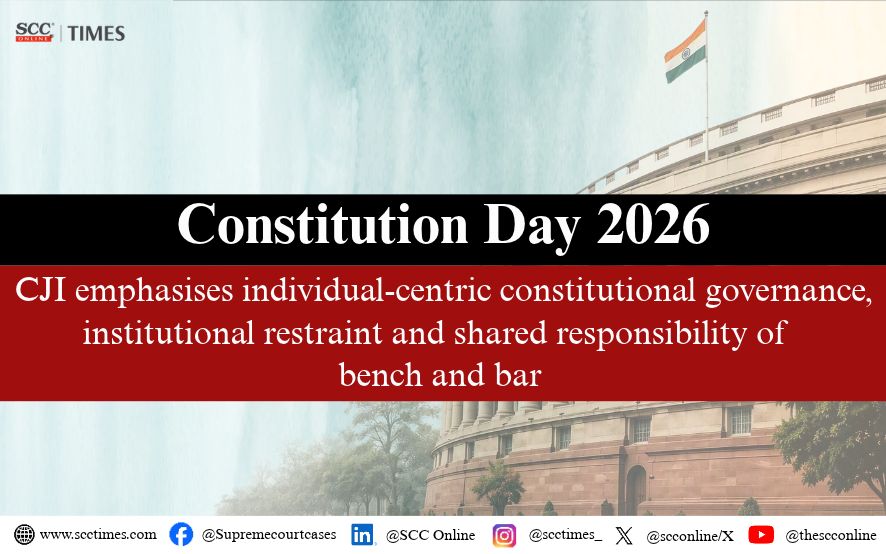
CJI Addresses Constitutional Governance on Constitution Day 2026
Summary
- On Constitution Day 2026, the CJI addressed the Supreme Court Bar Association.
- The CJI emphasized individual-centric constitutional governance and institutional restraint.
- Judicial independence was highlighted as a crucial element of India's legal system.
- The speech stressed the shared responsibility of the Bench and Bar in strengthening justice delivery.
- These remarks provided a blueprint for upholding constitutional values and improving the legal framework.
CJI Addresses Constitution Day 2026
The CJI's remarks centered on several foundational principles crucial for India's constitutional governance and the effective functioning of its justice system.
On the occasion of Constitution Day 2026, the Chief Justice of India delivered a significant address to the Supreme Court Bar Association. The CJI's remarks centered on several foundational principles crucial for India's constitutional governance and the effective functioning of its justice system. This annual observance provides a vital platform for reflecting on the nation's legal framework and the responsibilities of those who uphold it.
The address underscored the importance of an individual-centric approach to constitutional governance, emphasizing that the ultimate purpose of the legal structure is to serve the citizenry. This perspective highlights the rights and welfare of individuals as the core focus of all governmental and judicial actions. The CJI's speech resonated with the spirit of the Constitution, which was adopted on this very day, setting the blueprint for a democratic republic.
Pillars of Constitutional Governance
A key theme articulated by the CJI was the necessity of institutional restraint within the framework of constitutional governance. This concept calls for various state organs, including the judiciary, to operate within their defined boundaries, respecting the separation of powers and avoiding overreach. Such restraint is deemed essential for maintaining the delicate balance that underpins a robust democracy and prevents any single institution from dominating the others.
Furthermore, the CJI's constitutional governance remarks prominently featured the critical role of judicial independence in India. This principle ensures that judges can make decisions free from external pressures or influences, thereby upholding the rule of law impartially. An independent judiciary is a cornerstone of a fair and just society, safeguarding citizens' rights and ensuring accountability across all levels of government.
Shared Responsibility of Bench and Bar
During the Supreme Court Bar Association speech, the Chief Justice of India particularly highlighted the shared responsibility of the Bench and Bar. This collaborative duty extends to actively strengthening the justice delivery system, ensuring that it remains accessible, efficient, and equitable for all. The legal profession, encompassing both judges and lawyers, plays an indispensable role in translating constitutional ideals into practical realities.
The CJI emphasized that the collective efforts of legal practitioners are vital for the continuous improvement of judicial processes and outcomes. This shared commitment is not merely about upholding legal statutes but also about fostering an environment where justice can be administered effectively and expeditiously. The India Constitution Day speech served as a powerful reminder of this joint obligation to the nation's legal infrastructure.
Looking Ahead
The CJI's address on Constitution Day 2026 provided a comprehensive vision for the future of India's legal landscape. By focusing on individual-centric governance, institutional restraint, and the bedrock principle of judicial independence, the Chief Justice outlined the fundamental tenets that must guide the nation's progress. These remarks serve as a guiding light for all stakeholders in the legal system.
The call for a shared responsibility between the Bench and Bar underscores the collaborative spirit required to meet the evolving challenges of justice delivery. The speech reinforced the idea that the strength of India's constitutional framework lies not only in its written words but also in the dedicated efforts of those who interpret, apply, and uphold its principles daily. This collective endeavor is paramount for ensuring a resilient and responsive justice system.
Practical Implications
Lawyers should note the CJI's emphasis on individual-centric governance and institutional restraint, which signals the judiciary's philosophical direction and expectations for the bar's role in upholding constitutional values and strengthening the justice delivery system. This reinforces the ethical and professional responsibilities expected from legal practitioners.
Source
Source: Original reporting via SCC Times
How does this affect you?
Get an AI analysis of this article grounded in your jurisdictions, practice areas, and any policy documents you've uploaded to Wansom.
Finish Reading the Full Story and the Expert Analysis.
Get the latest legal & regulatory intelligence in India
Wansom is AI and can make mistakes.