
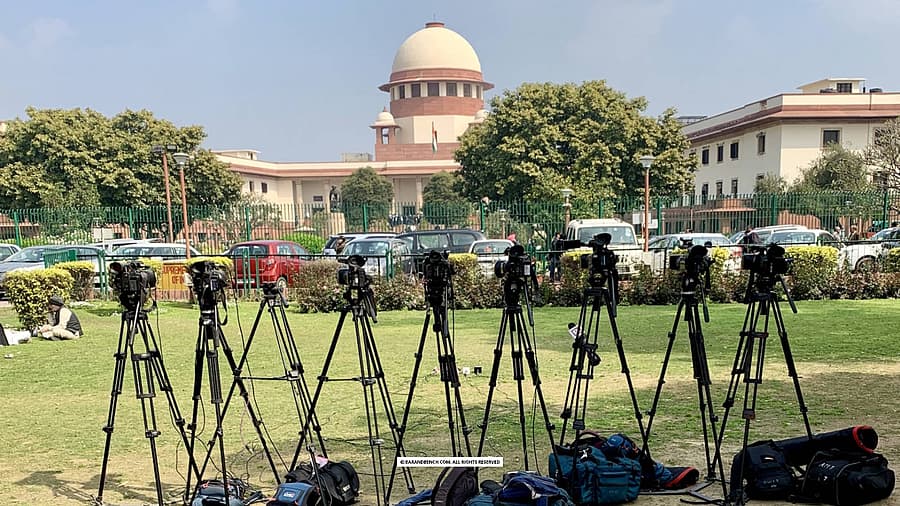
India Supreme Court: To Define Journalist Protection in Protests
Summary
- India's Supreme Court will examine the extent of protection for journalists covering public protests.
- A key focus is whether accredited journalists receive greater legal safeguards than self-proclaimed journalists.
- The inquiry stems from petitions by the Kerala Union of Working Journalists regarding alleged Delhi Police actions against reporters.
- The Court will define who qualifies as a journalist and if professional accreditation should determine their protection.
- Specific questions include whether journalists have special privileges with law enforcement during demonstrations and the legality of their forcible removal.
Supreme Court to Examine Journalist Protections
Justice Joymalya Bagchi notably remarked during the proceedings that individuals identifying as journalists might not be afforded the same level of protection as those who are officially accredited.
India's Supreme Court has announced its intention to thoroughly investigate the scope of protection afforded to journalists while they are covering public protests. A specific bench, comprising Chief Justice of India Surya Kant and Justices Joymalya Bagchi and V Mohana, will lead this crucial examination, which holds significant implications for media freedom and law enforcement interactions during demonstrations across the nation.
The central question before the Court is whether journalists who possess official accreditation should be granted a higher degree of legal protection compared to individuals who identify themselves as journalists but lack such formal recognition. Justice Joymalya Bagchi notably remarked during the proceedings that individuals identifying as journalists might not be afforded the same level of protection as those who are officially accredited. This distinction forms the crux of the judicial inquiry, aiming to clarify the legal standing of various media personnel in volatile protest environments.
This judicial review stems from petitions filed by the Kerala Union of Working Journalists (KUWJ), represented by Senior Advocate PV Dinesh. These petitions detail allegations against the Delhi Police, specifically concerning the reported detention and forceful removal of journalists who were covering protests demanding the resignation of Chief Election Commissioner Gyanesh Kumar. The Court's decision to delve into these matters underscores the growing concerns regarding journalist safety and operational freedom during public unrest.
Legal Context and Recent Rulings
The ongoing proceedings, formally titled `Kerala Union of Working Journalists v. Union of India`, serve as the vehicle for the Supreme Court's comprehensive inquiry into media rights during protests. While the broader questions are being addressed, the Court recently concluded a specific plea brought by the KUWJ. This particular plea pertained to the alleged detention and manhandling of seven journalists.
In disposing of this specific matter, the Supreme Court opted not to express any opinion on the merits of the allegations. Instead, it referred the case to an existing court-appointed inquiry committee for further investigation. This decision indicates the Court's preference for a detailed factual assessment by an established body before making pronouncements on individual incidents, while still reserving its authority to address the overarching legal principles at stake.
The broader implications of the `Kerala Union of Working Journalists v. Union of India` case extend beyond the immediate allegations, as the Court's upcoming deliberations are poised to establish clearer guidelines for both journalists and law enforcement agencies. The distinction between accredited and self-proclaimed journalists, in particular, will be a defining aspect of the Court's eventual pronouncements, shaping future media law and practice in India.
Key Questions for Deliberation
The Supreme Court bench has outlined several fundamental questions that will guide its examination into journalist protection during protests. These inquiries aim to establish clear legal definitions and operational parameters for media personnel and state authorities. Firstly, the Court seeks to define precisely who qualifies as a journalist in the context of legal protections, a question that directly impacts the accredited versus self-proclaimed debate.
Secondly, the bench will consider whether professional accreditation or institutional affiliation should be the determining factor in the level of protection available to journalists. This question is critical for understanding whether formal recognition by media bodies or employers confers distinct rights or safeguards. The Court will also explore whether journalists are entitled to any special privileges when interacting with law enforcement agencies while covering demonstrations, a point of contention in many past incidents.
Finally, the Supreme Court intends to address the legality and permissibility of forcibly removing a journalist from a protest site. The answers to these questions will significantly influence the framework of journalist rights in India, particularly concerning their ability to report freely and safely on public gatherings without undue interference from authorities.
Practical Implications
Lawyers advising media organizations or individual journalists in India should closely monitor the Supreme Court's examination of journalist protection during protests, particularly the distinction between accredited and self-proclaimed journalists, as this will define the scope of legal rights and potential liabilities for those covering public demonstrations.
Source
How does this affect you?
Get an AI analysis of this article grounded in your jurisdictions, practice areas, and any policy documents you've uploaded to Wansom.
Finish Reading the Full Story and the Expert Analysis.
Get the latest legal & regulatory intelligence in India
Wansom is AI and can make mistakes.