
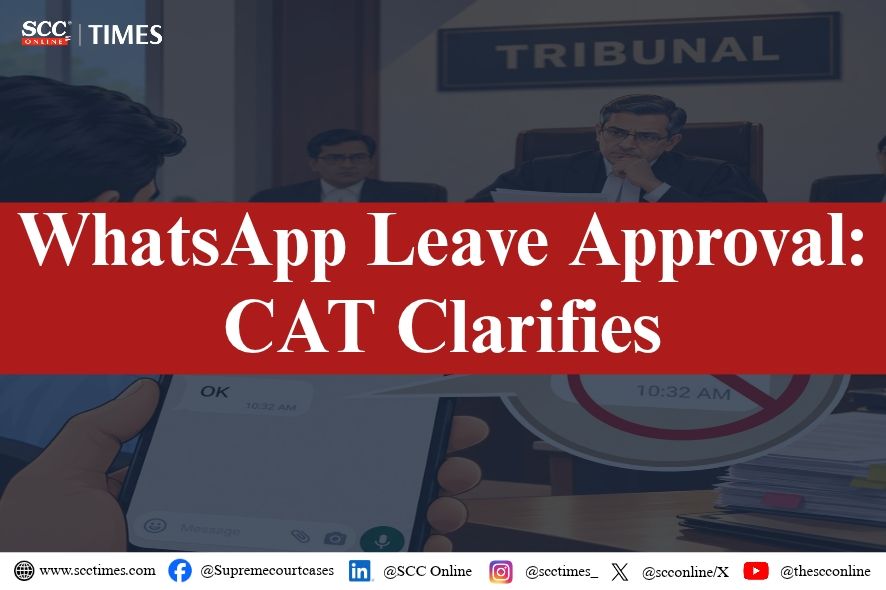
CAT Allahabad: WhatsApp 'OK' Not Valid Leave Sanction
Summary
- The Central Administrative Tribunal, Allahabad Bench, ruled that a WhatsApp message saying "OK" is not conclusive proof of leave sanction.
- The Tribunal noted that formal leave sanctioning required processing through an HRMS portal by a competent authority.
- A railway employee's challenge to his transfer from Prayagraj to Fatehpur was dismissed.
- The Tribunal found independent administrative reasons for the transfer and insufficient evidence of mala fides or punitive intent.
- The case, Priya Ranjan Kumar v. Union of India, reinforces the need for formal HR processes over informal digital communications.
The Tribunal's Ruling on Informal Leave
The CAT Allahabad ultimately determined that the WhatsApp 'OK' leave proof was insufficient to establish a formal sanction.
The Central Administrative Tribunal, Allahabad Bench, recently addressed a case involving a railway employee's challenge to a transfer and the validity of an informal leave request. In the matter of Priya Ranjan Kumar v. Union of India, the Tribunal considered whether a simple "OK" response received via WhatsApp could serve as conclusive proof of sanctioned leave. The employee, a railway worker, had relied on this digital message to assert that his absence was officially approved.
The CAT Allahabad ultimately determined that the WhatsApp 'OK' leave proof was insufficient to establish a formal sanction. This decision underscores the necessity for employees to adhere to established formal procedures for leave requests, rather than depending on casual digital communications. The Tribunal's finding highlighted that the employer, in this instance, required leave to be processed and sanctioned by the competent authority through a dedicated Human Resource Management System (HRMS) portal, a process the employee evidently bypassed.
Upholding the Employee's Transfer
Beyond the issue of leave, the railway employee also contested his transfer from Prayagraj to Fatehpur. The Central Administrative Tribunal Allahabad meticulously reviewed the circumstances surrounding this relocation. The Tribunal concluded that there were legitimate, independent administrative reasons prompting the transfer, which were distinct from any alleged disciplinary action.
The employee had attempted to argue that the transfer was punitive or motivated by bad faith, often referred to as mala fides. However, the Tribunal found that the material presented by the employee was not substantial enough to demonstrate such malicious intent or to prove that the transfer was merely a disguised form of punishment. Consequently, the challenge to the railway employee transfer was upheld, and the employee's overall petition was dismissed.
Implications for Workplace Practices
This ruling from the CAT Allahabad carries significant implications for both employers and employees regarding formal communication and human resources protocols. It firmly establishes that informal digital acknowledgments, such as a WhatsApp 'OK' for leave, do not equate to official sanctioning, especially when formal systems like an HRMS portal are in place. Employers are thus reinforced in their expectation that employees must follow prescribed channels for administrative requests, and this case serves as a clear precedent for maintaining the integrity of such systems.
For employees, the decision highlights the critical importance of ensuring all leave requests are formally approved through official channels to avoid disputes over unauthorized absences. Furthermore, the difficulty faced by the employee in challenging the transfer without clear evidence of mala fides demonstrates the high bar for overturning administrative decisions. This case reinforces that employers generally have broad discretion in employee deployments, and challenges require robust proof of improper motive, not just disagreement with the decision itself.
Practical Implications
Lawyers advising employers or employees on HR matters should ensure formal leave sanction processes are strictly followed, as informal communications like WhatsApp 'OK' are insufficient proof. This ruling also reinforces the difficulty in challenging employee transfers without clear evidence of mala fides.
Source
Source: Original reporting via SCC Times
How does this affect you?
Get an AI analysis of this article grounded in your jurisdictions, practice areas, and any policy documents you've uploaded to Wansom.
Finish Reading the Full Story and the Expert Analysis.
Wansom is AI and can make mistakes.